Perhaps it’s because of my overall fascination with shiny objects, but I’ve always had a bit of an unhealthy obsession with minerals and gemstones. Their vibrant colors, their shimmering surfaces, their unique textures – everything about them is utterly mesmerizing to me, and when I was a child, I would frequently seek them out as sources of comfort and serenity whenever the world became too overwhelming. All I would need to do is rub a smooth piece of copper goldstone between my palms or closely study the crystalline formations in a geode, and all my anxiety would fade into gentle background noise. So for the longest time, whenever I booted up Ocarina of Time, I would replay the Child portion of the game over and over again because of how much I adored collecting the Spiritual Stones.
To me, the glittering jewels were akin to the Mayor’s candy in that one episode of The Powerpuff Girls; no matter how many times I blinded Queen Gohma or obliterated Barinade, the sight of those iridescent hunks of rock would inject a fresh dose of serotonin into my brain, prompting me to restart the entire game and repeat the process ad infinitum. And of the three of them, the Kokiri’s Emerald – with its elegant teardrop shape and verdant green glow that embodied the spirit of the lush, fertile forest – captivated me the most, to the point where I formally declared the emerald to be my favorite gemstone of all time, despite never having seen a real one before.
Little did I know that, 20 years later, a seemingly insignificant discovery would throw a sizable wrench into my shallowly-rooted emerald mania and force me to reexamine my most beloved video game artifact. In early 2023, I decided to expand my personal dictionary of Japanese vocabulary by looking up a Japanese walkthrough of Ocarina of Time, and I noticed something rather curious about the names of the Spiritual Stones. While the Goron’s Ruby (Goron no Rubī) and the Zora’s Sapphire (Zōra no Safaia) are direct English translations of their original Japanese names, the same cannot be said for Kokiri no Hisui, which actually means “Kokiri’s Jade”. That’s right: the illustrious Spiritual Stone of the Forest has been an impostor this entire time!
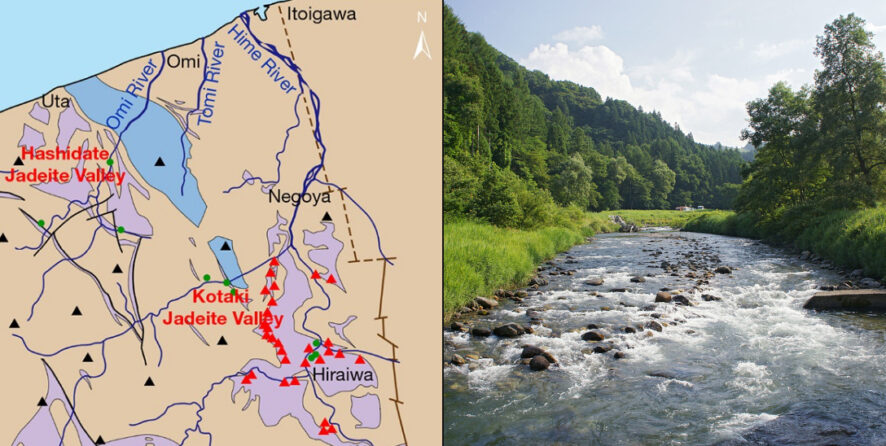
But hold on, friends, put down those pitchforks and torches for just one moment. If one takes a deep dive into the respective properties and histories of these two gemstones (geologists, you may now enter the chat), it does begin to make sense why a Japanese game company like Nintendo would choose jade over emerald. Jade is a name applied to two different types of silicate minerals: nephrite, a relatively common variety of amphibole; and jadeite, a rare, valuable pyroxene mineral (which is the one we’ll be focusing on). Jadeite can only form in metamorphic rock produced by high-pressure, low-temperature subduction zones, and most of the world’s commercial jadeite is mined along the Uyu River in northern Myanmar. However, the designation as the world’s oldest known jadeite culture belongs to Japan, stretching all the way back to the Jōmon period (~5,500 years ago). Numerous jadeite artifacts, including tools, taishu pieces, and magatama beads, have been recovered from archaeological sites in the Itoigawa Region, whose tectonic fault is responsible for the jadeite-rich Renge Belt. Nowadays, many of the country’s jadeite deposits can be found in the Kotaki Jadeite Valley upstream from the Hime River, or Himekawa (yes, indeed, this is where the famous Zelda manga duo derived their pen name from). So essential is jade to Japan’s cultural landscape that, in 2016, it was officially selected as the country’s national stone.
Emeralds, meanwhile, are a variety of beryl, a beryllium-based mineral that forms inside pegmatite rocks and hydrothermal veins; as is the case with green jade, the characteristic hue comes from trace amounts of chromium (though it can sometimes be caused by vanadium). The earliest-known people to mine emeralds were the Ancient Egyptians (~3,500 years ago), but when Spanish Conquistadors discovered that the native Muzo people of the eastern Colombian Andes had access to multitudinous emerald deposits, massive mining operations were set up in the regions of Boyacá and Cundinamarca. Even though most of the world’s commercial emeralds still come from Colombia, with Zambia’s Kafubu River deposits coming in at a distant second, they can be found in numerous countries all across the world and are held in extremely high regard by countless cultures. Japan, however, is notably absent from this list, and if evidence exists that emeralds have impacted the country in any meaningful way, I have yet to find it.
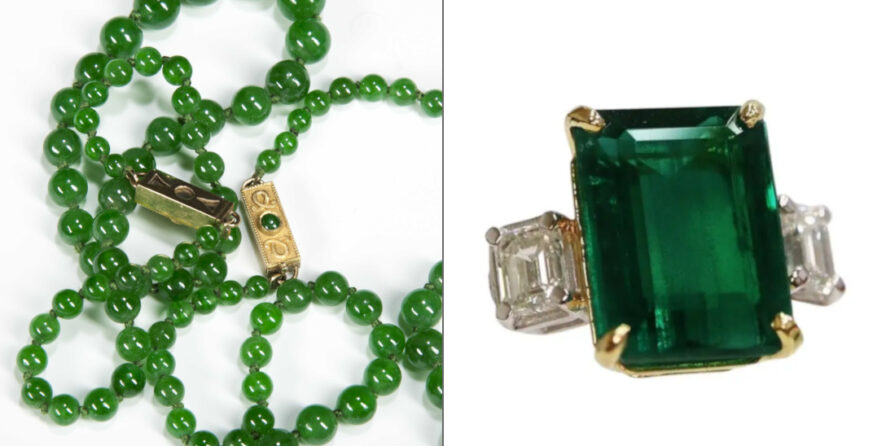
So, now I must ask the million-dollar question: why would the English localization team for Ocarina of Time go out of its way to transform the Kokiri Forest’s most vital treasure into a completely different jewel? Well, I can think of a few valid reasons why this decision was made. First off, the emerald is one of only four gems in this world considered to be truly “precious”, with the other three being ruby, sapphire, and diamond; therefore, it fits in much better with the other two Spiritual Stones than jade does. Second, people in the West are generally more familiar with emeralds due to their role in popular culture, with the Emerald City from The Wizard of Oz being one of the most famous examples of this phenomenon. And third, the Spiritual Stone of the Forest more closely resembles an emerald on the N64.
See, jadeite rocks are usually semi-translucent and have what is known as a “massive” crystal habit, which essentially means that the external crystals lack distinctive geometric patterns; because of this, polished jade is typically glossy and smooth to the touch. Emeralds, on the other hand, have a “crystalline” habit that results in the more angular appearance we often associate with gemstones, and premium stones are known for their transparency. If you look closely at the green Spiritual Stone in the game, you’ll notice that it does seem to have a shimmery crystalline surface (which is backed up by the official artwork), and the curved part of the gold setting is visible from the opposite side, indicating a highly transparent gem. (Curiously, the Kokiri’s Emerald in the 3DS remake has the sleek, opaque look commonly associated with jade. I’m pretty sure this is just a coincidence, though, since the Zora’s Sapphire is given the same graphical treatment.)


But I’ve overlooked one important factor that, in my opinion, tips the scale in favor of jade as the ideal gemstone for the forest’s teardrop-shaped relic: its durability. On the Mohs scale of hardness, which measures a mineral’s ability to resist scratches and abrasions from other hard substances, emeralds are rated 7.5-8, making them about twice as hard as jadeite (rated 6.5-7). This is a rather deceptive, however, because it turns out that emeralds are actually quite brittle. During their formation, emeralds tend to trap foreign materials like gases and sediments inside their crystals, causing internal fractures and fissures – known as “inclusions” – that ultimately weaken the gem. Jewelers often have a difficult time working with emeralds, because one bad cut can result in a severe crack that greatly diminishes the value. Conversely, jadeite is extremely dense and tough, able to withstand considerable trauma without cracking under the pressure; that’s why it was used to craft knives and axe heads during the Stone Age. It is this strength and integrity that makes jade the perfect symbol of Link’s harrowing trek towards adulthood.
According to an old Chinese proverb, “jade and men [are both] sharpened by bitter tools”. “Bitter” is certainly an apt way to describe the hero’s journey in Ocarina of Time, because fate hurls a staggering number of slings and arrows of outrageous fortune at Link all throughout the game. The young boy is forced to watch his adoptive father die a gruesome death that he was powerless to prevent, leave the only home he has ever known in exile, and grapple with unspeakable horrors as he attempts to cleanse Hyrule of evil, only to have his entire foundation of reality ripped out from under him when he leaps seven years forward in time and discovers his world broken and battered, a mere shadow of its former self. But just as toolmakers chip away at a slab of jadeite to craft a sharp, powerful weapon, destiny’s knife chips away pieces of Link’s soul until the shape of a true hero begins to emerge. He learns to adapt, think on his feet, and endure the pain without slowing down, smoothing away the sharp edges of his past and polishing his skills until he shines on the battlefield. And through the entire brutal ordeal, Link never once forgets his humble, rustic origins. All the refined warrior needs to do is gaze at that sparkling green pendant, as beautiful, strong, and imperishable as the forest itself, and he is once again a tiny stone full of untapped potential, quietly sleeping beneath the vast canopy of trees.

November 21st, 2023 marks 25 years since the release of Ocarina of Time! Join us in celebrating this nostalgic gem with an entire week of dedicated articles!