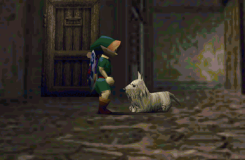
Link is a man of many titles. Some are dignified appellations bestowed upon him by Sages to reflect his status as Hyrule’s savior (“Chosen Hero,” “Hero of Twilight,” etc.), others are special nicknames given by local tribes to mark him as an honorary member (“Sworn Brother”), and a rare few are cruel monikers meant to smear his reputation and/or brand him as an outsider (“Thief,” “Mr. No-Fairy,” etc.). But if you ask me, the most appropriate title that we could confer on our green-clad warrior would be “Demolition Man,” because Link is utterly notorious for turning into a human wrecking ball whenever he comes face-to-face with breakable objects. Leave him alone for two minutes in a room full of pottery and furniture, and you’ll return to a scene of utter destruction, the floor littered with broken ceramic shards and splintered wood. But while these may sound like the machinations of an unhinged lunatic, rest assured that there are two extremely rational reasons why Link destroys other people’s property: 1.) Plundering is the most efficient way to acquire the supplies needed to save the world, and the average villager has a lot of spare money, magic powder, and active explosives tucked away in pots; and 2.) Breaking things is fun.
I think that pretty much every Zelda fan agrees with that second notion, which is why a certain rich socialite from Windfall Island has roused the ire of countless players over the years. Prior to his daughter’s return from the Forsaken Fortress, Mila’s father resides in the Windfall Auction House, where he has chosen to display several shiny and exquisite vases in an effort to showcase his vast wealth. If Link gives in to his natural impulses and goes Hurricane Mode on these vases, this man does the unthinkable: he demands a payment of 10 Rupees for every shattered relic and kicks the boy out of his house! Now, this simply isn’t fair, right? After all, these are known to be “the kind of vases one wants to break as soon as one catches sight of them,” so Mila’s father is just being reckless by having them on display all the time. And 10 Rupees a pop?! Who does this guy think he is, throwing such a wet blanket on one of the most entertaining gameplay mechanics in the entire series?!
However, there might be more to this story than meets the eye. Art historians will attest to the fact that not all decorative vessels are created equal, so what if, instead of immediately smashing any pot-shaped object we lay eyes on, we take some time to actually study these Auction House vases? In doing so, perhaps we can discover a method to the madness of Mila’s father and unpack a bit more from his rather one-dimensional character.
In the English localization of The Wind Waker, the sparkling vessels in the Auction House are known as “Extremely High-Class Bone-China Vases.” In the real world, the term “bone china” refers to a type of ceramic that was first developed by the Bow porcelain factory in mid-18th century England. As the name suggests, bone china is created by grinding and calcining animal bones (usually those of a bovine) until they turn to ash, then adding a considerable amount of the bone ash to a mixture of china stone and the clay mineral kaolin. This blend of ingredients undergoes two firing processes to harden and shape it into its final form. The first firing often results in warping and breakage, so a goodly portion of the bone china must be discarded at this stage. If the vessels survive the first firing intact, they are glazed and fired again, and only those that remain in pristine condition at this point are painted and given final touches. The result is a translucent, milky-white ceramic prized for its elegance and high durability, with gorgeous designs worthy of display in a museum.
So if the vases owned by Mila’s father are made from genuine bone china, how much did he likely have to pay for them? Well, since the materials are so expensive and the production process is so daunting, bone china is indeed considered a high-class luxury item; it’s not at all uncommon for individual pieces to fetch thousands of dollars each. So if, in this scenario, we presume that one Hylian Rupee is equivalent to $1, then Mila’s father could have conceivably paid over 10,000 Rupees for the eight bone china vases we see on the first floor of the Auction House.
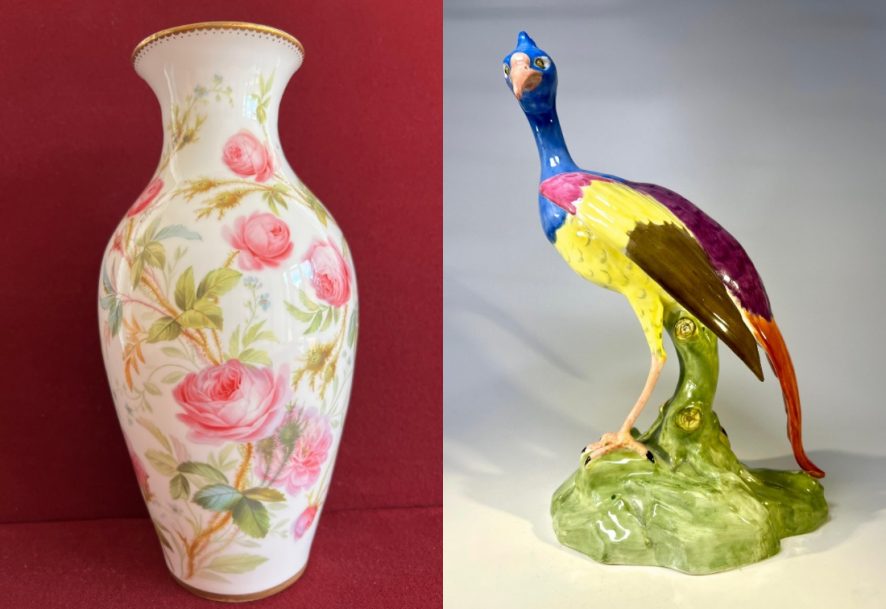
But hold on – this is just the beginning. Things get even more interesting when we look at what the vessels are called in the original Japanese version of the game: “High Class Kutani Ware Vases.” Kutani ware is a style of porcelain named after Kutani, a 17th century Japanese village located in modern-day Ishikawa Prefecture. In 1655, Maeda Toshiharu, the feudal lord (daimyō in Japanese) of Kaga Domain, received news that clays ideal for the manufacture of porcelain had been discovered in the mines of Kutani Village. In response to this, he ordered one of his clansman to construct a kiln in the village and learn how to make high-quality porcelain products, and thus, the earliest forms of Kutani ware – known as “Ko-Kutani” – began to emerge. One of the hallmarks of Kutani ware is the rich, vibrant color palette, achieved by applying thick layers of yellow, dark green, dark blue, purple, and red paint to the ceramic. These works of art proved extremely popular, and production flourished until 1730, when the kilns were suddenly shut down for unknown reasons. This style of pottery wouldn’t experience a comeback until nearly a century later, when artisans began producing “Saikō-Kutani,” a revival of Kutani ware that focused more on red and gold patterns.
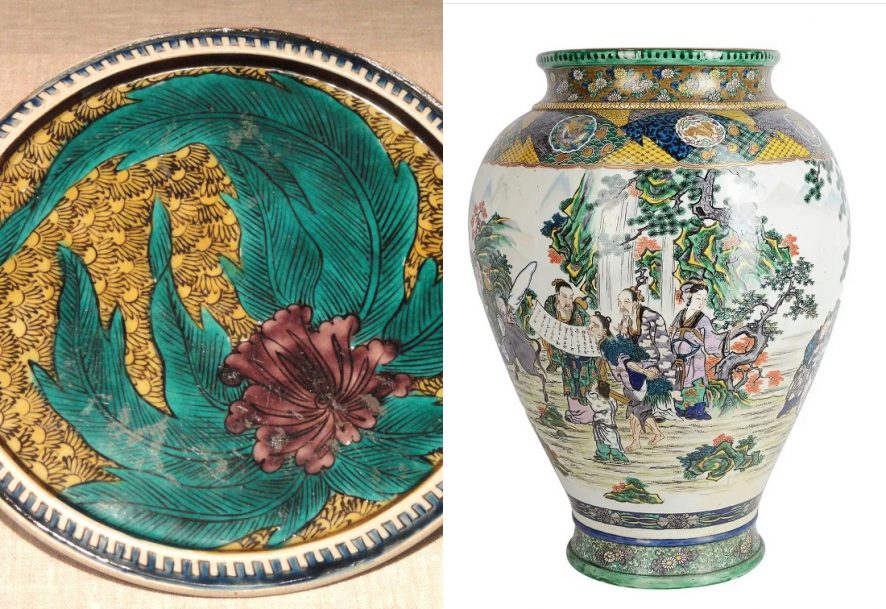
For our Windfall Island aristocrat, the possibility that his vases could be genuine Kutani ware puts an even greater strain on his pocketbook. True Ko-Kutani products are extraordinarily rare and likely unobtainable even for the richest nobles, but Saikō-Kutani pieces are readily available in online auctions. Individual vessels are frequently listed at over $3,000, which comes out to at least 24,000 Rupees for Mila’s dear papa!
So with all of this in mind, I have just one question: What right do we Zelda fans have to hate Mila’s father? I understand that we’ve been conditioned to pulverize every pot-shaped object that enters Link’s field of vision, but if the Auction House vases really are bone china or Kutani ware, then charging only 10 Rupees for each wantonly-destroyed receptacle is an act of pure charity! Link should consider himself lucky that Mila’s dad doesn’t unleash his inner Magda and thrash him into an instant Game Over!
But now that I stop to think about it, why doesn’t he dish out a more severe punishment? We’ve clearly seen that the man is arrogant, hot-tempered, and obsessed with money (prior to his redemption, that is), so demanding such a small fee for valuable possessions seems to go against his character. Is there something I’m missing here?

Well, I’ve come up with two different theories about Mila’s father that may shed some light on his hidden motivations. The first theory posits that his extremely high-class vases are actually cheap knock-offs that closely resemble real bone china/Kutani ware. I mentioned earlier that Mila’s father is reckless for putting such tantalizing pottery on display, but it’s possible that he is aware of the risks and has come up with a rather shrewd solution. Since it usually takes a trained eye to tell a replica from an original masterpiece, he could buy a warehouse full of forgeries for a pittance, and the average house guest would never be able to tell that they’re fake. That way, Mila’s father can brag about how his enormous fortune allowed him to buy these fancy vessels, and when one does inevitably get broken, it’s easy to recoup his losses and set out a replacement. This particular theory is supported by evidence within the game: not only does Maggie’s father brush off the shattered vases once he takes over the Auction House, but if you damage one of Sue-Belle’s humble little jars of water on Outset Island, she charges the same fee of 10 Rupees to replace them. All in all, it’s a smart but rather shady way for Mila’s father to maintain his image as a disgustingly rich tycoon with hoards of disposable income, without actually having to bleed his wallet in the process.
Meanwhile, my second theory rests on the assumption that the vases really are priceless works of art. Perhaps Mila’s father is a kinder soul than he would have us believe, and the last thing he wants to do is condemn a child to debtors’ prison over a broken piece of pottery. But he also doesn’t want such naughty behavior to go unchecked, so he acts like a nasty ogre and asks Link for a little bit of money in order to teach him a lesson about respecting other people’s property. This scenario casts a more positive light on Mila’s father, but it reflects rather poorly on our little doe-eyed hero. The countless hours that the artisans poured into crafting these valuable collectibles, the vast quantities of expensive clay and paint – all squandered because of a young boy’s wild enthusiasm for smashing ceramics against the wall. Has he no shame? Has he no reverence for arts and culture? Of course he doesn’t, don’t be ridiculous! Breaking things is a way of life for Link, as well as a hallowed tradition for every long-term Zelda fan, and no amount of money, beauty, guilt, or personal affection will be able to stop the Demolition Man from continuing his path of destruction. So if you have historical artifacts you want to protect, you might want to think about storing them behind glass.


The Wind Waker is 20 years old on December 13, 2022! We’re celebrating with dedicated articles throughout the first two weeks of December!