I think it’s a fair statement to make that Twilight Princess is one of the most polarizing titles in the lineup of 3D Zelda games, if not the entire series. Some fans wished to deviate from the trends set by the vibrant, whimsically cartoonish Wind Waker and wholeheartedly embraced the new game’s chilling atmosphere and realistic environment, while other devotees of the franchise found the graphics too bleak and disheartening and the gameplay too restrictive and linear. Personally, I liken the game to a bag of delicious candy that got dropped in a puddle, as the deeply compelling story and spectacular dungeons are somewhat diluted by painfully slow pacing and distracting plot holes. But despite the wide range of opinions, there are a few things I believe we can all agree on when it comes to Twilight Princess: Midna’s character arc is one of the strongest we’ve seen yet, the revelation that Ganondorf was Zant’s puppet master all along was incredibly rushed and poorly implemented, and Ooccoo is by leaps and bounds the most unnerving creature to ever ally herself with Link.
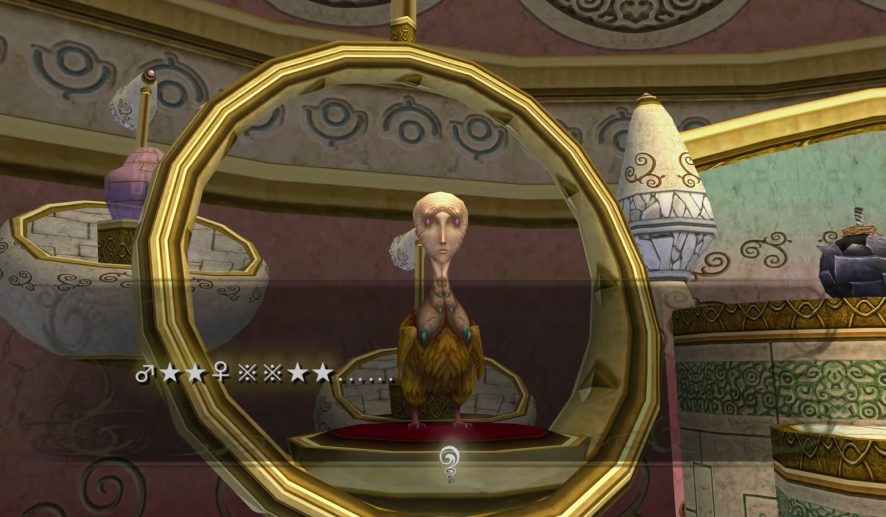
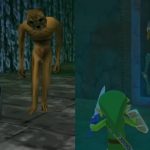
I know I shouldn’t be saying that, as Ooccoo is a gentle, compassionate sweetheart who proves beyond a shadow of a doubt that true beauty lies within, but her disturbing visage is rather difficult to ignore. She more or less epitomizes the uncanny valley, with a stretched humanoid face connected to the body of a chicken by an uncomfortably long, slender neck. These exaggerated features even visibly agitate Link when he first meets her in the game, which is a clear indication to me that Ooccoo was purposefully designed to bewilder both players and characters in-universe. So if it wasn’t an accident, then what was the motivation behind designing her this way? Do the developers of Zelda titles secretly delight in making the members of their audience squirm? Or might they be paying tribute to a group of bold, out-of-the-box artists who knew exactly how to exploit humanity’s hidden yearning for the unabashedly bizarre?
If you’re an avid follower of the video game trivia website Did You Know Gaming?, then you may already be aware of one possible source of inspiration for the Oocca and the City in the Sky. Back in 2013, the platform shared a post directing fans to an obscure 1947 woodcut print by renowned graphic artist M.C. Escher that would instantly grab the attention of anyone familiar with Ooccoo. During the 1930s and 40s, Escher’s work truly began to reflect his deep fascination with surreal perspectives, environmental paradoxes, and impossible objects, as can be observed in Doric Columns, Balcony, High and Low, and Drawing Hands. Another World is no exception to this, depicting an extraterrestrial structure with open archways on the floor, ceiling, and walls that show the lunar landscape from different perspectives. And standing at the center of each archway is a humanoid bird, giving the impression that the creatures are defying gravity itself by standing “upright” on the various surfaces. This mesmerizing and thoroughly disorienting dimension that Escher so kindly invites us to explore definitely calls to mind the otherworldly dungeon in Twilight Princess, where Link must make like an Oocca and climb the walls in order to navigate a city where stepping on the floor often means spiraling off into oblivion.
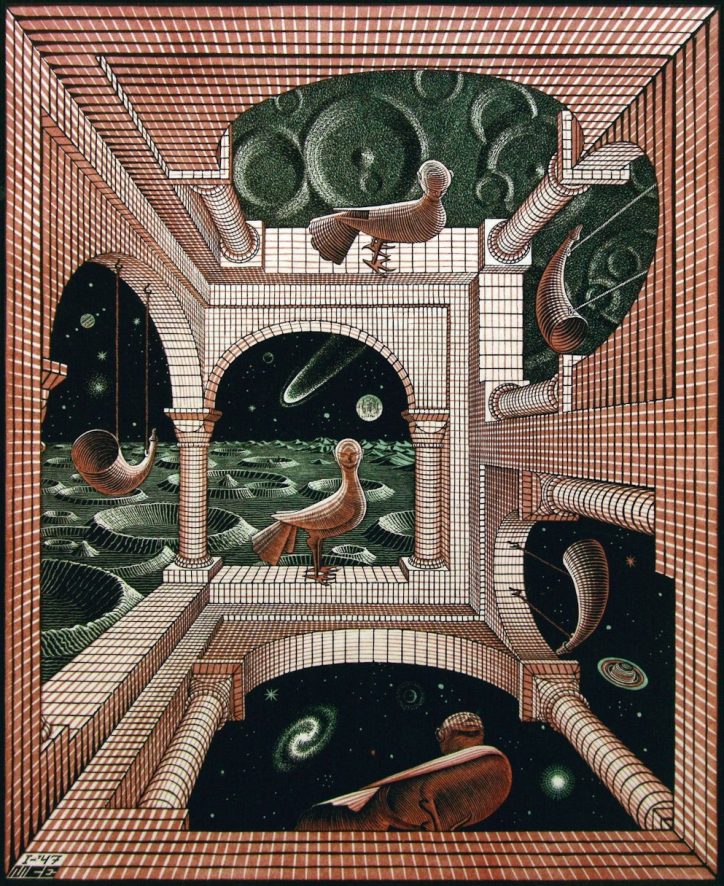
There are also a few particularly intriguing things to note about the human-bird hybrid in this picture. As it turns out, these aren’t living creatures as some may have initially believed, but metal sculptures that silently patrol each archway like a gargoyle of a cathedral. And this isn’t the first time that these statues have been featured in Escher’s work. In 1934, 13 years before Another World, it appeared solo in a lithography print entitled Still Life with Spherical Mirror, where it stands atop a newspaper and book lying on Escher’s workshop desk. That’s because the bird was a real-life sculpture gifted to Escher by his father-in-law, which then became a recurring motif in a number of his art pieces later on. Deeper and deeper the rabbit hole goes, but unfortunately, I couldn’t find any information about who crafted the original statue, so the search for Ooccoo’s earliest origins will have to continue another day. Even so, it’s pretty amazing that a single video game character could prompt a deep dive into a fascinating realm of optical illusions and dreamy surrealism.
But believe it or not, we’re still not done here! While Escher may have supplied Ooccoo with her basic bodily framework and her home in the heavens, another avant-garde artist from the early 20th century is likely responsible for her trademark facial features. If you comb through the colorful pages of concept artwork in Hyrule Historia, you’ll find a small caption about Ooccoo that points right to the culprit.

Predating Escher by around 20 years, Amedeo Modigliani was an Italian painter whose work collided with the modernist art movement between 1910 and 1920. A contemporary of Pablo Picasso, Modigliani primarily painted portraits of ordinary individuals who agreed to model for him, with a few key people appearing in multiple paintings (including his life partner Jeanne Hébuterne). If you browse his gallery, it quickly becomes clear that he was strongly influenced by the various art styles that were rising in prominence at the time, as he experimented with Cubist and Surrealist elements while maintaining a trademark look that was uniquely his own. And now you can probably see how Modigliani’s works likely inspired Ooccoo’s unusual features since he was known for painting his subjects with elongated necks, oblong heads, flat cheekbones, and long, thin noses.
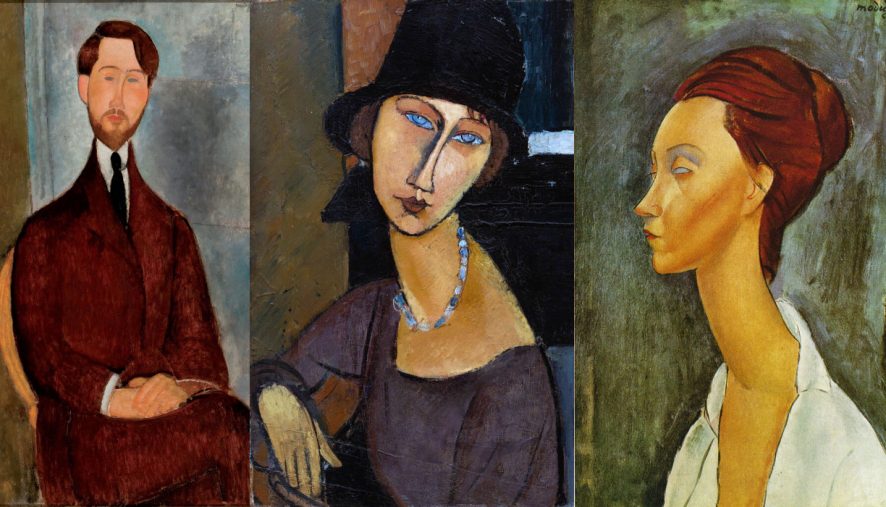
While this humble man’s paintings do seem rather unsettling on the surface, I can’t deny that they possess a kind of unorthodox beauty that can’t be found anywhere else in the world of art. The elegance and grace of his subjects shine through in a completely unexpected way, just as the dreamlike wonder of the everyday world is spotlighted through M.C. Escher’s bizarre twists on reality. Extraordinary minds like these, whose pieces can unleash a torrent of emotions ranging from mild consternation to full-blown disgust, force us to constantly redefine the nature of beauty in our minds. I think the same could be said of our loyal friend Ooccoo. She may not be a conventionally attractive creature, but this kind, quirky little bird holds the key to one of the most thrilling and wonderfully weird adventures we’ve encountered yet in the Zelda series. And for that, we owe her a debt of gratitude.