Breath of the Wild is home to a wide array of older characters, who remember the days of Hyrule before the Calamity. These elders bring out some of the more interesting themes of a post-apocalyptic Hyrule that the younger characters aren’t able to, and those from the Zora race in particular have pre-Calamity memories that serve this purpose. Because the Zora have such a long life-span, the grief caused by the Calamity is still quite fresh for a lot of their members.
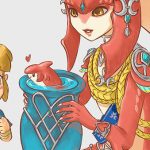
While characters like Sidon and Dorephan obviously grieve the loss of Mipha, there is an overlooked character we can examine when thinking about the Zora’s grief: Muzu.
Muzu admittedly plays a small role in the grand scheme of the game, as he is mainly there to be a stepping stone during the quest to quell Vah Ruta — he is the only one with knowledge of Shock Arrows. However, he does have a really cool design, with a head that resembles a manta ray. He is an interesting twist on the other Zora designs, especially with the manta ray mustache, making him one of the most distinct Zoras.
However, his design alone is not what makes Muzu interesting. Muzu’s journey as a character really highlights a lot of interesting themes in the game like grief, forgiveness, and the ability to change.
Muzu blames Link for Mipha’s death and has harbored a distrust of outsiders long before the Calamity. This treatment is of course unfair since Ganon is the only one responsible, but Muzu has held onto this hatred for 100 years after losing Mipha. He was Mipha’s teacher, so likely watched her grow up and grew to love her like his own child. And because Link and Mipha were childhood friends, it is likely that he knew of Link as well.

It was Link and Zelda who convinced Mipha to become a champion, so Muzu blames Mipha’s death on that simple choice. If Mipha had just stayed in Zora’s Domain, maybe they would not have lost her. If Link had never met Mipha, maybe she would have refused to become a champion. All these questions undoubtedly cycled in Muzu’s head for an entire century. His grief is complicated, and, in his hopelessness, he directs his anger at Mipha’s passing to Link.
But he does not stay in his hatred forever. When Muzu sees that Link is a perfect fit for the armor Mipha crafted, he realizes that Mipha loved Link. He realizes that he was wrong to hate Link and asks Link for forgiveness. Muzu finally finds some closure and also realizes how wrong he was in his resentment.

Muzu’s journey of grief is perhaps one of the most realistic in all of Breath of the Wild, which is telling for a game that has grief as a core part of its story. He shows development, moving through the stages of grief from anger and bargaining to acceptance and repentance. It is this development and willingness to change that makes Muzu one of the more interesting older characters.
Muzu demonstrates that grief is a long and hard journey. He shows that it can sometimes make us bitter and hateful. But he also shows us the power of healing and forgiveness. And as one of the oldest characters, it shows us that change can happen at any age. It is a strong message to come from a rather minor NPC, but that is what makes Muzu feel all the more real.
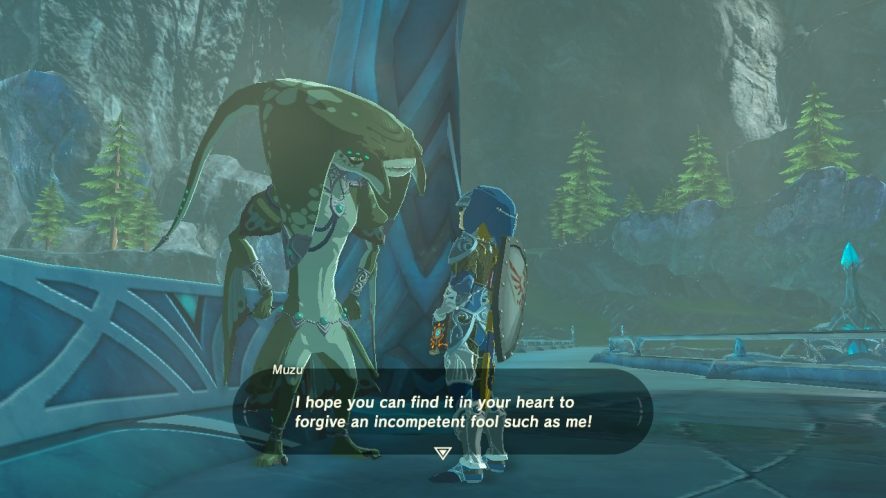
No matter how long you grieve, there is always an opportunity to heal. Mipha may have had healing magic, but Muzu demonstrates that some wounds can only be healed through your own self-reflection.