We say something is “stranger than fiction” when real-world happenings careen into the seemingly fantastic, into the bizarre. Sometimes, they stray so far as to be unthinkable, and it’s these events we might find ourselves wishing were merely a literary trifle instead of a literal tragedy. For many of us, the games of The Legend of Zelda franchise can be a much-needed escape from a sometimes much harsher reality. In Hyrule, the edges are softer, the path is clearer. There’s typically not a lot of moral gray area to navigate. You are Link, and Link is going to do the hard thing to save everyone.
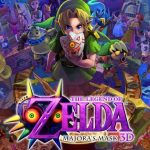
In Majora’s Mask, the people of Termina find themselves staring down the apocalypse, through no fault of their own. They largely conduct themselves with dignity and put on a brave face in one of the series’ most intimate adventures, much of which addresses dealing with grief and loss. As an escape, it still works, because Link intervenes and sets everything right — but what happens when life begins to imitate this art?
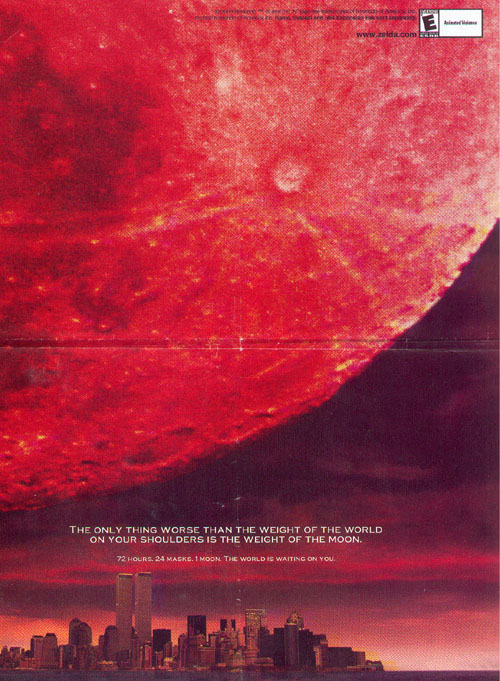
After being introduced to Zelda as a middle school kid by Ocarina of Time, I was eagerly awaiting the forthcoming sequel. Despite the relatively quick turnaround, two years feels like a long time at that age. I was excited one day to find a print ad in a news magazine for Majora’s Mask. It was (and remains) a little strange to bump into your beloved personal childhood obsession in a mass-marketed item intended largely for adults, so promptly I tore it out to save as a memento.
Some months later, after playing and thoroughly enjoying Majora’s Mask, I posted a scan of the advertisement to my Zelda fan site, looking to pad it out with some extra content besides merely screenshots and promotional art I’d ripped from the net. I thought other fans might enjoy seeing some of the game’s official advertising material, and it felt very intrepid as a young person to have produced some “original content” (to use the term liberally). In the process of writing this column, I wanted to check the file meta-data to see exactly when I uploaded it: September 1, 2001.
I suppose I hardly need to say what happened shortly thereafter. In the interest of completion: ten days following, four commercial aircraft were hijacked by terrorists after departing from airports in the eastern United States. One never reached its target, downed in a field in Somerset County, PA during an attempt by the passengers to retake the plane. Another crashed into the side of the Pentagon in Arlington, VA. The remaining two crashed, one each, into the Twin Towers of the World Trade Center in New York City. Within a few hours, both structures collapsed, leading to a catastrophic loss of life totaling more than 2,600 people.
Days like this are singularly strange, but I’d argue especially so as a child. When you’re young, it’s hard to gauge how important things are when they get adults agitated or otherwise excited. The ’96 Atlanta Olympics were a big deal. Y2K was (suggested to be) a big deal. The 2000 presidential election was a big deal. You are told these things are important, and you just take people at their word because as a kid you lack the context to fully comprehend why. As an adult, you develop something of an intuition about when you’re living through an important moment — big or small. Moments where everything turns, true inflection points of your personal history, or that of an entire country, tend to stick with you.
When you’re young, though, you don’t know to expect this. Instead, you’re left with a sampling of nearly random, albeit nearly eidetic, memories of this very strange, very sad day. The one that stands out most to me was watching the news on a big 35-ish-inch CRT television strapped to its perch, high atop one of those welded steel carts, so kids could all see. I’ll never forget literally watching the world burn, drinking a carton of chocolate milk, and eating a Baby Ruth candy bar. Everyone in my class was doing the exact same thing because they were birthday treats brought for the entire grade. Not one, but two girls in our grade both had a birthday that day. I still remember their names, despite not having seen or spoken to them in roughly two decades.
That fact always stuck in my head- how improbable it was that they shared a birthday. Turns out this isn’t that surprising at all. If you work the math, for a class of about 50, there’s something like a 97% chance that two people would share a birthday. Still, I don’t know that the analysis is much good for relating the odds of those two people sharing that same day with a human-made disaster that would forever alter the geopolitical landscape of the world. I felt bad for them that day — it was supposed to be fun turning 14. I still feel bad for them: to have their birthday overnight become a convenient shorthand for a monumental tragedy is its own, much smaller, loss.
To come back to the Majora’s Mask print ad I’d described earlier: As a kid who grew up in the midwest, before that day I hadn’t the faintest clue what a World Trade Center was. I now knew those buildings exclusively in the context of what had transpired that day. In the weeks that followed, I stumbled back across the ad, and with the increased understanding of the gravity of what had transpired, it sent a chill down my spine. With the benefit of hindsight, this isn’t as spooky as it felt. New York City is iconic, and so the Towers show up in many places across media.
I didn’t know that, though. At the time, it seemed a grim portent had found me specifically through The Legend of Zelda, something that was deeply important to me at the time. It was disturbing to look at the image and be forced to juxtapose the two sets of events. Link saves Termina, using the Ocarina to twist and loop time to get not just a second or third chance, but as many as he needs to gather his strength and set things right. In the real world, of course, everyone gets just the one chance. For thousands of people that day, their time ran out too soon.
I actually haven’t played Majora’s Mask since it was first released in 2000. My memories of the game are fond, if fuzzy from the intervening 20 years of life. Sometime in the next year, it’s on my list to revisit though, and I’m really looking forward to the experience. It will be nice to make some new memories in Termina, even if I’ll never quite shake the mental association with the old ones. Those are destined to remain permanent, stoic, if not especially welcome, residents in my head. Though perhaps it would be stranger still to lose them.