Ingo from Ocarina of Time is definitely one of those characters people love to hate. One might sympathize with him at first because his hard work at Lon Lon Ranch is taken for granted, but that all goes out the window when he reveals that he made a deal with Ganondorf to take the ranch by force. He’s greedy, arrogant, dishonest, and just downright vile.
So, you can probably imagine how horrifying it was to learn that the sequel would feature not one, but three parallel universe counterparts to Ingo. What a nightmare!
However, Majora’s Mask managed to surprise me. Instead of the trio of evil Snidely Whiplash-esque villains I was fearing, we got a heart-wrenching, painfully relatable story about disillusionment, self-identity, and the enduring power of familial love.
At the heart of this story is Gorman, the leader of a humble circus troupe (the Gorman Troupe) that travels around Termina, performing carnival acts in front of less-than-enthused crowds. A new chance at stardom has brought them to Clock Town, as they are set to open for the famous Indigo-Go’s at the annual Carnival of Time.
We first meet Gorman as he’s hurrying to the Mayor’s Office to speak with Madame Aroma, and his excitement is evident as he impatiently shoos Link out of his way. He has waited a very long time for this opportunity, and he won’t let some annoying kid slow him down!
Unfortunately, his enthusiasm doesn’t last long. When he finally meets with Madame Aroma and Toto, the manager for The Indigo-Go’s, Gorman is dealt a crushing blow: The band’s lead singer has mysteriously lost her voice, so their act, and by extension, his, has been canceled. And as if this wasn’t devastating enough, Madame Aroma decides to pour vinegar on the wound by dismissing him in a flippant and unnecessarily cruel way.

With his entire world crumbling beneath him, Gorman retreats to the bar. He angrily lashes out at everyone who speaks to him and attempts to drown his raging emotions in milk. In his drunken state, he begins to open up about his past, revealing himself to be the second of three brothers raised on a horse ranch. From there, the portrait of a lonely, disenchanted outcast begins to emerge from beneath his curmudgeonly exterior.
In addition to struggling with middle child syndrome, Gorman has always felt like the black sheep in the family due to his lack of skill with handling horses. While his older and younger brothers eventually took over the family business, Gorman made the difficult decision to break away from ranch life and seek out his place in the world. But with every humiliating failure and demoralizing rejection he encounters in the entertainment industry, he wonders more and more whether he made a terrible mistake.
Sadly, this is an all-too-common dilemma that people encounter in the real world. Whether one wants to open up their own restaurant or become a headliner on Broadway, following one’s passion is always a risky venture that requires great courage and a spirit steeled against disappointment. The real world can be a truly harsh place, and even the most hopeful, starry-eyed dreamers can start to question what made them choose that path in the first place.
And when pursuing your dreams also involves breaking from family tradition, there is an added sense of shame when things don’t pan out, as well as a fear that your family won’t accept you back into the fold.
But all is not lost, as Gorman’s story later demonstrates. Back at the Milk Bar, Gorman is still wallowing in despair as Toto the band manager asks Link to help him with a soundcheck, even though the performance has been canceled. Link must use his three transformation masks to piece together an ensemble performance, resulting in a beautifully melancholy piece performed on ocarina, pipes, drums, and guitar.
Gorman, who has been booing Link the entire time, is now overwhelmed with nostalgia, remembering how the song, “Ballad of the Wind Fish,” first inspired him to pursue acting. Even though his problems aren’t solved, a spark of renewed hope has ignited inside Gorman, giving him the strength he needs to keep following his passion.

Grateful to Link for soothing his pain, Gorman gives him the Circus Leader’s Mask and spends the rest of the night weeping in the bar, contemplating whether he should pay a visit to his estranged brothers.
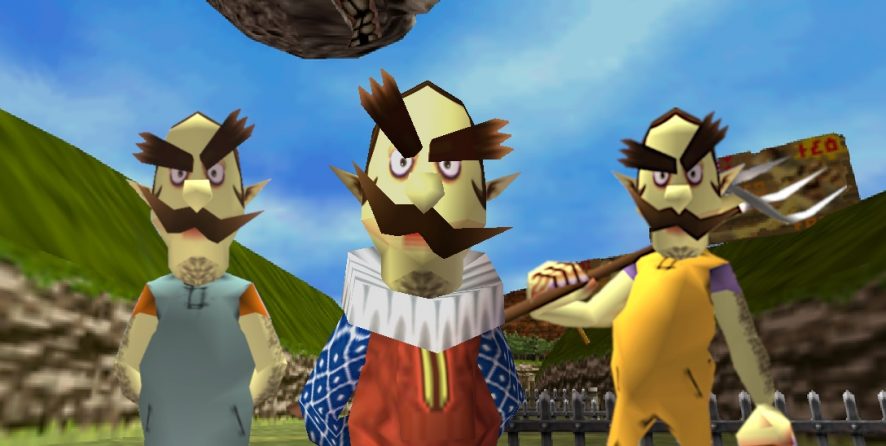
So, what are Gorman’s brothers up to while all this is going on? As I touched on earlier, Big Bro and Little Bro (their nicknames for each other in the game) are born-and-bred horse ranchers who aggressively advertise their business of training horses to be worthy of racing, as well as their “superior” milk products.
These guys are much closer to what we would expect from the parallel universe counterparts to Ingo, as they contemptuously scorn anyone without a horse, gouge their customers with outrageous prices, and attempt to maliciously sabotage their competition at Romani Ranch.
In fact, they are the main antagonists of the Day 2 milk run sidequest: Link must stop them from destroying Cremia’s supply of milk, or else they will succeed in running Romani Ranch out of business. Pretty irredeemable actions, if you ask me.

There still seems to be some shred of humanity in them, though. If Link dons the Circus Leader’s Mask in front of Big Bro and Little Bro, their demeanor completely changes. Their faces fall with sorrow, and they reflect on how Gorman is struggling to make ends meet out there in the world. For a brief moment, they actually show remorse for all the nefarious acts they commit to get ahead, while their brother is working so hard to follow his dreams without stepping on the toes of others. And above all, they demonstrate that they still care deeply for Gorman and want him to come home.

As if there weren’t enough things to love about Majora’s Mask already, the Gorman Brothers further show just how much richness and complexity the creators poured into each and every corner of the game. They could have so easily been one-dimensional villains like Ingo, but all three characters are humanized by their moments of self-reflection, their capacity for compassion, and their loyalty to the bonds of brotherhood.
Gorman’s story alone should encourage any struggling artist to remember what first inspired them, and use that memory to keep going through the darkest of times.