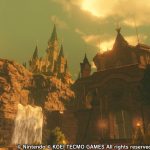
Hyrule Castle is a constant source of fascination for me. In most settlements throughout the three-dimensional Legend of Zelda games we see how the inhabitants live their day-to-day lives, but in Breath of the Wild, however, we see the land of Hyrule in a state of decay not seen before. Though some games allow us to see the castle still in use, in Breath of the Wild we find it a hollowed-out shell. So we explore what remains of it with wonder, questioning how each room was used, what it was like when the halls rang with voices, when the servants’ quarters clattered with life, and what it might have been like to live there surrounded by splendor.
Beyond the ruins of Princess Zelda’s bed-chamber lies one of Hyrule Castle’s most intriguing rooms: Princess Zelda’s Study. To reach this little gem of a room you can either scale the exterior of the castle, locating it within the tallest tower on the western side of the Castle, or it can be reached by following the interior corridors through to the Princess’s bedroom, defeating the Silver Moblin, then climbing up into the round antechamber. Through the arched doorway is a bridge, and across that is a mostly intact tower, containing the remains of the Princess’s private study.
Arrive at the right time, and sunlight streams through one of the empty window arches, suffusing the room with a golden glow. Rubble and detritus lie in mounds around the entrance, and most of the window shutters have rotted away, but some of the furniture and Zelda’s belongings have survived. Interestingly, there seems to be more of Zelda’s things remaining in here than in her bedroom, and by contrast, this tiny room has much more of her personality present.
While her bedroom is formal and restrained, her study is cluttered and appears lived-in. Her bedroom is very much like the rest of the castle, and displays little of her personality, with the exception of a small desk covered in notes. Her study, however, gives us some real insight into the princess’s character. The walls are lined with stone shelves which are filled with many objects of interest. There are test tubes, jars and bottles, beakers, display cabinets, drawstring bags, little drawers, and terracotta plant pots. From the ceiling, there appear to be more planters hanging, suspended from chains, and there are large planters along one wall. Plantlife is still spilling from these, giving the room an overgrown look not seen anywhere else within the barren castle. There’s even a decaying rug on the floor, giving the room an element of coziness and comfort.

One of the most affecting touches in the room is the single flower growing just inside the entrance. A lone Silent Princess, the flower that Princess Zelda admires so much. In Recovered Memory #9, she tells Link about the little flower.
“This one here is called the silent princess,” says Zelda. “It’s a rare, endangered species. Despite our efforts, we can’t get them to grow domestically yet. The princess can only thrive out here in the wild. All that we can hope… is that the species will be strong enough to prosper, on its own.”
Throughout the game, this pale blue-and-white flower is a reminder for Link, and the player, of Princess Zelda. It is her emblem, and reflective of her. Appearing to be delicate, it is deceptively strong, popping up in the most unlikely of places, such as amongst the rubble in this tower. It is wild and free, two aspects that Zelda valued most and wished for in her life. These flowers also flourish around Fairy Fountains, appearing in places linked to magic and the goddess. Lastly, they emit a soft glow in the dark, a tiny beacon of hope reminding Link that the light will come again and banish Calamity Ganon’s darkness from the land. If the Master Sword is the “Sword that Seals the Darkness,” then Zelda is the light that shows the way. In the final battle, Zelda gives Link the Bow of Light to finish Ganon once and for all. She is always synonymous with light, throughout every entry in the series, but the symbol of the Silent Princess highlights her resilience and courage for us too. She has a strength that is different from Link’s strength in battle, but it is in no way lesser. It is simply different.
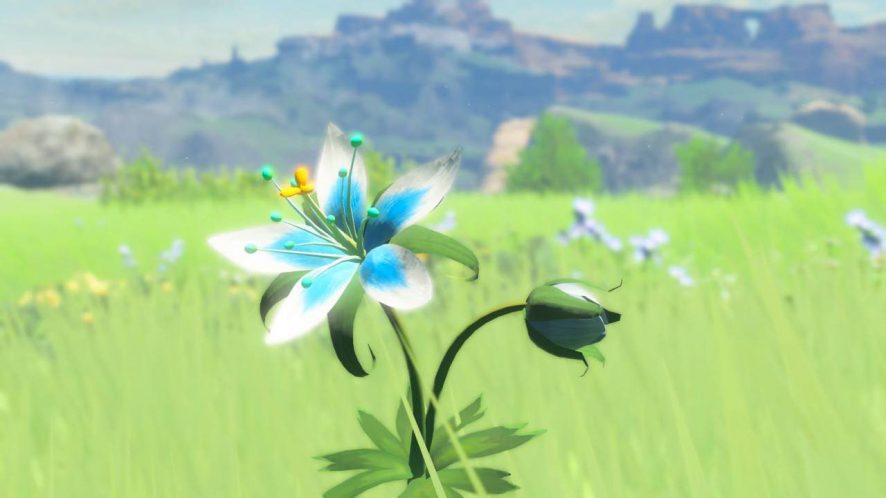
This little flower popping up, along with the overgrown pots scattered around, reminds you of Zelda’s love for the natural world. Along with the test tubes (or possibly sample tubes), there is a brass microscope on her desk, along with a set square, and a large piece of parchment weighed down by rocks and a candelabra. There is a box of rolled parchment and diagrams plastered across the walls. A telescope sits on the shelf above the desk too. This is, after all, Zelda’s Study, and she used it exactly for that purpose. This was where the princess came to pursue her interests; studying plants, soil, the artifacts she found at archaeological digs, and the prophecy that foretold the rise of Calamity Ganon.
It is a little unexpected for a traditional princess to have her own study, to experiment and explore botany and astronomy, but Zelda regularly defies expectations. Just think of her development in Ocarina of Time, training with the Gerudo to disguise herself as Sheik. Instead of the princess being rescued from the tallest tower like the fairytale cliche, here Zelda works on her rescue plan for her land and people.
On the desk lies Zelda’s Diary, one of two located in the castle. Read this and you’ll learn that Zelda dug up the Sheikah Slate at an archaeological dig and spent time with Impa, Purah, and Robbie learning about the ancient people and technologies. As you read each successive page, you see the princess grow more and more desperate to utilize the ancient technologies around Hyrule, such as the Guardians and the columns to protect the castle. Read on further and you will discover Zelda’s increasing fear of the Calamity, that she’s disturbed by the need for the Shrine of Resurrection. Her notes end there, with the hope that the Shrine of Resurrection might never be needed, that there would be no bloodshed to necessitate using it. It’s poignant to read this, years later in a very different Hyrule, potentially mere moments from finally confronting the Calamity Ganon in the final battle. It’s impossible not to feel for this young woman who did everything in her power to stop this monstrosity and still failed.
This is further highlighted in Recovered Memory #12, titled “Father and Daughter,” which you collect on the bridge leading to the tower. Zelda’s father harshly condemns her experiments, accusing her of not training hard enough to unlock her Goddess Powers. In this memory, you almost see the princess’s heart breaking. She has done everything that she possibly can to unlock her Goddess Powers, and her failure weighs heavily enough on her, so she doesn’t need the king ordering her to stop messing around. This “messing around” is Zelda’s only other option; she must find another way to stop the Calamity before it starts because she is literally powerless to stop it once awakened. Not only does this encounter hurt Zelda deeply, but it fractures her relationship with her father for good, something that they never get the chance to fix.

Between Zelda’s Study and the Recovered Memory outside it, we get a really interesting picture of a wonderfully complex character. While she is a princess, born with a sacred gift, she’s also a hard worker. She’s studied and worked for her breakthroughs, and she’s made a difference in Hyrule long before she’s placed Link in the Shrine of Resurrection. We see aspects of her personality, her inquisitiveness, how she truly cares for the land and her people, and how heavily her duty rests on her shoulders. When she believes she’s failed to access her Goddess Powers, she pushes on anyway, trying again and again. When that fails she explores other avenues, using science and technology, consulting those in the land that are wiser than she. She is a bold and determined young woman, and I think we see all of this in her little study, the only room left in the castle with life still growing in it.