We know that Shigeru Miyamoto drew inspiration from Disney when creating Zelda, such as from the classic tale of Peter Pan (to which Link likely owes his green tunic and the Kokiri owe their eternal childhood). Mythology and lore from cultures in real life often lend their intrigue and creativity to games, and in a series as unique as Zelda, it’s unsurprising to find a plethora of references to and recreations of them.
One classic legend that clearly made its way into the Zelda series and rooted itself there — fitting, considering the legend is about a firmly embedded object — is the story of the sword in the stone from Arthurian legend.
Whether or not it’s a confirmed reference to the Arthurian story, it can’t be coincidence that the Master Sword recurrently rests in a stone pedestal throughout the Zelda series, waiting for someone deserving to pull it out. In particular, Breath of the Wild only allows you to draw it from the stone once you’re strong enough to be the hero, like how Excalibur in the Arthurian legend could only be pulled by the deserving and true king Arthur.
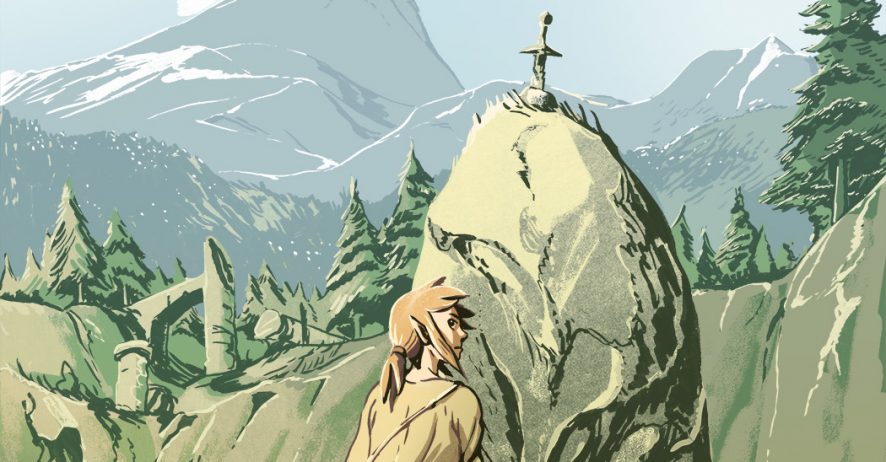
What’s especially interesting to me about the use of the sword in the stone motif in Breath of the Wild is how it’s foreshadowed right at the start of the game, deliberately placing emphasis on the idea of Link becoming worthy of the sword. I’m evidently not the only person to spot the inconspicuous inclusion of a sword in the stone, as Tumblr artist Rob Dunsmuir created a beautiful piece of art about it. His art depicts this clear reference to the legend and its use at the beginning of Breath of the Wild, beautifully shown with a storybook vibe that is truly deserving of the legend it borrows. More importantly, to me this art captures an iconic moment that encapsulates Link’s journey as a hero in Breath of the Wild.

As if it were yesterday, I remember exiting the Shrine of Resurrection and facing the vast, oh-so-vast world of Hyrule that awaited me for 100 years. I remember being thrust into this world with no weapons, no armor, no map — nothing. Only the echoing words of Zelda and my inborn sense of courage gave me the guidance and encouragement to start exploring this expansive world. I remember wandering down the hill, meeting Zelda’s disguised father, seeing the ruins of the Temple of Time in the distance, and looking eagerly for any sticks and food to protect and sustain me. Then, I remember seeing a sword in a stone on a cliff — just like Dunsmuir’s art depicts. I was exactly like Link in this artwork: still looking over one shoulder, wary of the at-the-time deadly Bokoblins lurking nearby, still soaking up all my surroundings. But I was drawn to that sword in the stone.
I remember fumbling my way toward it, floundering in the water, and clambering up the cliff it was perched on, as I was still figuring out the controls for swimming and climbing. But that resolve was part of the beauty of this moment.
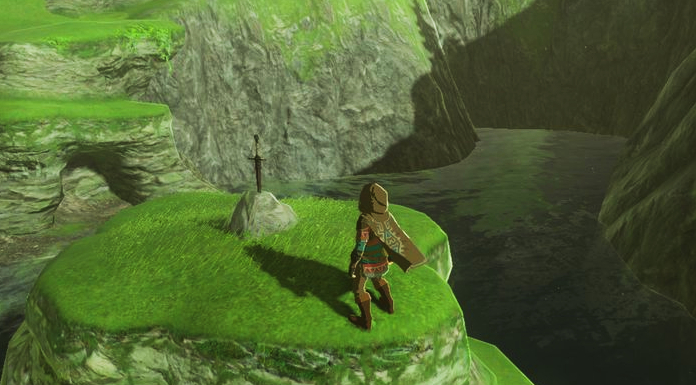
When I reached that alluring sword in the stone, I quickly realized these efforts were only for a rusty broadsword (though it didn’t faze me — I needed anything I could get) and a nod to the Master Sword. But then it occurred to me it was much more than just a fun nod. It was a foreshadowing. It was reassurance. It was a reminder of your humble beginnings now and where you would eventually end up in your hero’s journey.
While Link and your skills may have been quite literally rusty, like this dirty sword in a misshapen stone, it was a clear reminder that Link was still destined to be the hero — destined to pull out the real deal embedded in a pedestal, the true sword in the stone.