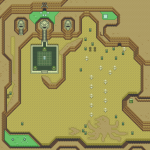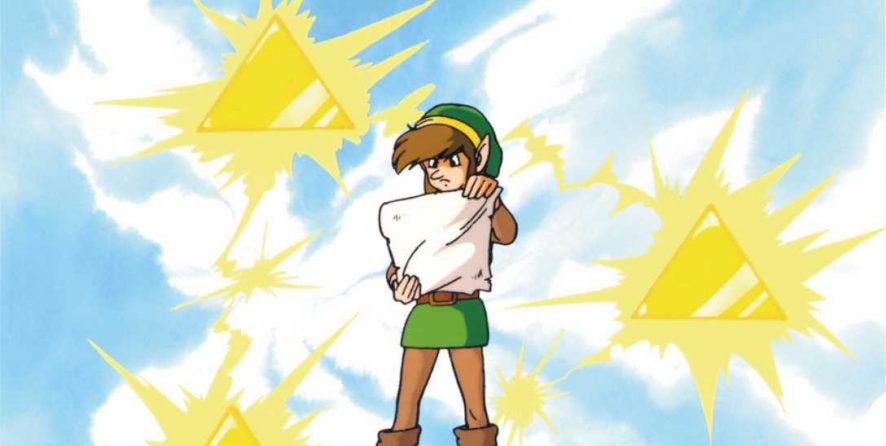
After getting the lay of the land in northwestern Hyrule, Link finally traverses a very dark but not-so-dangerous cavern and arrives at the Parapa Desert on the other side. As he scans the horizon, he notices the first of the various palaces he must seal with a crystal he received from Impa if he’s to awaken Zelda from her slumber.
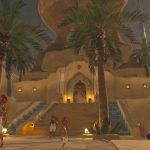
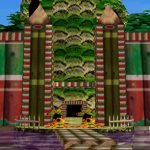
As Link approaches the palace entrance, with an intimidating Iron Knuckle statue seemingly to dissuade any would-be tomb raiders, he steps on the elevator and descends into the depths of the palace, crystal in hand.
Back when Zelda II: The Adventure of Link was released, it was clearly at a time when Nintendo was very experimental. Its sidescrolling elements were no doubt a result of the popularity of NES games also being sidescrollers. While it did incorporate a lot of elements of the first game, Zelda II did whatever it wanted and as a result, became the black sheep of the series because it dared to be so drastically different from the rest of the franchise.
The dungeons in Zelda II, as a result, are quite a bit different. They’re less focused on puzzles and more on ensuring the player keeps a good mental map of where they’re going as well as focusing on combat and some platforming encounters. I would go so far as to argue that Zelda II is primarily a game about its combat, especially given how difficult it can be.

Parapa Palace is the first dungeon you explore and, as all good opening Zelda dungeons, it sets the precedent as to what to expect for the rest of the game. It’s an easy dungeon to navigate, is quite small, and the most dangerous enemies in it are the weakest variants of the Iron Knuckles and the boss at the end.
From the get-go, you’ll find a locked door as you head to the right. As well as that, you’ll be attacked by an endless onslaught of dog warriors called Wosu. They have the pesky trait of not only infinitely spawning but also giving no experience, in addition to taking away any experience Link has accrued should he get hit — and Link will, of course, take HP damage on top of all the aforementioned ailments. The only saving grace is that the Wosu only bounds at you at a slow pace and falls in one hit regardless of your strength level.
Heading to the left to find a key, you’ll encounter Stalfos, which are easily felled with some crouching stabs, as the Stalfos will never move its shield. After seeing the key, however, it is lodged in between a block and the floor. Link can’t fit into this crevice, so the solution is to stab it with your sword to pick it up. This not only acts as a very simple puzzle but also ensures the player knows that sometimes they must slash at items to pick them up, such as the Treasure Bag.
From here, the dungeon repeats the pattern of enemy encounters, placing them on various platforms of varying height to give them the foes the advantage and to force the player to carefully think about how to approach them. The only exception is on the bottom floor to the left where a massive lava pit lies in wait. As Link walks over the bridge, it crumbles behind him and he must run without stopping lest he falls into the fiery pits below and immediately loses a life. If he’s feeling brave, he can stop to pick up the Treasure Bag on the way across.
After traversing all the trials within and picking up the Candle (which allows Link to see in the dark caves), he faces off against his first boss foe, Mazura. You might know him as Horsehead instead, which is what he’s known as in English, as Mazura is roughly translated from Japanese to “horse face.” He can be a relatively dangerous foe but is easily dispatched if Link jumps and stabs him in his face. The Jump spell can help make this fight a lot easier to aim Link’s attack as well.
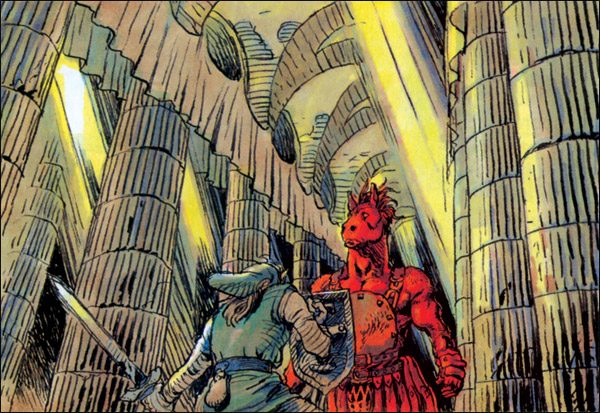
Once the horse menace is dehooved, Link acquires the key from his body and opens the door to the statue where he places the crystal and seals the first palace. Upon doing so, he instantly gains a free level, and exits the dungeon to the right, ready to move on to the next palace in Midoro.
It’s true that, compared to all of the other dungeons in the series, Zelda II‘s can seem pretty lackluster by comparison as they’re almost entirely comprised of combat encounters. But as someone who finds the sidescrolling elements of the game to be quite fun, this is precisely why they’re so enjoyable to me. In addition, I love the graphics of the various blocks; it really does feel like you’re exploring a deep and almost sacred palace! While there may have been very small sidescrolling sections in the original Zelda and later in Link’s Awakening, none of them have the intricacy and depth that Zelda II has. There’s really nothing quite like Zelda II in the series, which is what cements it as a black sheep. But who says being a black sheep is a bad thing?