Nintendo released its annual financial report earlier this week. The financial portion of the report leads with the core good news for the 2020 fiscal year (FY20) and shows that sales and profits are broadly higher than the 2019 fiscal year (FY19). Net sales were up 9% compared to FY19 and profits were up at least 30% across all three profit metrics: operating, ordinary, and net. While total sales were up 9% for the year, there was only an 8.8% increase in dedicated game platform sales. By comparison, mobile and IP royalty sales increased by 11.5%. An interesting category that saw a large increase in sales was a category which they labeled “Playing cards, etc.” and was up by 57.1%. This increase was partially attributed to Nintendo TOKYO, its first store in the country of Japan, opening in the fall of 2019.
In terms of hardware sales specifically, Switch hardware sold more than the forecast 18.0 million units and ended up with a total of 21.03 million units sold. This put the Nintendo Switch at a lifetime total of 55.77 million units sold. While Switch sales were up, they saw a sharp decline in sales of the 3DS and both Classic Edition mini-consoles. The 3DS, in particular, had a 73.0% decrease in hardware sales and a 62.3% decrease in software sales, though that did still constitute 0.69 million units and 4.99 million units respectively. While the Classic Edition consoles were not forecast for in previous years at all, the 3DS’s dwindling sales saw Nintendo not include 3DS sales forecasts for FY21.
While profits and sales were up, so too were expenses for FY20. The profit and sales increases easily cover these higher expenses, but it is interesting to see where those expenses were. Selling, General, and Administrative (SG&A) expenses were up from the previous year by 15.0% which sees them rise to a 22.1% expenses-to-sales ratio (i.e. 22.1% of the money made on a sale goes to SG&A expenses). They attribute this increase to primarily an increase in digital sale transaction fees due to a growth in digital sales as well as a significant increase in research and development (R&D) expenses. R&D alone had a 20.9% increase in expenses in FY20 compared to FY19.
Another item that impacted profits for FY20 was a strengthening of the yen which contributed 15.8 billion yen to its total 17.4 billion yen of non-operating losses. That 17.4 billion in non-operating expenses is a massive 2,541.9% increase in expenses compared to FY19 which consisted of only 0.6 billion yen. It was not entirely bad news on the currency exchange front though as they attribute much of its ordinary profit increase to an increase in interest from U.S. dollar deposits.
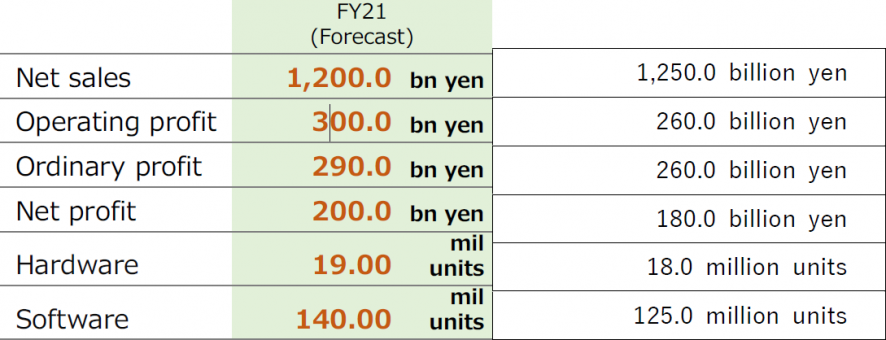
Right: Financial forecast for FY20
While FY20 was an overall net positive for Nintendo, its forecast for the 2021 fiscal year (FY21) is not quite so positive. Its forecast for FY21 ranges from as little as 8.3% less in net sales to as much as 22.7% less in net profits compared to FY20. This is not a huge surprise from Nintendo for multiple reasons, however. First of all, Nintendo far exceeded many of its forecast numbers for FY20 in terms of sales, profits, and overall units sold in terms of both hardware and software. Secondly, Nintendo is historically very conservative in its financial forecasts and these FY21 forecasts actually exceed most of its original forecasts for FY20 by a small margin. Lastly, the software lineup for the upcoming FY21 is largely empty at this point pending some sort of large announcement this spring/summer and may be further impacted by longterm COVID-19 related delays.
Speaking of COVID-19, the report outlines a number of thoughts regarding its impact both on the end of FY20 and the forecast going into FY21. It addresses some impacts to its production process but states that the delays are slowly recovering, but the report does go on to mention that if the situation is prolonged or worsens that product supply could be affected. The report also addresses the issue of the consumption of products as well. As a number of physical stores have been closed or otherwise hampered, the ability to move physical products, including games and hardware, may well be affected. It could even extend to its digital distribution and online services should events cause a disruption in the stability of its network systems. R&D is also a concern for COVID-19 impact as development schedules may be impacted by prolonged restrictions forcing work from home with this impact being more strongly felt where it involves affiliated companies, especially those from outside Japan. Lastly, as addressed earlier, currency exchanges are constantly fluctuating and it is unknown what those will look like with everything is over and how that might impact forecasts.
The report also goes into the performance of FY20 releases. Pokémon Sword and Pokémon Shield sold 17.37 million units and Animal Crossing: New Horizons sold 11.77 million units, bringing the total number of million-seller Switch titles to 27 total (nine of which are non-Nintendo titles). Animal Crossing: New Horizons, in particular, was noted as being the fastest-selling in the series with a six-week total of 13.41 million units sold, which is more than the lifetime sales of both Animal Crossing: Wild World and Animal Crossing: New Leaf. This also made it the fastest-selling game for the Nintendo Switch to date. They also note that over 40% of players of the new entry were female and that, among this particular demographic, many appear to have purchased a Nintendo Switch recently or specifically for the game itself.
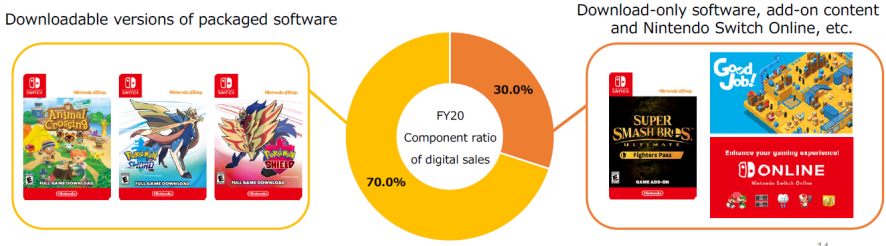
As a part of these impressive sales numbers, digital sales for both of these games, as well the entire Switch library, were higher. Digital sales (which consist of more than games) grew to an astounding 204.1 billion yen which is 71.8% more than the previous year with 34% of that coming from software sales. There is also a breakdown of digital sales and it shows that downloadable versions of retail releases constitute 70% of overall digital sales while the remaining 30% consists of download-only titles, DLC, Nintendo Switch Online subscriptions, and so on.
The report clearly shows that FY20 was another strong one for Nintendo despite what felt like a weak year to some. It does, however, further emphasize the uphill battle that they face in the coming year. With COVID-19 having as yet unknown impacts throughout the industry and the world, Nintendo has a murky future at best. This, on top of a release lineup that is practically non-existent at this point. While many of us hoped that Nintendo would have some big reveals for the remainder of the year at E3 2020, that is no longer the case and we may well not get any big announcements out of the Big N until late summer. It makes us wonder if Nintendo, in a lot of ways, is just taking the year off.