Before its launch, some might have worried that Tears of the Kingdom was just glorified, full-priced DLC for Breath of the Wild. That worry is completely misplaced. Not only is Tears of the Kingdom a worthy game in its own right, it is an absolute must-have for any Zelda fan. If you poured hours upon hours of time into Breath of the Wild, you will absolutely do the same here — possibly even more so — regardless of whether your last foray into Hyrule was six years ago or you have the entire map memorized. And if you haven’t played it, well, let’s say that this game is an experience like none other. Tears of the Kingdom is worth it no matter the circumstances.
Tears of the Kingdom was always going to face an unenviable task. As the successor to a revolutionary take on the open-world genre and winner of multiple Game of the Year awards, any small, safe step would inevitably be overshadowed by its predecessor’s giant leaps. And as a direct sequel, the opportunities that Tears of the Kingdom could take would naturally be restricted by the pre-existing world, characters, and plotline bereft of the defeated Calamity Ganon. For so many other game companies, this would be an impossible task.
But this is Nintendo. And Nintendo has done what they do best: taking some fun (and yes, sometimes quirky) mechanics and then turning the volume up to 11.
Borrowing from the Best while Expanding the Rest
On the game’s surface, Tears of the Kingdom feels a lot like Breath of the Wild. In part, Tears of the Kingdom continues the storyline that was left wide open for future expansion. But much more significantly this game borrows so very much from its predecessor. Yes, weapon durability is back. Yes, there are a hundred and change Shrines to complete. And yes, sigh, there is Korok poop aplenty to flush into Hestu’s magical maracas. In fact, it’s quite hard to not bring up its predecessor because they share so many traits. But to say that Tears only borrows from Breath of the Wild is to vastly undervalue all the new things it has created and expanded upon.
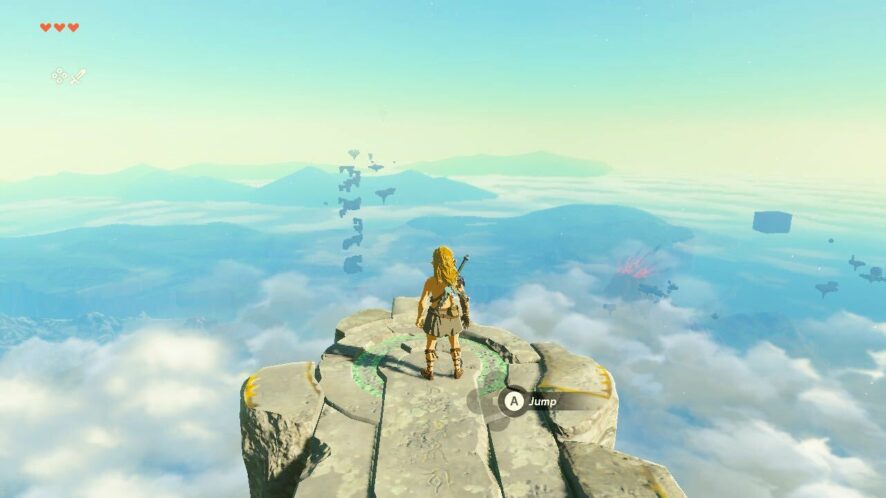
The first glimpses of Hyrule will completely take your breath away.Tears adds brand new ways to get from Point A to Point B.
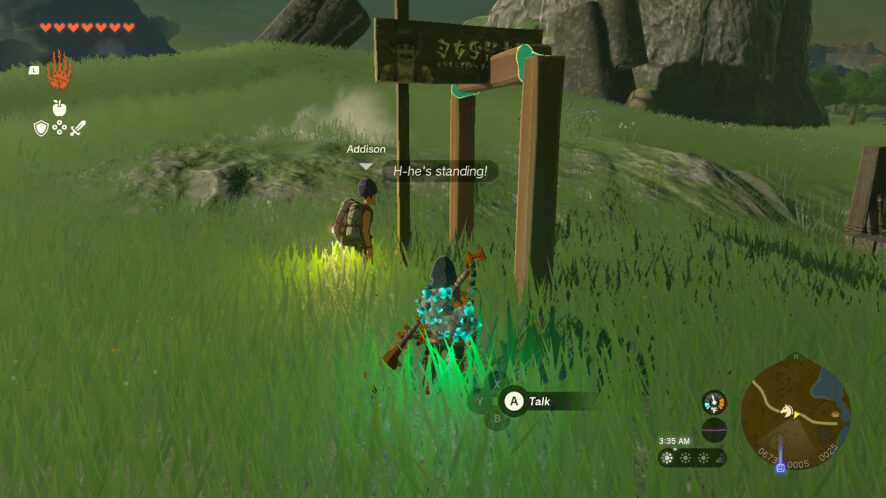
As before, Link begins the game in a tutorial area where you’ll spend the first hour or three (or maybe five!) learning the game’s primary mechanics before galivanting across the bigger world. The opening area is utterly massive. It doesn’t look that big on the map, but navigating from one place to another isn’t necessarily a quick task. And furthermore, there are lots of important secrets to find as well, so you’ll want to slow your pace and take a leisurely stroll amongst the beautiful palette of autumn leaves. Then as you wander, you’ll receive the primary tools of the trade — your four new abilities that will be your constant companions through the game’s challenges and puzzles.
To say that Tears of the Kingdom only borrows from Breath of the Wild is to vastly undervalue all the new things is has created and expanded upon.
Fuse allows you to combine just about any old object you find in the overworld — other weapons included! — and apply them to your swords, spears, shields, and arrows. Oftentimes, this is to merely increase a weapon’s durability or attack power. But there are many, many more creative solutions to be found as well: homing arrows, bomb arrows, makeshift sledgehammers, flame-throwing spears, and shields that will literally rocket you skyward. Everything you collect now serves an integral purpose in your inventory, and your first instinct when picking up any weapon should be how to get the most potential out of it.
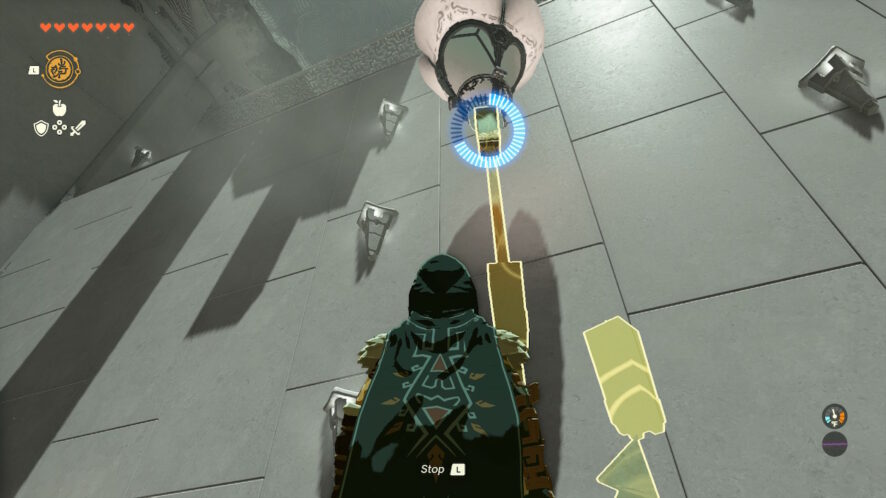
Ascend will change how you explore the world. If the ceiling or an outcropping above you is low enough, and the surface above that is flat enough, you can swim up through any amount of solid material to reach the top. It makes for a quick escape out of any cave system you might find yourself in, a fun way to explore buildings, and a poor man’s Revali’s Gale to quickly reach the top of hills given the right situation.
Recall is an enhanced version of Breath of the Wild’s Statis rune; instead of just freezing an object in time, it will send said object backwards in time as it returns to its point of origin. This works not only for objects that move on their own but also for any item that you’ve moved as well. The game is quite literally tracking objects and remembering their position through time. Once when I was being attacked by a Bokoblin riding a horse pulling a wagon, I was surprised that I could target the wagon, sending both it and the enemies backwards in time as well!
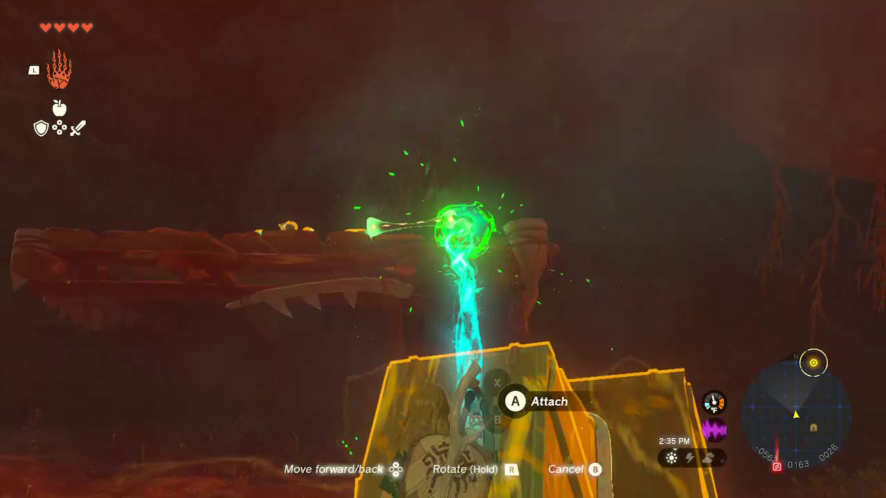
Ultrahand is the most utilitarian ability as you can build almost anything with it.Recall will pull its object backwards through time, but it still interacts with everything it touches.
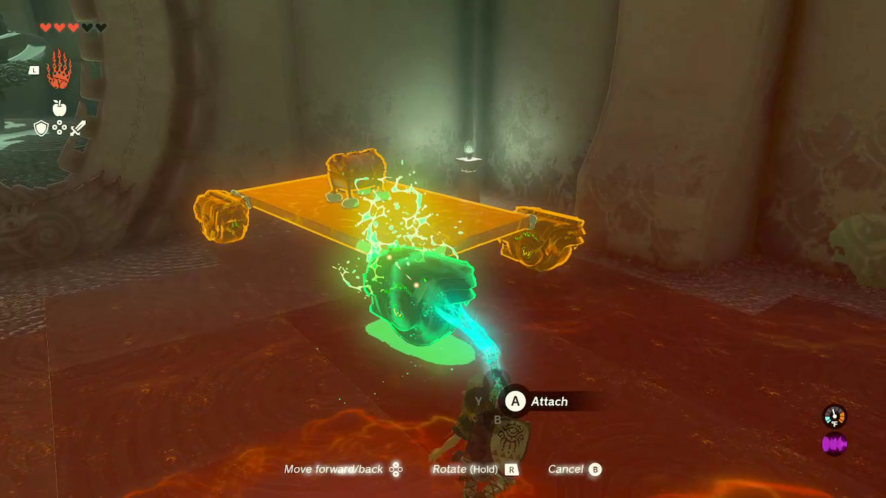
But the belle of the ball is Ultrahand, the most creative power the Zelda franchise has ever had, and this is the skill that gets the most love in the various shrine puzzles you will encounter throughout the game. This ability serves as the version of Magnesis you could only dream of having back in Breath of the Wild. It allows you to glue all sorts of random objects to each other to build boats, wagons, hot-air balloons, gliders, roller coaster carriages, and even laser-shooting mechas. And the game will put your grey matter to the test by asking you to MacGyver your way across large lakes with nothing but shoestrings and duct tape. That said, it will never accuse you of cheating should you do it a different way. Build an absurdly long bridge instead of a boat, and it is still a success for Link all the same. Just like in its predecessor, there are always multiple ways you can solve puzzles.
Some might be worried that this is going to tax their cerebral skills to the max and that they won’t be able to figure out any of the puzzles. And I won’t lie, I was stuck on one shrine puzzle for the better part of a half hour. Yet when I finally figured out a solution, it turned out to be different to the one my wife had used on the same puzzle. (I used Ultrahand and mechanical engineering; she used Ultrahand and Recall, for example.) Tears of the Kingdom doesn’t leave you completely hanging without any tips or pointers. Inside shrines, there’s usually example devices that demonstrate some basic elements to start playing around with. In the overworld, Ultrahand isn’t as important, and it can be used as much or as little as you like according to your personal tastes. But Hyrule is littered with basic tools — wooden planks, posts, wheels, and such — to allow you to be as creative as you like, if that’s how you’d like to play.
To the Ends of the Earth
When Nintendo first showed off Breath of the Wild, they made the casual comment that the Great Plateau, the game’s tutorial area, represented only two percent of the game’s overall playable space. This so perfectly illustrated the utter vastness of what Breath of the Wild brought to the Zelda franchise at the time.
Tears of the Kingdom’s opening area represents even less of the overall explorable gamespace. Sure, this would technically be true simply because there’s the scores and scores of Sky Islands above; however, the game adds way, way more for you to explore than just those. Skads of cave systems have opened all throughout Hyrule, adding a significantly subterranean aspect to the game that never really existed before. And, you know, just a suggestion, you could always jump into that gargantuan pit left over from Hyrule Castle rising into the air; you never know what you might find. (Make sure you’re suitably equipped first!!!) But seriously, I was left utterly gobsmacked when I realized just how big this game is; it’s utterly immense. Every time you discover a new aspect of the game that invites you to explore it, you will find yourself repeatedly in awe at the boldness of Nintendo’s developers.
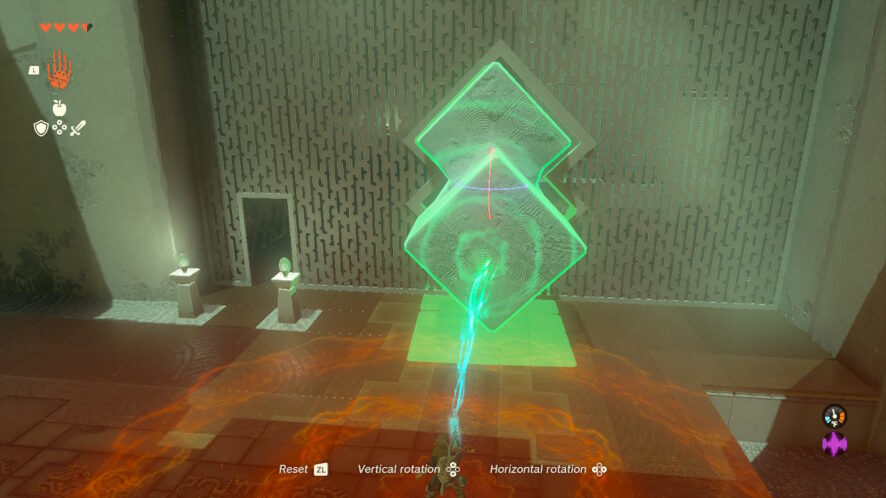
Just one of the many, many puzzles that need solving. Don’t worry, the challenge is in actually executing it.
A gargantuan overworld doesn’t work unless there’s a gargantuan number of things to do in it, but Tears of the Kingdom provides so much to do that it can be difficult to make up your mind what to do first! Shrines return in this game, and (to quote the famous Poké Rap) “there’s a hundred and fifty, and more to see.” These shrines will test you in a variety of ways. The early shrines will teach you the mechanics of your new abilities and give you some basic combat training. But once you leave the early game, the gloves are off, and the game will start to throw every possible challenge at you. And these puzzles are extremely creatively made to test your thinking caps. I’m thirty-some shrines in, and (barring a few of the combat training shrines) I’ve yet to find any two shrines that have been remotely alike.
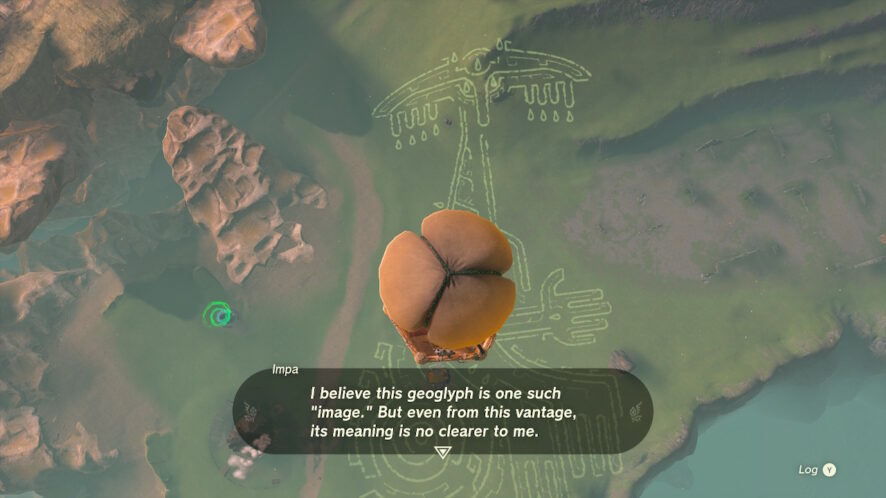
The world is also scattered with around a dozen “geoglyphs.” These crop circle-like patterns drawn upon the terrain have a mystery associated with them, and it’s up to the players to scour the landscape to find them all and unlock the mysteries secretly within. Tears of the Kingdom adds a lot of depth (quite literally) by providing countless cave networks dug into the cliffs. These caves will frequently hide several treasures, valuable items, and quite possibly a sweet piece of equipment. There’s a million and one Korok seeds to find, special enemies to kill and loot, and several NPCs who will splash some Rupees to you for every signpost you fix and well that you find. And of course, many of Hyrule’s landmarks have undergone significant changes since you’ve seen them in Breath of the Wild, so it’s entertaining just going to visit them to see what’s different.
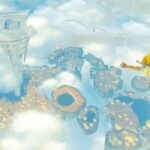
This just scratches the literal surface of the world. With the Sky Islands and more beyond, the only big choice to make is where to visit first.
Prepare for Trouble, and Make It Double
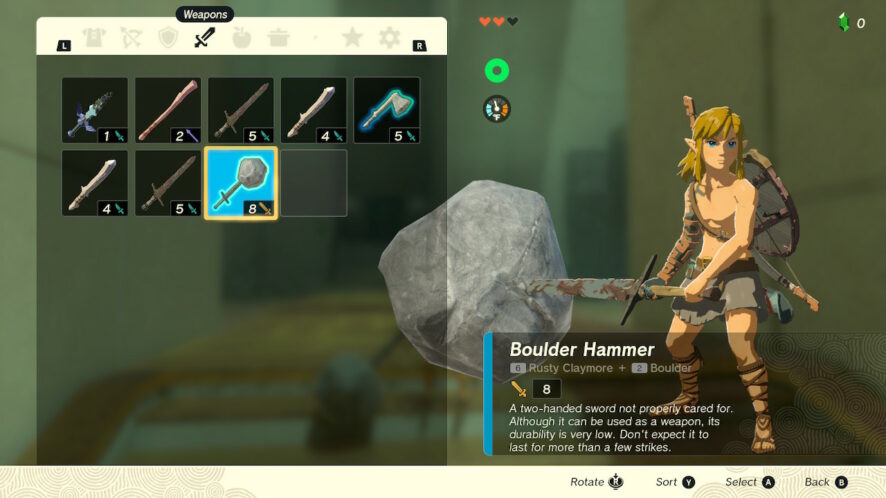
Of course, exploring the world isn’t any old walk in the park. On the contrary, you will be challenged early and often by countless scores of enemies. But Link has a trusty arsenal on hand ready to fight back. Outside of his magical abilities, Link carries an array of spears as well as one- and two-handed swords for melee attacks. And of course, there’s a good assortment of bows. You’ll soon find that finding particularly strong weapons is a lot harder than it used to be. Most of what you will find out there are wooden sticks and rusted claymores. And with weapon durability rearing its ugly head, you need something better. Suffice it to say, weapon Fusion becomes an integral and necessary component to survive the evil that plagues the land, so make sure you use it often as you explore.
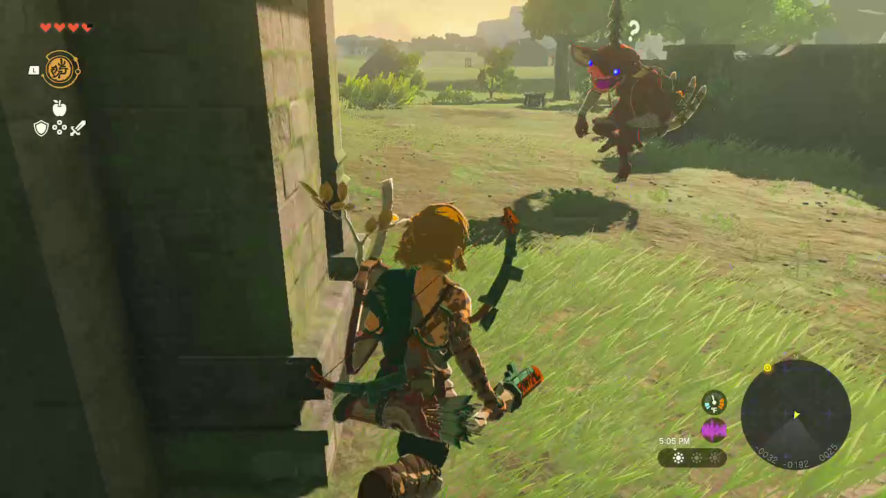
And that evil is more varied this time around as well. Yes, the staples of Bokoblins, Lizalfos, Moblins, Keese, Taluses, Hinoxes, and more all return for this game. But what is new is that some of them have learned new tricks, so you always have to be on your toes. In addition, Tears of the Kingdom adds in so many enemies, both enemies from Zelda’s extensive back catalog (such as Like Likes and Gleeoks) as well as completely new enemies to terrify you. These additions are a much-needed improvement as it keeps encounters fresher for far longer. And dare I say it, there are now many more encounters that seem infinitely scarier, especially when you meet enemies that will temporarily remove heart containers.
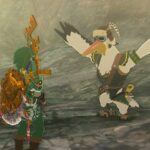
Most weapons aren’t fantastic until they’re Fused to something else.Even classic enemies have new tricks; this Bokoblin throws fireballs.
If you approach fights too casually, you will get wrecked very quickly. After all, it’s not just Link that has the power to Fuse weapons together. Many enemies have these advanced weapons as well, and it is very easy to get completely one-shotted. Thankfully, the game’s auto-save feature is generally good, and should you accidentally Game Over, you can quickly get right back into the action to try again. In fact, death generally doesn’t feel like failure; Tears of the Kingdom wants you to experiment and hone your skills as you play the game.
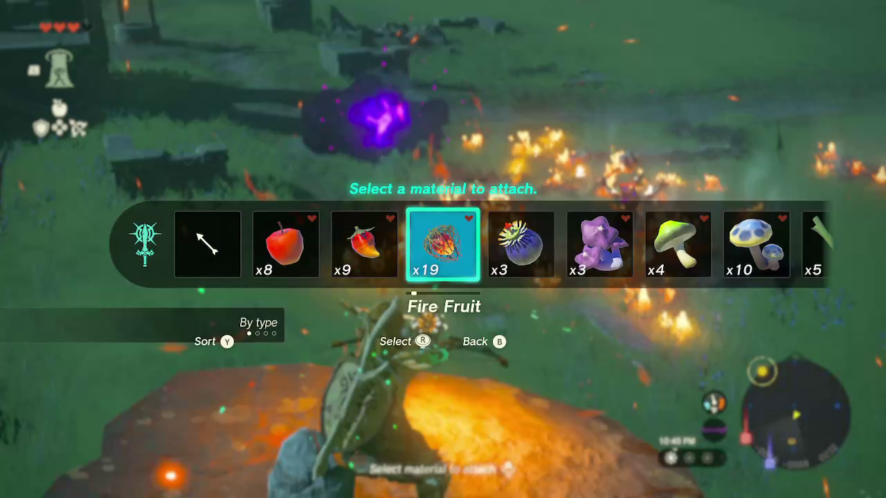
Perhaps the only complication with combat in Tears of the Kingdom is that the controls are slightly technical and, in some cases, cumbersome. While some may scoff at shrines that teach you the controls, I have found them extremely invaluable, especially since I never really mastered all the skills that Breath of the Wild had on offer (like parrying). These tutorials are important because some controls require pressing three different buttons in the correct order. Want to craft a fire arrow? Press and hold ZR, then press and hold D-Up, select your fire-based item from the long list of items with the right stick, and then let go of D-Up, then let go of ZR to fire. And there’s no real way to shortcut that process save that the item menu remembers the last item you selected. Eventually it will become second nature, but it takes a small bit of time to get used to.
Get used to seeing this menu; you’re going to be in here a lot.
Go with the Flow
I don’t want to (sky)dive too deeply into the story. And to be honest, I can’t say I have plumbed the full depth of the narrative or even the full scope of the primary plot. But if you’ve seen the official trailers for the game, you’ll already have a good idea of where the game is headed. While the beginning of the game is rife with plot and intrigue, most of Tears of the Kingdom involves gathering various bits and bobs of story and piecing them together like a detective. If you haven’t played Breath of the Wild, do yourself a favor and watch Nintendo’s catch-up video before diving in as it will help you make sense of the state of the world. Because, in a vague sense, the game expects you to have some of that background going in since this Link has already saved Hyrule once already. While the game will call out important characters and give you their bios, returning characters won’t directly introduce themselves to you; you’re already jumping into the middle of their (and your) stories.
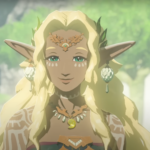
There’s so much to see and so many characters to meet.
As a result, the plot just flows and has an incredible smoothness to it. Plot lines and quest lines feel connected. It’s no longer just about NPCs asking you to accomplish random tasks and explore some other area before they agree to help you. Now it feels natural, like you’re going on a journey alongside other characters rather than just using them to achieve an objective. Nintendo has also consciously placed more significant quests into the game. They’ve even split the various sidequests into “Side Quests” and “Side Adventures,” which mirrors many other open-world RPGs like Horizon: Forbidden West by splitting out the richer activities that provide more characterization and narrative from the ones simply there to give you minor items.
Can I also just add that I love the fact most of the denizens of Hyrule recognize Link? Given that every other Zelda game portrays Link as some nobody from some backwoods town, it is refreshing to see that people know he’s the savior of Hyrule, greet him by name, and are genuinely curious about the recent goings-on he encountered during the game’s introduction. Seriously, so many people got the memo that Link and Zelda went off on some small adventure at the beginning of the game! We get to see Link telling NPCs what has been going on for once instead of the other way around. That said, I personally wish Link would get his own voice during the cutscenes because Link’s stark silence can cause brief moments of cringey awkwardness. Those moments aren’t many, but they do exist.
Just how “traditional” Tears of the Kingdom‘s dungeons are will be a matter of debate that will likely rage on social media and forums in the years to come.
Of course, what Zelda game is complete without dungeons? For starters, there are no more Divine Beasts to speak of; all that ancient Sheikah technology has disappeared into the ether. So of course, there’s something else awaiting at the end of each of the main plot lines. Personally, while I’ve only seen one of the dungeons this game has to offer thus far, I will say without a doubt they resemble a more “traditional dungeon” experience than Breath of the Wild. Just how “traditional” they are will be a matter of debate that I’m sure will rage on social media and forums in the years to come, but I believe most long-time fans will prefer these dungeons over the Divine Beasts of yesteryear. To say much more beyond that would delve too deeply into spoiler territory.
Given that Tears of the Kingdom is so big in so many ways — the vast world, the seemingly limitless creation mechanics, and the deeper cast of characters and enemies on display — one thing I have heard over and over from talking to other people playing the game is that everyone is amazed this game can run on the Switch. Given that the Nintendo Switch is just over six years old and was, comparatively speaking, underpowered compared to its then-competitors the Xbox One and the PlayStation 4, Tears doesn’t fall over on its face the way many other games do. Seriously, there are so many games with game-breaking bugs or completely janky glitches, and overall it runs solidly! There’s very, very few bugs (surprising, given the limitless capacity of Ultrahand!), though occasionally the camera can get caught up when you’re trying to assemble your clever contraptions.
It is utterly astonishing that this game works as well as it does on the hardware it runs on.
Despite it all, the frame rate usually maintains a steady 30fps, only dipping below that in certain areas or when starting up Link’s abilities. Moreover, the loading screens are significantly shorter than they were in Breath of the Wild. Sometimes, you won’t get time to read many of the helpful tips the loading screens provide before you’re back into the game. The only downside to the experience is that your Switch’s fan will be running nonstop while playing. Tears of the Kingdom certainly pushes the hardware to the max.
Off the charts
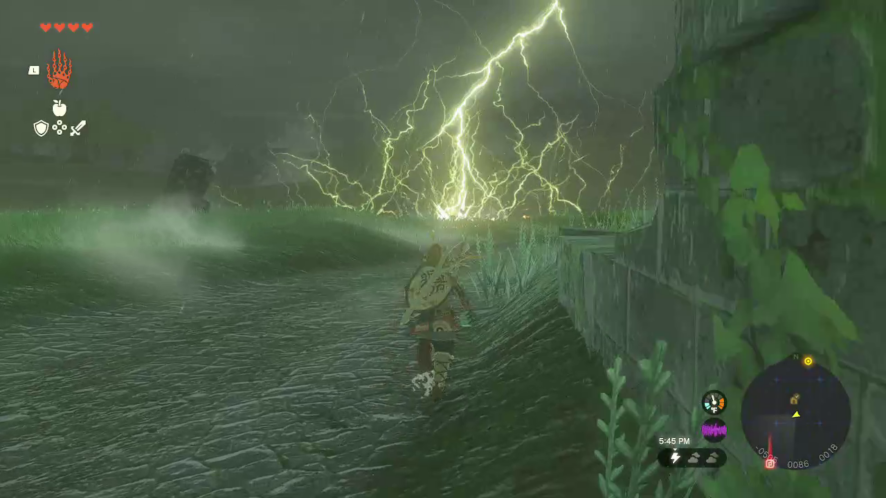
Tears of the Kingdom is the kind of game that gives me an insidious urge to take a day off work and call in sick so I can play. When forced to leave Hyrule to do my normal adult responsibilities in the real world, I am left daydreaming of Hyrule and hoping I can get back to Zelda as soon as possible. And I’ll be honest, I’ve already lost so much sleep since this game came out because it’s so easy to want to do “just a little bit more,” and this is something that few games give me. It’s easy to say that Nintendo has scored a huge win with Tears of the Kingdom. And considering that, just like its predecessor, there is a strong community vibe where everyone is sharing the crazy things they’ve found — or made — in the game, it lets you know that lightning has struck twice with Tears of the Kingdom.
The odds of lightning striking twice with this game world are so small, yet it happened.
Six years ago, when I reviewed Breath of the Wild, I declared that game to be the best Zelda game to date and gave it a 10/10. So now I am faced with the impeccable dilemma of how to score this, a game that’s not just a bigger, wider, and inherently more creative version of Breath of the Wild but also recontextualizes everything we knew about the original. Yes, you might remember where all the Shrines and old town ruins are in the prequel, but that doesn’t mean you know where to find things this time around. You still need to re-explore everything. For some, maybe a little bit of that magic will be lost by it not being completely fresh, but I really want to revisit every little vista, back alley, and hot spring to see if there’s something new waiting around the corner. So far, it hasn’t diminished my experience whatsoever. Besides, I know all these places have changed, and I long to go and visit my Hyrulean friends and see how life has fared for them.
Tears of the Kingdom is a game that absolutely cannot be missed.
If I could give Tears of the Kingdom an 11 out of 10 without making a complete mockery of our scoring system, I would be sorely tempted. To quote the movie This Is Spinal Tap, “the numbers [on this amplifier] all go to 11; it’s one louder.” That’s exactly my feeling with Tears of the Kingdom. My ardent recommendation for you is this: Tears of the Kingdom is a game that absolutely cannot be missed. There are very, very few games out there quite like it. So do yourself a favor and give it a go. You honestly won’t regret it.
Score
Similarity to other Zeldas
10/10
Breath of the Wild – ▲▲▲▲▲ A Link Between Worlds – ▲▲▲▲△ The Wind Waker – ▲▲▲△△ Skyward Sword – ▲▲△△△
David Johnson
David Johnson, a.k.a. "The Missing Link," was once the webmaster of both Zelda: The Grand Adventures and ZeldaBlog. He works as a software engineer in the games industry. David also pontificates about Zelda, writes features and guides for ZU, and obsesses about CD-i.


 by David Johnson on May 19, 2023