Fitness games have had an interesting journey through the annals of video game history. From the Power Pad on the NES to Dance Dance Revolution’s dance mat, they have seen a lot of ups and downs. It wasn’t until the launch of the Wii and Wii Fit when fitness games became a huge deal. Why just play video games or just go to the gym when you can do both at the same time?! That proved successful as Wii Fit (and its enhanced version Wii Fit Plus) sold a combined 43.8 million units, making it one of the best-selling games of all time, even beating out games like The Elder Scrolls V: Skyrim.
Since then, everyone has tried their version of a fitness game, but nowadays fitness games are becoming less common. Once people started getting tired of that type of game, most companies and developers changed course and began work on other things. Not only that, most fitness games present themselves as exactly what they are. “Oh you’re called ‘Fitness Boxing’? So you box to the beat and do fitness? Cool.” They stay in their lane and don’t try to be anything else.
This is where Ring Fit Adventure, the latest game from Nintendo EPD, tries to break the wheel. From the initial teaser in early September to the announcement trailer, we saw people having fun with a ring and a strap, and then we found out it was an RPG. It feels like someone went, “Final Fantasy, but Wii Fit?!”
It’s not exactly a combination you’d think were synonymous with each other. However, Ring Fit Adventure manages to blend them well enough to harbor an enjoyable experience while also making you sweat.
Full Disclosure
Nintendo of America graciously provided us with a review copy of Ring Fit Adventure for the Switch. This review is based on version 1.1.1. As such, the new additions will be accounted for.
Meet the newest Switch accessory
What’s interesting about Ring Fit Adventure is that it markets itself as an adventure game. You fight monsters, explore fictional lands, and collect items on your quest. It just so happens to be an adventure game that you control with your body.
Ring Fit Adventure’s centerpiece is the unique pair of controllers you use: the Ring-Con and the Leg Strap. The Ring-Con is a heavily modified Pilates ring. The main difference is that Pilates rings normally have two hard plastic handles with concave sides with padding so it can be comfortable when doing thigh workouts. The Ring-Con replaces those handles with some small padding for your hands. As someone used to a normal Pilates ring, it feels a little strange, but it’s something you get used to. Then there’s the Ring-Con attachment itself, where you put the right Joy-Con. The Joy-Con’s accelerometer and gyroscope detect the Ring-Con’s position, whether you’re pushing in on the sides or pulling them away from each other. The IR sensor also tracks your heart rate by placing your right thumb over the sensor. It seemed to be fairly accurate, as it was within a 1 or 2 bpm difference when compared to my Apple Watch.
The Leg Strap is far less high tech — it’s literally a thing that you strap to the center of your left thigh and put the left Joy-Con in. That’s it. The Joy-Con itself does the work of making sure your leg is in the right position for the exercises thanks to its gyro and accelerometer.
Admittedly, the story doesn’t try too hard to immerse you, but it still tries.
At the end of the day, however, the technology is nonetheless impressive.
One thing I do appreciate about the game is that Nintendo tries to make this game a circular experience. When you load into your file, the game asks if you want to warm up with some dynamic stretches before you jump in so you can get your body ready and avoid straining or injuring yourself. During the game itself, it’ll ask you after a while if you want to keep going or cool down. When you decide you’re done for the day, the game asks if you want to do some static stretching as a means to cool down. This structure gives a nice arc that, as someone with a movement background, I appreciate.
I’m going on an Adventure!
The story is fairly standard. You control an athlete who meets a sentient ring, and together you explore the world and fight a bodybuilding dragon named Dragaux (yes, you read that correctly). You explore many worlds, help people along the way, and gain new abilities by constantly butting heads with Dragaux.
The plot is cookie cutter, but it also doesn’t try to be anything it isn’t. The basic story line works here. It’s moderately self-aware in parts, and it’s mostly enjoyable. It’s a tad basic at times, and Ring (the only character who is fully voiced) tends to repeat lines a bit, but it’s not enough to ruin the experience.
Expecting too much from the story would be a mistake, but it will help you pretend it’s not just exercise.
The game itself is very straight forward. Levels consist of two different modes — exploration and combat. The exploration is on rails, which makes sense because you move in one of two ways, either jogging or running in place or by doing small bends (what Nintendo calls “silent mode”). Silent mode is supposed to be a way to play the game without disturbing people by running in place. It was also the mode I used more because I dislike running.
As you traverse the levels, you can pull and push the Ring-Con to release gusts of air to hit boxes and suck up coins. Additionally, you can use the Ring-Con in other positions for specific actions, like pointing it down in order to jump, twisting it from side to side to row across a river, or pushing inward with your abs to destroy rocks blocking your way. You’ll gain experience as you continue, making you more formiddable in combat.
Speaking of combat, it plays out like a traditional turn-based RPG. You attack by doing various exercises from one of four different groups: Arms (upper body), Stomach (core), Legs (lower body), and Yoga (dynamic poses). The game telegraphs how long you hold the pose and then the release of it triggers the attack. Some of the exercises make you hold position for a while (the squats are rough), while others have you move to the beat. Certain enemies are affected more by specific moves; for example, red enemies are susceptible to exercises focusing on upper body. You get to decide what exercise to use, or you can shuffle the exercises, so there is a variety. The game also aids you in combat with lots of outfits and smoothies, Ring Fit’s equivalent to potions. Outfits have a set attack and defense stat like any armor in a typical RPG. There are also smoothies to consume, which have various effects ranging from from healing damage to boosting attacks of a specific type.
You face Dragaux multiple times through your adventure, and he does have some variety in his attacks. He’ll occasionally throw boxes at you that you have to shoot with the Ring-Con, in addition to just flat out attacking you. The game also doesn’t penalize you should you die in boss battles either — it will let you just skip right to the boss fight if you want to. That choice is nice.
Ring Fit Adventure sticks fairly well to many traditional RPG elements.
That includes the nemesis that monologues and swears this meeting will be the last.
It’s not as complex as franchises like Final Fantasy or Pokémon, but it does enough to be enjoyable. And with 20 worlds to explore, there is enough content here to last you at least 20-30 hours of just adventuring alone. Additionally, during your quest, you’ll come across certain minigames. These minigames, like trying to get points by tilting your body side to side, add an extra bit of variety to the overall gameplay.
Ironically, where Ring Fit Adventure drops the ball a bit is in its overall design and music. When I think of an adventure game or an RPG, I expect a vast array of beautiful trees, vistas and dungeons. Ring Fit sets its levels in one of three locations — a trail through nature, where you explore vistas and go through caves; a wooden obstacle course built in a dojo-looking area complete with treadmills, hoops, and more; and a ruins area for the boss fights. It got to a point where I noticed how often the areas cycle between each level. After a while, it does start to feel stale.
Ring Fit Adventure’s music is pulsing, upbeat, and modern to pump you up, but most of it is also forgettable.
Music is vital to how RPGs and adventure games create the mood you should experience in combat and cutscenes. Ring Fit’s music is pulsing, upbeat, and modern to pump you up for the exercises you perform. This is great for a fitness-centric game; however, most of the music is a bit forgettable. The music often gets drowned out by the sound effects and Ring’s lines, and, when you do hear it, it doesn’t really feel like I’m a hero exploring the world and fighting monsters. I feel like I’m in a fitness studio. For a game that’s marketed to be an adventure game first, it feels like they came too short.
Additional fun to be had
Of course, the adventure is only one part of Ring Fit Adventure. The game also provides some additional modes if you don’t have time to spend on the main campaign. The Quick Play mode has a fairly robust set of minigames and exercises you can do, separated into three categories: simple challenges (where the goal is to get the highest reps possible); minigames (more specific exercise with concrete goals, like making pottery while squatting to raise and lower the hands); and sets (consisting of pre-selected exercises from upper arms to glutes or from aerobics to flexibility). You can adjust the strength setting to make things easier or more challenging depending on your ability, and these modes are a very good way to quickly target a small set of muscles.
Your scores for these are also put online to see how well you stack up against other players. At this point, the rankings are all that online is really utilized for. It’s sort of disappointing that Nintendo didn’t add a way to play the adventure mode with online co-op, but maybe that’s just me.
There’s also Custom Mode, where you can make your own workouts using all sorts of different exercises. They have some preset options, or you can pick and choose from the standard Upper Body, Core, Lower body, and Yoga menus.
At least the devs acknowledge you’ll be binging Netflix at some point. “Multitasking,” indeed.
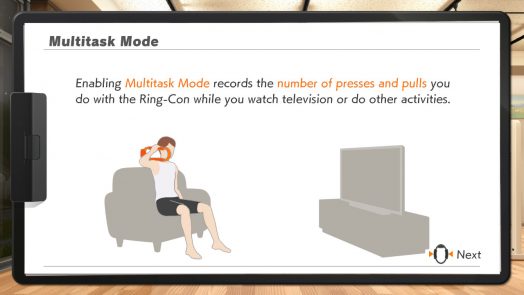
Lastly, there’s Multitask Mode, where you can work out using only the Ring-Con while you’re not playing the game. Basically it records the number of presses and pulls you do with the Ring-Con while the Switch is in sleep mode or turned off. Once it’s enabled with the right stick, you can continue doing other activities, like watching The Mandalorian on Disney+ (at least that’s what I’m doing) and exercise while you do it. The next time you boot up the game, you’ll get a bonus in the Adventure Mode according to how many presses you did. It does limit you to 500 reps, which seems low to me, but considering that most people are going to just sit and watch a movie or a TV show for more than two hours while exercising, I understand.
A nice way to gamify exercise
Despite the story falling a bit short, Ring Fit Adventure is still a very enjoyable experience with a lot of replay value. It has several different modes to play, a terrific variety of exercises, and is great if you want to get some workouts in when you don’t feel like leaving the house because of bad weather. If you’re a fan of the hardcore mechanics of RPGs like The Elder Scrolls, Final Fantasy or Pokémon, Ring Fit may be basic, but that’s not what it places its emphasis on. The mechanics are accessible so that anyone can pick it up and enjoy it, and maybe It’ll get people into traditional RPGs. The only thing holding it back is not doubling down on the adventure/RPG genre in terms of scenarios and music.
Score
7.5/10
Alex Rosenberg
Alex Rosenberg is the Media Director for Zelda Universe. Outside of Zelda Universe, he is a multi-faceted performance artist and Twitch Streamer.


 by Alex Rosenberg on November 25, 2019
 What’s interesting about Ring Fit Adventure is that it markets itself as an adventure game. You fight monsters, explore fictional lands, and collect items on your quest. It just so happens to be an adventure game that you control with your body.


 Speaking of combat, it plays out like a traditional turn-based RPG. You attack by doing various exercises from one of four different groups: Arms (upper body), Stomach (core), Legs (lower body), and Yoga (dynamic poses). The game telegraphs how long you hold the pose and then the release of it triggers the attack. Some of the exercises make you hold position for a while (the squats are rough), while others have you move to the beat. Certain enemies are affected more by specific moves; for example, red enemies are susceptible to exercises focusing on upper body. You get to decide what exercise to use, or you can shuffle the exercises, so there is a variety. The game also aids you in combat with lots of outfits and smoothies, Ring Fit’s equivalent to potions. Outfits have a set attack and defense stat like any armor in a typical RPG. There are also smoothies to consume, which have various effects ranging from from healing damage to boosting attacks of a specific type.


 Despite the story falling a bit short, Ring Fit Adventure is still a very enjoyable experience with a lot of replay value. It has several different modes to play, a terrific variety of exercises, and is great if you want to get some workouts in when you don’t feel like leaving the house because of bad weather. If you’re a fan of the hardcore mechanics of RPGs like The Elder Scrolls, Final Fantasy or Pokémon, Ring Fit may be basic, but that’s not what it places its emphasis on. The mechanics are accessible so that anyone can pick it up and enjoy it, and maybe It’ll get people into traditional RPGs. The only thing holding it back is not doubling down on the adventure/RPG genre in terms of scenarios and music.