We all want to be the very best, like no one ever was. To catch them is our real test and to train them is our cause. With Pokémon Sword, this is even more true. If last year’s Pokémon Let’s Go was more about updating the first generation of Pokémon while implementing features of Pokémon Go into the mix, then Sword borrows these mechanics, opens up the world, and reveals bigger ambitions for the eight generation of Pokémon.
The story begins in a much more familiar manner, where a youth begins their journey in a small town, working their way through the region, catching monsters, and earning gym badges in order to take on the current champion of the Galar region and claim their title. The region in Sword and Shield draws heavy inspiration from the United Kingdom. The grassy countryside of Postwick has a vertical layout with cascading viridian grass, plowed land ready for crops, and lovely brick-sided dwellings. The location is ideal as a starting area and reveals how the characters are all tied into the game’s story, piece by piece. Your character just happens to be friends with your soon-to-be rival Hop, who is the younger brother of the regional champion named Leon. It is from a hometown visit that Leon gifts you and Hop both your starter Pokémon and endorses you into the Gym Leader challenge.
What is interesting here is the set-up of different character involvements when compared to the norm for Pokémon. For example, it isn’t the professor of the region that grants you your first Pokémon, but rather, the reigning, undefeated champion. This swap of a mentor who simply guides you to one whom you must overcome is a breath of fresh air for Pokémon and a welcomed one at that. Likewise, the entire narrative is more connected and linear in a great way, with characters that differ in what their interests are and who take on some dynamic development throughout the entire adventure. Not only does the main character grow in strength and notoriety as they take down each gym leader, but the rivals vary in what drives them to compete against your player character. This helps diffuse some of the flat character development of the rivals and other important figures from past Pokémon games and helps to make Sword and Shield a more cinematic game.
Pokémon Sword, being a main series game, takes one of the biggest issues generated from Pokémon Let’s Go and fixes it. Instead of having to catch Pokémon through the usage of berries or Pokéballs in the same manner that Pokémon GO did, players have to do things the old-fashioned way and battle the Pokémon down to low health, chuck a Pokéball, and pray to the random number generator that the catch rate is forever in their favor. Different types of Pokéballs make a remarkable return, adding to the variation of landscapes and capture situations one might find themselves in while searching the Galar region. Battles are also refreshed with series staples like abilities and items/berries that Pokémon can hold, something absent from Pokémon Let’s Go.
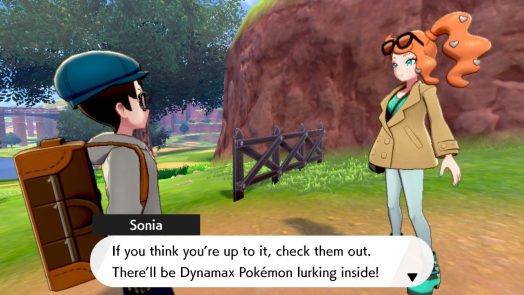
Sonia, the Galar Professor’s granddaughter, follows you along your journey and assists the player.
The game also adds in features that players have been begging for as the generations have rolled through: the ability to use Pokémon boxes in the field, no need for Hidden Machines to access areas, the experience all being always on, as well as the ability to actually customize the player character on such a deeper level than seen before. Technical Machines make a return and allow you to teach the same move to your Pokémon through repeated use, but now there is a different category of moves called Technical Records that break after a single use, meaning that the move is only able to be taught once before the Technical Record breaks.
The last few generations of Pokémon have had some sort of new gimmick that has been tacked on, such as Mega Evolution or Z-moves, and Sword’s Dynamax/Gigantamax concept seems to follow in this tradition. During gym battles, Pokémon can grow to epic proportions and gain more powerful moves. This phenomenon adds a layer of spectacle to the already broadcasted feel that each gym challenge represents. The only underwhelming aspect is that each gym leader saves their last Pokémon to Dynamax, essentially forcing the player should save their option to Dynamax for the end.
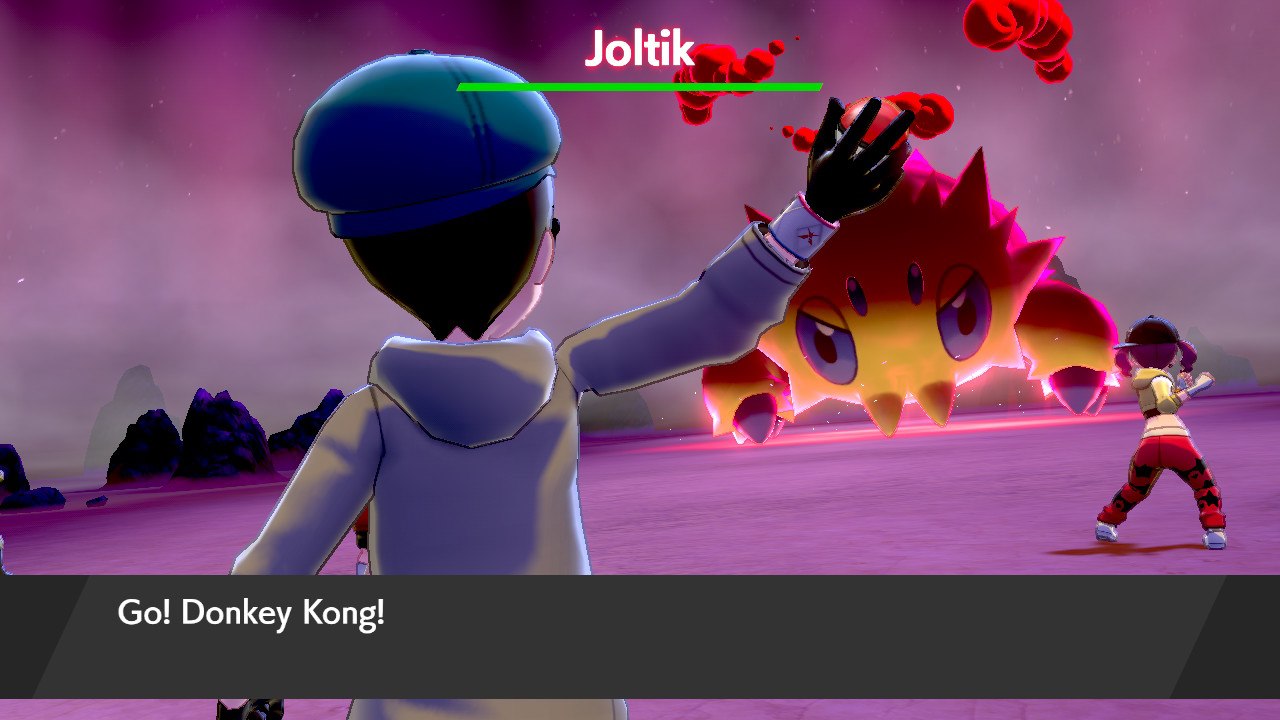
Where the mechanic shines is when players encounter Dynamax Pokémon in the wild that they can then tackle with either three other live players or through NPCs that the game generates. During a Dynamax raid, the objective of the players is to defeat the Pokémon so that they each have the ability to gain items and potentially catch the Pokémon. While this takes away the general strategy of bringing a Pokémon’s health down to critical levels, it does add another level of strategy for each of the player’s Pokémon to work together to bring down a much stronger opponent. Some specific Pokémon take on another form, much like Mega Evolution, and are referred to as Gigantamax Pokémon. In a way, Dynamaxing and Gigantamaxing combines both features of Z-moves and Mega Evolution into one literal giant package.
Dynamax in the wild. Here, my player character is being assisted by three NPCs.
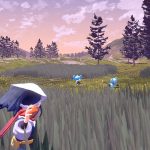
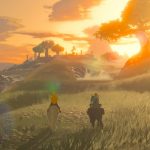
In what seems like a cue from Breath of the Wild, the Wild Area is where players can encounter Pokémon in an open world setting. Players can now see what Pokémon roam in specific terrain types, decide if they want to battle it, or avoid it completely. This helps in cutting out random encounters to a degree, although players can still sneak around the grass and find patches with randomized Pokémon in them. These ‘mons are usually rarer and harder to obtain although most you will be able to identify from their overworld model roaming about. Some Pokémon will even come after the player and charge forward, while others will run away from you. With this level of exploration, players can spend many hours in the Wild Area. In order to keep players on track with the story, the gym challenge limits what level of Pokémon a player is able to catch, simply meaning the more badges a player has the higher level of Pokémon they can capture.
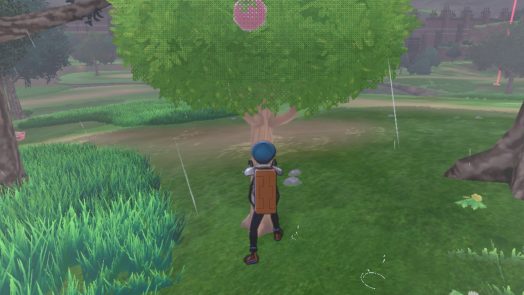
In the Wild Area, shaking a berry tree in order to collect ingredients for curry.
Players will also find the Wild Area containing large amounts of items like berries, battle items, evolution items, and other collectibles to pick up. Another similarity to Breath of the Wild includes the ability to cook in the game to increase your Pokémon’s abilities. In a sense, you gather berries and combine them with other ingredients to make curry at camp. Setting up camp allows the player a chance to interact with their Pokémon to increase happiness, heal them of their status problems, or even heal their hit points. Once you are finished playing with your Pokémon by either using a bell-like toy or by throwing bouncy balls for your Pokémon to fetch, then it’s time to cook. Once you select different berries for the desired effects, you have to fan the flames, stir the pot, and see just what kind of dish you end up with. Successful dishes award experience points and other buffs, such as health refreshes, status refreshes, or happiness increases.
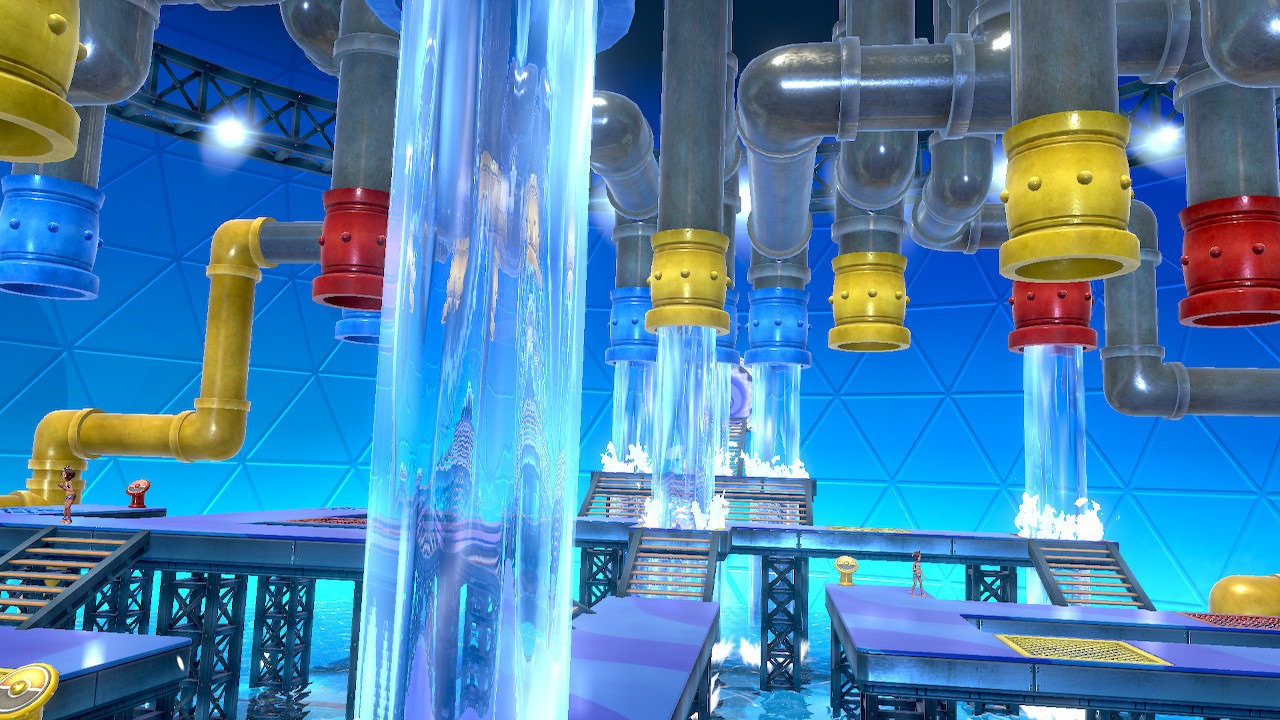
In terms of graphical prowess, Pokémon and the environments have never looked more stunning. Unlike the cel-shaded graphics of Sun and Moon, Pokémon have fresh new looks and interact with the watery lakes, gem-lined caverns, and even the desert-swallowed ruins of their surroundings very well. In each town, the respective element of the gym is somewhat generalized from an outside perspective. Once you enter the gym, things change completely. Each gym has a challenge that trainers must complete before they face off with the head honcho of the gym. These challenges are usually mini-games or puzzles. The very first gym’s challenge involves herding the sheep Pokémon, Wooloo, to the next section of the gym so that they may break through the barrier set up to keep you out. Small touches like that make each gym feel unique. You aren’t going into each gym to just fight the fledgling trainers guarding their boss, you have to complete the challenge while also fighting off the trainers. The charm and individuality of each gym’s interior is stunning and memorable. The water gym had a water-pipe challenge where the pipes looked like something out of a Mario game!
To whet the trainer’s proverbial appetite when it comes to interacting with others who own the game, Sword allows you to join up with others using the internet to battle one another, trade Pokémon, trade league cards, and even request help with raids. These can be randomized or completed with friends. Other trainers will actually pop up in the Wild Area map to a certain degree to where the player can interact with them and see them moving in real-time, which is a nice feature in such a big environment. The only negative to this is that the native service on the Switch is a little cumbersome to use, so players will probably opt to find other trainers in a separate service like Discord to gather parties and tackle raids. It would have been a lot better to enable some form of communication so that players knew what they were doing as a team when facing off against a Dynamaxed or Gigantamaxed Pokémon, instead of having to guess and hope that the other players have a clue as to what the party needs to accomplish.
The game’s soundtrack is amazing with catchy tunes and unique instrumentation like Team Yell’s battle track containing screeching metal guitars. The Gym Leader Battle track has chanting incorporated into the background to increase the feel of a live audience clamoring in anticipation of what your Pokémon’s next move is going to be. Different instruments like bag pipes and different progressions of music add to the feel of a region truly inspired by the United Kingdom. The game incorporates familiar sound effects like menu sounds, the Pokémon Center healing song, and even the trading sequence song to stay familiar to longtime fans.
Pokémon Sword takes the best parts of Pokémon Let’s Go and adds the features that main series Pokémon fans have been dreaming of making a come back. The Galar region is charming and has such an interesting layout that clearly shows the inspiration of where the developers took cues from. Characters are dynamic and break the mold with how they grow and develop within the setting. There is plenty to do when it comes to the main story, the Wild Area, and the post-game content. Although many have complained about the decrease of Pokémon from the National Pokedex, it does seem like a great refresh in order to make things more memorable for the region. The new Pokémon have great designs and add plenty of variety to the pool of Pokémon available to choose from. With Sword, The Pokémon Company has also made it easier for casual players to get involved with the competitive side of Pokémon by allowing players the opportunity to deeply edit the stats and natures of their Pokémon. You can now maximize their effectiveness in battle without having to grind as much, keep spreadsheets, and rely heavily on the random number generator for success.
Pokémon Sword is a wonderful game and I encourage anyone, newcomers to hardcore players alike, to give it a swing.
Score
8.5/10
Brian Pope
Brian Pope is a loving father of two, a musician, writer, and all around Zelda enthusiast. When he isn't writing, he is playing games, writing music, or enjoying life with his two sons. Oh, and he likes Pokemon.


 by Brian Pope on December 31, 2019