Let Us Awaken, Together: Jungian Psychology in Link’s Awakening
 by Erin Roll on December 21, 2021
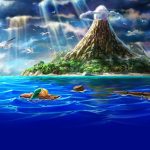
From the moment Link washes up on the shores of Koholint Island, we know that Link’s Awakening is going to be a strange and weird game. The game takes Link and the player into a world of dungeons, caves, dreams, and nightmares, leading up to the final battle atop Mt. Tamaranch.
This journey is not simply a physical one, but a psychological and spiritual one as well. Much of this ties into the studies of psychoanalyst Carl Jung, who wrote at great length on archetypes, journeys, and the Shadow.
Link’s Awakening, of course, is meant to be a video game first and foremost, rather than an honest-to-Hylia study in Jungian psychology. By the same token, this article is not meant to be a full-fledged treatise on all things Jung. But the game does present many different ways of talking about the psychology of dreams, nightmares, and the symbolism of the quest.
Jung died in 1961, a good two decades or so before video games became commonplace. It is interesting to speculate what Jung would have made of The Legend of Zelda series and other such games. Barring that, we do have the scholarship of many writers and gamers who have done their own studies on the psychological themes in video games.
It’s Dangerous to Go Alone
Link’s Awakening, like all Zelda games, is very much a quest story. Link sets out at the start of the game, and has to work his way across the land, including through dungeons and caves, to the ultimate goal: in this case, waking the Wind Fish.
Steve Kuniak is a contributor to The Psychology of Zelda: Linking Our World to the Legend of Zelda Series, which is a collection of essays on the psychological themes in the games. In his essay, “It’s Dangerous to Go Alone,” Kuniak finds parallels between Link’s quests and the Hero’s Journey pattern established by Joseph Campbell – who was himself influenced by Jung. Kuniak says that the Hero’s Journey is one reason why The Legend of Zelda has stood out among other adventure-themed video games over the decades.

“The continued success of the Zelda franchise exemplifies the strength of its ability to create a bond with us. Link was one of the first heroic characters with whom we could heft the sword and shield and march off to make a difference in the virtual world, and he remains one of the most effective, as well as one of the most enduring, in creating a bond with gamers.”
(Kuniak, Steve. The Psychology of Zelda, pg. 57)
In other words, the quest allows the player to grow and become more experienced with Link.
Link’s journey in Link’s Awakening is a symbolic life: he is washed up from the sea in classic shipwrecked hero fashion. It is a symbolic birth, in a helpless state. He requires healing and nurturing from Marin and Tarin before he is strong enough to go venturing out. His final battle with the Nightmares and encounters with the Wind Fish are a symbolic death before another rebirth or awakening, this time back out on the sea.
The Dreaming Island
Within moments of Link’s arrival on the island, the Owl flies down and explains to him the story of the Wind Fish, who at that moment slumbers in his egg atop the mountain. Link’s ultimate task is to awaken the Wind Fish.
The implication in the game is that the island is a product of the Wind Fish’s dream. However, we are asked to wonder if this is truly the Wind Fish’s dream, or if it’s Link’s dream as well.

The music is a symbol of this. The Mabe Village theme, for much of the game, seems to contain elements of “Zelda’s Lullaby” and the Kakariko Village theme. The recurring music, in a way, is part of the collective unconscious. These are themes that have appeared in most Zelda games, so we could say that they are a part of the series’ ancestry. The notes from “Zelda’s Lullaby” also add a sense that this is a sleeping, dreamtime world.
The remake of Link’s Awakening adds an extra little touch that wasn’t present in the original 1993 Game Boy version. The edges of the screen are always blurred, so that you can’t see what’s beyond your current screen until you move. We may suggest that this was intended as a graphic design decision by the programmers and designers — that it just looked better on the screen — but it adds a certain dreamlike haze to the game’s landscape.
The Potion Shop, the Ocarina, the Graveyard, and other such people and places that routinely show up in Zelda games appear in Link’s Awakening, but in modified forms, much as a dream would take everyday things and mix them up a bit.
The challenge of the Dream Shrine, meanwhile, presents a dream within a dream. Link must lie down on the bed and go to sleep in order to face what lies within the shrine, and solve the puzzle therein. This may be taken to symbolize a further descent into the subconscious or the unconscious.
It is rather telling that the Nightmares that Link encounters inside the Wind Fish’s egg take the form of Link’s own enemies. An eagle-eyed player can recognize the forms of Ganon and Agahnim from A Link to the Past. Other enemies take on the forms of bosses that Link has previously battled in the game, like the Moldorm. So this helps give credence to the idea that this is Link’s dream, rather than purely the Wind Fish’s dream.
And if so, who is to say that other people in the game might not be dreaming as well?
Born of Nightmares
One of the cornerstones of Jungian psychology is the concept of the Shadow: the darker, though not necessarily evil, side of the self.

Prior to Link’s Awakening, players got their first taste of Jungian psychology in The Adventure of Link. That game marked the first appearance of Dark Link as the ultimate boss. Link is literally fighting his own shadow, and it knows every one of his strengths and weaknesses. That is what makes Dark Link so unsettling. He is not an external boss like the others that came before him. He is a part of Link: an aspect of Link that our hero most likely would prefer not to exist. Subsequent games, most notably Ocarina of Time and Hyrule Warriors, gave Dark Link an expanded role, even tapping into how Dark Link rises from Link’s own personality.
On the macro level, it is not just Link that has his own shadow or dark mirror image, but Hyrule as well. A Link to the Past gave us the Dark World that runs parallel to Hyrule’s Light World, and A Link Between Worlds gave us the twin kingdoms of Hyrule and Lorule.
Thus it continues in Link’s Awakening. If Link’s Awakening takes place after A Link to the Past – and we are all aware that the Zelda timeline is the subject of much debate – it is not unreasonable to imagine that Link still bears a few mental scars from battling Ganon and Agahnim. These particular Nightmares, while not being a shadow version of Link per se, are still connected to aspects of his personality, and to his life experiences.
Louise Grann is also a contributor to The Psychology of Zelda. In “The Nocturne of (Personal) Shadow,” she writes that the interplay of light and dark, both in the person and in the world, is a crucial element of all Zelda games. This is shown most prominently when Link goes into a dungeon. In each dungeon, Link finds some item that will be essential to his quest, and which is often used to defeat that dungeon’s particular boss. This is a Jungian concept of growth known as individuation:
“In a Deku nutshell, individuation refers to the process by which the unconscious shadow is confronted and integrated into the conscious ego in order to realize one’s whole personality: the self. To become a true hero, Link must face, overcome, and ultimately accept his personal shadow” (Grann 63-64).
(Grann, Lousie. The Psychology of Zelda, pg. 63-64)

Furthermore, in most Zelda games, it is impossible to complete the game without going into the dungeons, which reflects Jung’s statements on coming to a reckoning with the Shadow:
“To become conscious of it involves recognizing the dark aspects of the personality as present and real. This act is the essential condition for any kind of self-knowledge, and it, therefore, as a rule, meets with considerable resistance. Indeed, self-knowledge as a psychotherapeutic measure frequently requires much painstaking work extending over a long period.”
(Jung, Carl. The Portable Jung, pg. 145)
Indeed, any player who has found themselves trying to beat the same dungeon boss over and over again, to the point of wanting to throw their game controller across the room in despair, will likely agree with this.
Verily, It Be the Nature of Dreams to End
Link starts his quest down by the sea, and he completes it atop a mountain. Link’s entrance into the Wind Fish’s egg represents the last battle, the descent into the final dungeon where all will be revealed.
The Wind Fish departs with this final saying: “Someday, in the waking world, you may recall this dream.” Link is washed away in a giant spout of water and awakens to find himself clinging to the wreckage of his boat. Koholint Island appears to have vanished — if indeed it existed outside of the dream world to begin with. It is after this final encounter and awakening that Link reaches an understanding of everything that has happened.

We are left to guess what exactly is running through Link’s head as he sits on the wreckage, awaiting rescue. But it is clear that Link is not the same person at the game’s end that he was at the beginning, after meeting all of the denizens of Koholint Island, confronting the Shadow in its many forms, and finally meeting the Wind Fish. And the Wind Fish does one final flight overhead as Link watches with joy, perhaps as a symbol of the unity of the self that Jung writes of.
The journey is complete — at least, until the next game.