Spoiler Warning: This feature discusses the newly-released Tears of the Kingdom and contains minor spoilers for the game’s story, lore, sidequests, etc. that you do not wish to see. Continue reading at your own discretion.
The Legend of Zelda has long been incorporating constructed languages (conlangs) into its games, most often versions of Hylian/Hyrulean. Though less-often featured but just as fascinating, we have also seen the (very) gradual growth of the Gerudo language, best-documented in Breath of the Wild, with a few new pieces of vocab appearing in Tears of the Kingdom.
In February 2022, I wrote Sav’aaq: A linguist’s take on the Gerudo language, which pulled apart the details of the minor conlang to find patterns hidden within. Over a year later, the release of Tears of the Kingdom has brought with it a new language to the world of Zelda; one not only with a generous amount of vocab, but fully formed sentences with syntax structures, grammar rules (sort of, we’ll get into that later), and evidence of its relationship to Modern Hyrulean. This is, of course, the language of Ancient Hyrulean.
The Foundations of Hyrulean
Note: The language of Hyrule has been referred to as both Hyrulean and Hylian. However, in Tears of the Kingdom, it is referred to as Hyrulean — as this is the game we’ll be discussing in the most detail, we’ll use this phrase.
As mentioned, the Hyrulean language is not at all a new addition to the series. In different games across the timeline, it has appeared as numerous different scripts. However, this script has always been something of a cipher: each Hyrulean character corresponding with a letter from a real-life alphabet. In earlier games, the real-life alphabet used was Japanese Kana. However, in later games, the Hyrulean scripts have shifted to being ciphers of the Roman alphabet instead.
That explanation is a little wordy, so it might be easier to see the differences in the two images below. On the left is TheWind Waker Hyrulean, which connects to Japanese Kana. On the right is Skyward Sword Hyrulean, which connects to the Roman alphabet.
Two of the past Hyrulean language scripts. Left: The Wind Waker. Right: Skyward Sword.
Tears of the Kingdom introduces another new script — Ancient Zonai. Here’s where it throws a wrench in the works: We’re still in the pretty early days, admittedly, but those of us with a penchant for nerdy linguistics have been having a tough time figuring out exactly how its alphabet works. The symbols seem to appear in repeating patterns that don’t match up with English equivalents, which implies it’s not a Roman alphabet cipher this time, at least, not a straightforward one. All kinds of theories have branched out from this realization, such as that it’s a more complex Japanese Kana cipher than we’ve seen before, or perhaps even some kind of hieroglyphics system. Whatever it is, everyone is keen to crack the code.
We know that Ancient Hyrulean was used around the time that the Zonai were present in Hyrule, so the languages of the two peoples will inevitably have had some sort of relationship with each other. We still don’t really know a whole lot about the Zonai as a people, though. How many of them were there? How long did they stay? These questions are important when thinking about language, because if we could find an answer to them, we’d be able to figure out so much more about how Ancient Zonai impacted Ancient Hyrulean.
Ancient Zonai script etched into a Shrine’s interior.
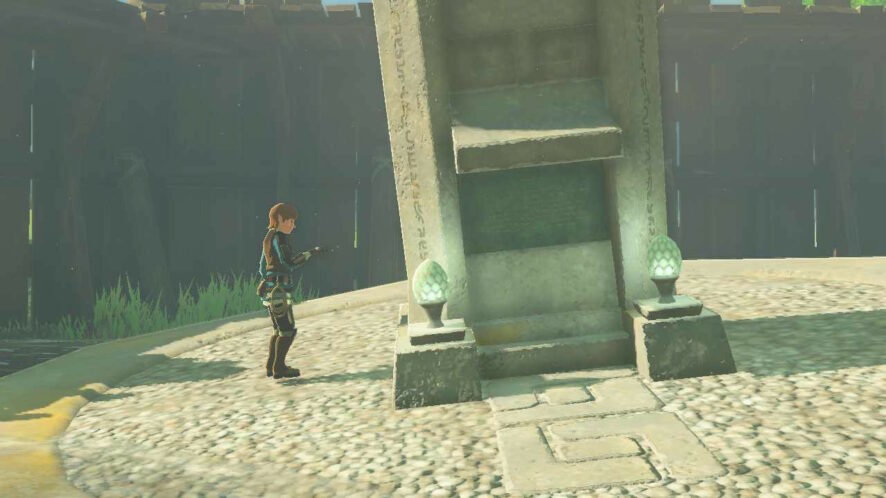
These are all questions I’d love to see answered. Today, though, we’re going to be focusing more on the relationship between Ancient and Modern Hyrulean. To do this, we’ll be using the thirteen stone tablets found in the sky that Link photographs and then shows to Wortsworth in the Messages from an Ancient Era quest.
Studying Ancient Hyrulean
Graphemes (i.e. letters) aside, we can actually get a pretty good understanding of Ancient Hyrulean from the translations that Wortsworth provides. Once you show him a photograph of each stone tablet, he’ll recite it back to you in a version of Ancient Hyrulean that uses the language you’re playing the game in.
(As another quick note, this feature is written from the perspective of playing the game in English, and therefore receiving a translation of Ancient Hyrulean that is written in something close-to-but-not-quite the English language. If you played Tears of the Kingdom in another language, you may well find some different patterns!)
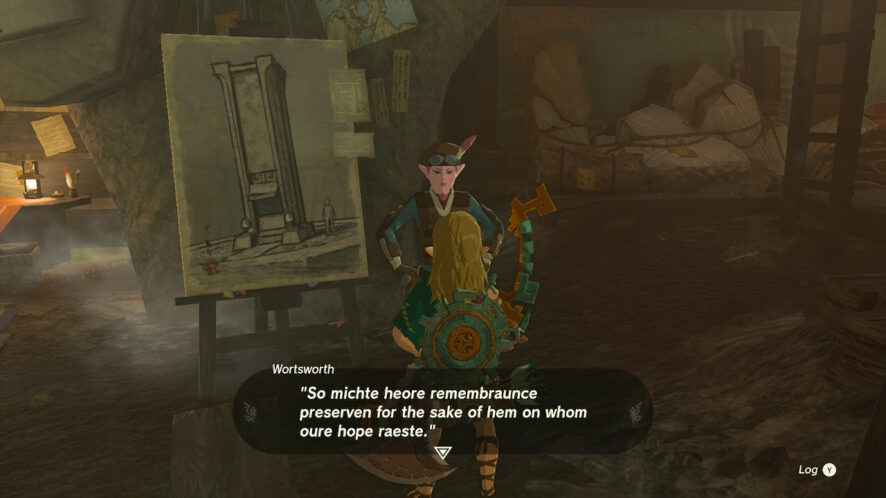
When Wortsworth gives his translation, he first provides a direct account of the stone tablets’ text in an English-adjacent language, before summing up the text again in plain English. Essentially, this means that if you don’t catch a word of what he’s saying the first time around, it doesn’t matter, because he’ll give you a much easier to understand overview right after. However, with a bit of concentration, it’s not too tricky to create a direct translation to Modern English yourself. For example, in the screenshot below, we can see Wortsworth’s translation:
“So michte heore remembraunce preserven for the sake of hem on whom oure hope raeste.”
Taking a close look at this phrase, first marking what looks most familiar and then filling in the gaps, we get something like this:
“So might here preserve remembrance for the sake of him on whom our hope rests.”
Wortsworth’s reading of one of the stone tablets.
Now, you don’t need a background in linguistics to recognise that Ancient Hyrulean is essentially a fictionalized version of Middle English. But we’re going to go deeper and pull it apart to look at some of its staple features. The full translations won’t be listed here, as the entire document of those is over 2000 words long, so we’ll just be looking at some key words and phrases to get an idea of how Ancient Hyrulean works.
The Evolution of Language
The similarities between Ancient Hyrulean and Middle English make a lot of sense when you put them into the context of the game.
We’re not really given a sure answer of exactly how many years Zelda has traveled back, but that’s okay — all we need to know is that it’s been many, many generations. Natural languages take an incredibly long time to change and develop; even though new words and phrases might pop up all the time, shifts in things like grammar, syntax, and spelling take far longer. Evidence of change is one of the most fundamental parts of a language, so much so that many conlang creators actually devise artificial histories for their languages to make them feel more natural. Even Tolkien did so for Quenya and Sindarin in Middle-earth lore.
But why are we using Middle English as a comparison rather than Old English? Well, in terms of intelligibility, Middle English is the better match. It’s tricky to read, yes, but you can just about glean the meaning, even if there are certain words that don’t seem to translate naturally. Old English, on the other hand, is far more difficult to understand if you haven’t already put some time and effort into learning it.
In the same way we can see similarities between Middle English and Modern English, so can we see the similarities between Ancient Hyrulean and Modern Hyrulean. Hyrule is thousands of years old, with numerous different peoples and cultures who have each brought their own influences to the language. To now have documented accounts in the ancient language brings the kingdom to life, as we can see how it shifted over the ages to become the land our story takes place in.
Mattison encapsulates this blending perfectly: A daughter of two peoples, using the unique dialects of both in one short sentence.
Spoken Versus Written
Though Link takes the slates to Wortsworth to be translated fully, we’ve established that we, the player, can get a general sense of what they say. Zelda, on the other hand, seems to have no issue at all conversing with Rauru, Mineru, Sonia, or anyone else she meets when she travels back in time.
The first and most obvious reason for this is that it would hinder the story significantly if she were unable to understand anyone. The in-universe reason, however, could be that there’s a notable distinction between how Ancient Hyrulean was spoken versus how it was written. Even in Modern English, there are a number of differences; the way dialogue is written in a book is, in truth, not a very accurate representation of how people speak naturally. Their word choices differ, their grammar is messy, their sentences run long, to name a few. Perhaps written Ancient Hyrulean is a more formal version of the language, while its spoken form is less so, making it easier for Zelda to communicate.
Zelda communicates very easily with Rauru and Sonia.
Missing Standardization
One of the most interesting features of Ancient Hyrulean is a lack of standardization. While there are certainly patterns, it’s difficult to pen them into strict rules the way we do with modern language.
Again, though, older versions of English had a similar habit. The language fluctuated a lot in terms of spelling and grammar; it was in 1755 with the publication of Samuel Johnson’s dictionary that firmer ‘rules’ for the English language really settled in.
We’re also working with a relatively small sample size, having only these thirteen inscriptions to work from. If we had a larger amount of text to study, some of the seemingly inconsistent features may actually be revealed to have more complex patterns. For this reason, we can observe and study what’s been put in front of us, but we can’t declare any strict rules with absolute certainty.
Ancient Hyrulean Features
Now, we can properly get into the little features and details of the language. The way Ancient Hyrulean is depicted in English is complex, to say the least, so naturally not everything will be listed here. These are the language features that are recurring, seem to have patterns, and/or are just generally interesting to note.
Spelling
The ‘i/y’ Interchange
The ‘I’ personal pronoun is always replaced with a lowercase ‘y’. Example:
‘In min wieried wei don y what much y con, but y fer haven that it ben litel avail.’
(Rough translation: In my wearied/worried way I do what much I can, but I fear that it has been [to] little avail.)
‘Y’ seems to show up fairly consistently instead of ‘i’ when the sound is an ‘ai’ or ‘ei’ diphthong (i.e. a vowel sound that starts off being produced in one part of the mouth, then moves to another, such as ‘claim’ or neighbor’). Examples: ‘life’ becomes ‘lyf’, ‘waive’ becomes ‘weyve’.
There’s less of a pattern for monophthongs (i.e. vowel sounds that are produced in one part of the mouth and don’t move). For example, the short ‘i’ sound is replaced in ‘king’ to become ‘kyng’, but not in ‘princess’. What’s more, other short ‘i’ sounds are replaced with other vowels entirely, for instance, ‘sister’ becomes ‘suster’.
The reverse happens when ‘royal’ becomes ‘roial’. Example:
‘This, ond al thirteen, serven als roial families recorde, min werk final, ful-wroht for al age.’
(Rough translation: ‘This, and all thirteen, serve as [the] royal family’s record, my final work, fully written for all ages.’)
The ‘o/a’ Interchange
Short ‘a’ is replaced by ‘o’ in certain words: ‘and’ becomes ‘ond, ‘land’ becomes ‘londe’.
However, this also reverses: ‘stone’ becomes ‘stan’. Example:
‘Alon kerv y thes wordes upon this stan.’
(Rough translation: ‘Alone I carve these words upon this stone.’)
There doesn’t seem to be much consistency with this one — the spellings aren’t adjusted to be phonetic, flipping back and forth regardless of sound. There are additional inconsistencies with these words’ spellings, too. ‘Land’ is spelled once as ‘londe’, then later as just ‘lond’. It could be that the lack of rules is the feature here.
The ‘u/v’ Interchange
Words spelled with ‘v’ are sometimes spelled with a ‘u’ instead, likely due to the similarity of the letters’ appearances (or whatever the equivalents are in Ancient Hyrulean script). For instance, ‘even’ becomes ‘euen’, ‘serve’ becomes ‘serue’. (Note: the actual use of the latter is ‘seruen’ in place of ‘serven’, but we’ll get onto grammar and suffixes in a moment).
Perhaps this is to represent that the Ancient Hyrulean script is more restricted, with fewer and therefore more flexible lettering.
Variation
Even within a relatively short piece of text, certain words appear to have multiple different spellings, for example, ‘princess’, ‘princes’, and ‘princesse’.
‘Queen’ also appears as both ‘quen’ and ‘quene’.
Other titles are more consistent, such as ‘kyng’ and ‘champioun’.
From this, the variation in spelling seems to apply more to traditionally feminine titles, however with such a small sample size, we can’t truly identify any patterns here.
Phonetic Spelling
Many of the spellings that don’t fall into any particular pattern diverge from their English equivalent in order to be spelled more phonetically.
For instance, ‘once’ becomes ‘ones’, ‘scourge’ becomes ‘scurge’, and so on.
There are more complex versions of this in spellings such as ‘twelf’ (‘twelve’). The ‘v’ and ‘f’ sounds are very similar, both fricatives produced with the lips and teeth (making them what’s known as ‘labio-dental’ sounds). The only difference is that ‘v’ is voiced, whereas ‘f’ is voiceless. That said, many non-standard pronunciations of ‘twelve’ may well leave the consonant voiceless, meaning that ‘f’ actually would be the more accurate phonetic spelling.
The Zonai Survey Team and Wortsworth’s makeshift study in Kakariko Village.
Grammar
Proper Noun Capitalization
Capital letters aren’t used for titles or proper nouns other than the person’s given name. Example:
‘Ones held y honore als hochmayde to kyng Raru ond quen Sonia, thaerafter to his suster ond to princess Zelda.’
(Rough translation: ‘Once I held the honor of handmaid to King Rauru and Queen Sonia, thereafter to his sister and to Princess Zelda.’)
Possessives
There are no possessive apostrophes (‘s). Instead, Ancient Hyrulean uses just a straightforward ‘s’ suffix if the word ends in a consonant, ‘es’ if it ends in a vowel.
For the most part, plurals work as they do in English, i.e. with a ‘s’ suffix. Example:
‘…so maked the quene to sharen tales of hir lond, of shirines al grene yglouen.’
(Rough translation: ‘…so made the Queen share tales of her land, of shrines glowing green.’)
However, this is not always the case. We’ve seen above that ‘stone’ becomes ‘stan’ in Ancient Hyrulean, however, its plural form isn’t ‘stans’, but ‘stane’. Example:
In min herte y woot y helpen mot, on y asked of Mineru, canst yow devyse the menes to upreisen in the skie thaes stane.
(Rough translation: ‘In my heart I would help, and I asked of Mineru, can you devise the means to raise into the sky these stones.’)
So, much like Modern English, plurals can be both regular and irregular.
‘En’ Verb Suffix
Certain verbs in the Ancient Hyrulean text have an ‘-en’ suffix (ending). ‘Fall’ becomes ‘fallen’, ‘preserve’ becomes ‘preserven’, and so on.
The accounts are generally all written in the past tense, howeven, the ‘-en’ suffix seems to be added to verbs that would otherwise appear in their base or present-tense forms:
Zelda, she much desired on hit to riden, ond ne conne nat y seien coust hir stoppen. Tough I dyde protesten. Loudli.
(Rough translation: Zelda, she much desired to ride on it, and I could not seem to stop her. Though I did protest. Loudly.)
That said, the ‘-en’ ending also gets used for verbs that appear in fully present-tense sentences:
Speken she with open herte, eornest to alle, euen to the Zonais kyng.
(Rough translation: ‘She speaks with [an] open heart, earnest to all, even to the Zonai’s king.’)
And finally, the ‘en’ suffix appears once attached to an adverb, again in a present-tense sentence:
Sonia, quen to Hyrules kyng, bi birthe Hylian preesterresse, hiself yborn of londe, nat of skie aboven.
(Rough Translation: Sonia, Queen to Hyrule’s King, by birth a Hylian Priestess, herself born of land, not of sky above.)
There’s no immediately obvious strict rule about when this suffix is and isn’t used. It appears in several present-tense or root verbs, yes, but there are plenty of other occasions where it doesn’t appear. It feels like there probably is some rhyme or reason as to when it’s used and when it isn’t, but without a larger data set, it’s very tricky to say.
‘Y’ Verb Prefix
A grammatical feature with an ever vaguer sense of pattern is Ancient Hyrulean’s ‘y’ prefix. Much like the ‘en’ suffix, this seems to be mostly attached to present tense words. However, this one is not restricted to only words that are present tense or have no exising modifiers attached:
Todai cam hit ipassen that Mineru sheued to Zelda construct althergrettest y hav ysen.
(Rough translation: Today it came to pass that Mineru showed to Zelda the greatest construct I have seen.)
Possibly most interestingly, the word ‘ipassen’ appears to have both the ‘en’ suffix and a version of the ‘y’ prefix attached.
Unfortunately, there’s even less appearances of this feature, making it even more difficult to pin down a pattern.
Missing Articles
Ancient Hyrulean appears to be missing articles in some places. It appears that these are simply removed altogether, rather than incorporated into the noun itself.
This includes definite articles, such as ‘the’:
This, ond al thirteen, serven als roial families recorde, min werk final, ful-wroht for al age.
(Rough Translation: This, and all thirteen, serve as [the] royal family’s record, my final work, fully written for all ages.)
…as well as indefinite artlicles, such as ‘a’:
Whan y make remembraunce of hir markes, fele y flaume of hope, though ful small, within mi.
(Rough translation: When I make remembrance of their marks, I feel [a] flame of hope, though small, within me.)
This is another rule that lacks consistency, as both definite and indefinite articles appear in other parts of the text.
Articles are a type of determiner. Other types of determiner, such as the demonstratives ‘this’ and ‘that’, also make appearances in the text; the missing features seem to apply only to articles, and even then, it only happens in certain circumstances, the requirements of which (if there are any) are unclear.
Gendered Adjectives
Aside from pronouns, Modern English doesn’t have a whole lot of grammatical gender in comparison to other languages. The words that are gendered are usually loanwords, for example, fiancée and fiancé, which are taken directly from French.
Ancient Hyrulean, however, shows some evidence of gendered adjectives, most clearly illustrated here:
Gret kyng, grete quen, y thank ye.
(Rough translation: Great King, Great Queen, I thank you.)
Perhaps, even in the English version of the game, Ancient Hyrulean takes inspiration from languages outside of Modern and Middle English. (As a note, Old English did have more gender involved in its grammar, but this fell out of use).
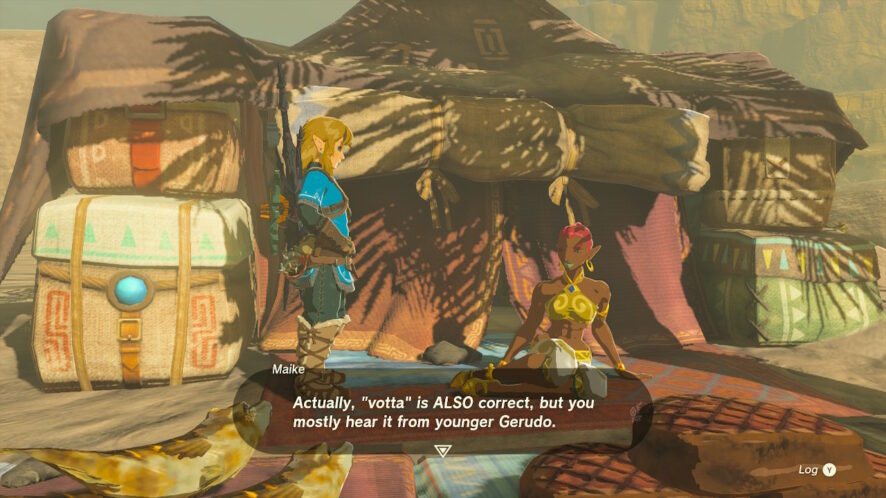
Shifts in grammar to create slang, usually led by younger generations, seems to also be a phenomenon in Gerudo.
Syntax
The Ancient Hyrulean syntax system is complex and, to no one’s surprise at this point, not especially regular.
Much of the time, it follows the general patterns of English: Subject-Verb-Object, Adjective then Noun, etc. However, it does move things around from time to time. Here are some examples:
‘The Temple of Time y sawe’
Translation without syntax shift: The Temple of Time I saw.
Translation with syntax shift: I saw the Temple of Time.
‘In hir time werd everichon patrons of bright hewes’
Translation without syntax shift: In her time wore everyone patterns of bright hues.
Translation with syntax shift: In her time everyone wore patterns of bright hues.
‘Todai cam hit ipassen’
Translation without syntax shift: Today came it [to] pass.
Translation with syntax shift: Today it came [to] pass.
The syntax also shifts in different ways. For instance, the first example here is Object-Subject-Verb, whereas the second is Verb-Subject-Object.
It really does seem that Ancient Hyrulean, while mostly inspired by English (again: in an English language playthrough), other languages are making influences that are resulting in these mixed, irregular rules (or lack thereof).
One particular phrase does stand out with its syntax rules, however: The ‘Ne-con-nat’ phrase.
The ‘Ne-con-nat’ Phrase
‘Ne-con-nat’ and its variations are used for negative phrasings, and works in such a way that it encompasses nouns and auxiliary verbs (i.e. would, could, should) and precedes regular verbs to create their negative meaning. For example:
Ne con hit nat: never can it / it can never
Ne con nat met: Never met
Ne conne nat y: Not could I / I could not
Ne coude nat: Could not
We can also see some spelling features here: ‘can’ seems to consistently be ‘con’, and ‘could’ appears to be able to be spelt as both ‘conne’ and ‘coude’, possibly depending on context or simply just because the spelling isn’t standardized.
If we’ve learned anything so far, it’s that Ancient Hyrulean is anything but standardized. Its rules are unclear, especially from such a small sample size, and in some cases it seems that such rules are missing entirely. However, we seem to have the beginnings of a pretty fascinating grammatical pattern here. (Well, fascinating if you’re a language geek, which if you’ve read this far — surprise! You probably are.)
Worstworth in his study.
The Other Languages of Hyrule
One of the few sureties of languages is that as soon as they’re in contact with one another, they’re going to begin creating and gaining influences from one another, exchanging loan words, leveling dialects, and even causing accent shifts.
If we look at Ancient Hyrulean as a functional language, there is no doubt that the same occurred both in the lead up to the Stone Slates being written, and in the generations that followed between then and Link and Zelda’s time.
We know that the Zonai had their own language, and their arrival on the surface no doubt will have held influence over Hyrulean, especially since they were so revered by Hylians. But it’s not just the Zonai who will have had an impact — the Gerudo have their own language, so maybe other Hylian races do (or did), too. Even if Hyrulean is the central language of Hyrule (being the language of the royal family, knights, trade, etc), it will have been influenced by all the different communities and cultures within it.
If you look closely, there is evidence of multiple language influences in the journals found scattered across Hyrule. Some write left-to-write, whereas others write top-to-bottom. Again, outside of the game, this influence comes from various real-life languages (e.g. English versus Japanese), but it also translates to the myriad of language influences within the story.
The Zonai’s arrival and Rauru’s and Sonia’s founding of Hyrule likely had a major impact on the Hyrulean language being so universal among each group of people. We can ask questions such as: What was the language diversity like before the Zonai’s arrival? Did the Zonai’s impact on language stretch beyond just Ancient Hyrulean to influence that of other races, including Gerudo, and maybe even Goron, Rito, and Zora? Was this the event that spurred such a leveling of language that Link can travel anywhere in Hyrule and be perfectly understood?
A hopeful student of Wortsworth’s examining the stone tablet in Lookout Landing.
It’s not always satisfying to be left with a stack of questions and only a handful of answers, but it wouldn’t be The Legend ofZelda if we weren’t left to wonder a bit for ourselves. These thirteen inscriptions of Ancient Hyrulean are short, but make for probably the most detailed account of any canon Zelda conlang. We’re given not only words, but grammar and syntax, too.
It would, however, be incredibly difficult to learn properly. For one thing, the grammar and spelling choices fluctuate in seemingly irregular patterns. For another, the inscriptions are written out based on the language the player has set their game to, meaning that there are multiple versions of Ancient Hyrulean out there each connected to a real-life language.
Not only that, but the Ancient Zonai script still remains something of a mystery, more complex than the ciphers we’ve seen before. Between Ancient Hyrulean and Ancient Zonai, it seems that the conlangs of The Legend of Zelda are becoming more and more complex. Who knows, maybe one day there’ll be a fully fledged constructed language for linguistics geeks to sink their teeth into. For now, though, there’s still plenty to keep unraveling here.
Caitlin Stratford
ZU feature writer and aspiring fantasy author. Hobbies include reciting obscure Zelda trivia to people who are politely feigning interest.


 by Caitlin Stratford on August 14, 2023