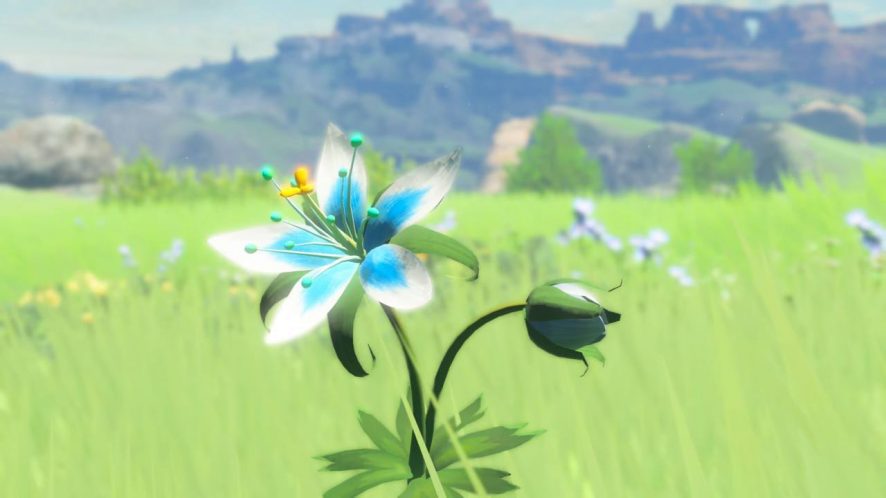
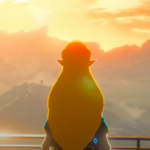
These are the first words that Link and the player hear in the opening moments of Breath of the Wild.
Breath of the Wild is a game that is many things to many people: an open-world game, a combat game, a reinvented Legend ofZelda game, and so on. At its heart, however, Breath of the Wild is a game about memory. Most significantly, it is about how memories can be affected by severe trauma, how those memories can be recovered, and how it can be painful to recapture those memories.
From the moment he steps out of the darkened chambers of the Shrine of Resurrection, Link starts on a healing process, not only for a wounded kingdom but also for his own mind. Just as Hyrule needs to be rebuilt from the ruins of the Calamity, Link needs to rebuild his own traumatized memory from scattered fragments.
Links to the Past
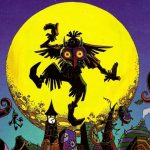
Breath of the Wild isn’t the first Legend of Zelda game to address the topic of memory loss. Ocarina of Time and Majora’s Mask touched upon the topic, but in different ways. With the reversal of time in both games, none of the secondary players have any knowledge of the dramatic events that had transpired. But this is more a matter of time being reversed rather than someone’s memory being wiped. After all, how can someone remember an event that didn’t happen in their timeline?
Only Link remembers what happened before the clock was turned back. He remembers everyone and everything, but they don’t remember him. That in itself is a form of isolation, and a rather painful one. The people who have forgotten you or don’t know you are people that helped you. (For more on this subject, read our column about the influence that the 1998 German film Run Lola Run had on the storyline of Majora’s Mask and the reversal of time.)
For Larisa A. Garski and Justine Mastin, Link’s memory loss, and subsequent recovery of specific lost memories, in Breath of the Wild represents one of many examples of posttraumatic growth in the Zelda games. It’s a trend that has been seen in every game from A Link to the Past onward. Garski and Mastin reflect on this in an essay in the anthology The Psychology of Zelda: Linking Our World to The Legend of Zelda, a series of essays on the psychological themes in the games.
In Breath of the Wild, amnesia is paradoxically a source of trauma while also shield against it: “While amnesia fends off his PTSD, it also keeps Link separated from his true self and destiny. Ironically, the more memories he finds, the more flashbacks he acquires, the closer he comes to engaging with, and subsequently overcoming, his PTSD. Not since Majora’s Mask has Link been so lost and alone, bereft of the family and community he once loved.” (The Psychology of Zelda: Linking Our World to The Legend of Zelda p.145)
In order to heal, Link must experience pain. It is much like anesthesia wearing off and the patient remembering that they still have a surgical wound that needs to heal. The player is left to guess at what feelings run through Link’s head as he remembers each face and each moment. We can probably guess at some of them, however: sadness, guilt, frustration, fear, anger, and, yes, happiness.
Link’s Awakening
Link wakes up in the darkness of the Shrine of Resurrection at the start of the game, with no memory of what happened a century before. The dark, closed space of the Shrine is symbolic of Link’s mental state. He is literally in the dark about who he is, what has happened to him, and the people he once knew.
We are never told, at least not with absolute certainty, what caused Link’s memory loss. It might have been a function of being in the Shrine — a resetting to factory mode, if you like — or the result of trauma from his near-fatal battlefield injuries at Fort Hateno. The only clue we have comes when Zelda hints to the Deku Tree that Link may lose his memories while in the Shrine. Whatever the cause, we may safely say that Link’s amnesia is still certainly the result, either directly or indirectly, of the traumas of the Calamity.
Link hasn’t lost everything, however. He appears to have retained all of his motor skills, and he still appears to be capable of coherent speech and thought, even if the player can’t hear him speak. (The subject of if and how Link speaks has already been the topic of much conjecture, and therefore is the subject for a separate article.)
The remembering process begins with Link’s encounter with the mysterious Old Man on the Great Plateau, later of course revealed to be the spirit of King Rhoam.
Naturally, Rhoam knows everything that has happened to Link but does not deem it prudent to provide those memories to Link the moment he emerged from the Shrine. Instead, Rhoam waits to tell Link about what happened until Link completed the first four Shrine trials, which gave him a chance to adjust to the outside world and to strengthen himself. “I did not think it wise to overwhelm you while your memory was still fragile,” Rhoam says.
We may see this statement as an acknowledgment that the remembering process can be painful: It may not be good for someone’s health and well-being to immediately unearth specific moments from the past. It is, rather, a process that must be done gradually.
Déjà vu all over again
Over the course of the game, Link must use the Sheikah Slate to revisit at least 12 places he once traveled to with Princess Zelda. In doing so, he is able to recapture memories he had of those visits. Other memories are triggered when Link travels to the places that the four Champions called home and sees or hears some reminder of them.
Hyrule, like Link’s memory, is badly fragmented. The once-proud kingdom was all but wiped out with the rise of Calamity Ganon, leaving a countryside scattered with ruins, outside of a few fortified domains and villages. All of these places that survived the Calamity are spread far across Hyrule, with a long journey in between them (unless one has a Sheikah Slate and convenient access to a travel gate at the local Shrine or Tower, of course).
The loss of memories, institutional as well as individual, is likely to be a significant problem for the kingdom as well. We can assume that much of Hyrule’s culture and learning was wiped out by the Calamity, and the few remaining fragments are found in the few collections of books and artifacts that were preserved. The only people with actual memories of the kingdom are the ones who survived to a very ripe old age, such as Impa, Purah, and Robbie.
The filling in of the map on the Sheikah Slate is also a symbol of Link’s memory and its recovery. At the start of the game, the Slate is a blank map, a sea of dark blue swirls. The unlocking of each Sheikah Tower fills in a new section of Hyrule’s map, with all of its landmarks, roads, and points of interest.
Link encounters all of the different races of Hyrule in his travels, and through both main quests and sidequests, he ends up making new friends, encountering old ones, and bringing different groups together. The settling of Tarrey Town is a prominent example of this. Link played a significant role in acquiring materials and bringing people to the town, after all.
“Ultimately, these reforged connections with the Zora, Goron, Korok, Rito, Gerudo, and Sheikah communities enable Link to rejoin Zelda and defeat the Calamity that has decimated Hyrule. This serves as an important reminder that such social connections are critical to achieving posttraumatic healing.” (The Psychology of Zelda: Linking Our World to The Legend of Zelda p.145)
Not yet complete?
At the end of the game, after the final battle, Zelda turns to Link and asks, “Do you really remember me?”
The key question, one that remains unanswered in the game, is how much of Link’s memory has been restored, and how much yet remains.
The memories housed in the Sheikah Slate can be compared to shards of a broken pot — part of a larger piece, but they are not the whole piece. We can try to conjecture what the unbroken object looked like just by examining the shards, but that’s all that is: conjecture. We do not see what happened immediately before the events of those memories took place, nor what happened afterward.
But it may be that the memories in the Sheikah Slate are also like strands of a spider web: Tug on one thread, and it will tug on others. It may be that Link remembered other things after seeing the Sheikah Slate locations, and that these things simply weren’t revealed to the player. We may surmise that the Fort Hateno catastrophe was a particularly strong memory, strong enough to jar other hidden memories in Link’s head.
Zelda’s words at the end of the game hint that the healing process has only just begun, and that there are more memories still to be unlocked for Link, for herself, for the kingdom.
“Although Ganon is gone for now, there is still so much more for us to do,” Zelda says. “And so many painful memories we must bear.”
Erin Roll
Erin Roll is a freelance writer, editor, and all-around slinger of words for fun and/or profit.
Erin lives at the top floor of a haunted house in Montclair, NJ. She loves music, reading, hiking, and kayaking, and spends entirely too much of her free time playing video games.


 by Erin Roll on July 21, 2021