It’s no secret that Zelda II: The Adventure of Link has divided more fans of the series than almost any other entry. Being such a drastic change from the original game, and so dissimilar to the many entries that followed it, this reception is understandable. Zelda II is a demanding game: it demands attentiveness, planning, good reflexes, and exploration of the game’s various systems and environments in order to succeed. The finished product doesn’t much resemble the first Legend of Zelda, but that was the explicit intention behind its development. Though it is notably more punishing than might be expected, a difficult game doesn’t always mean a bad game, and I have played few NES games with a better balance of difficulty than Zelda II.
First, a few experiential notes. With any piece of media, it’s important to set measured expectations and keep an open mind with regards to new possibilities. I know that many wish to complete this game just to tick a box, but going into anything with the notion that it must be powered through is not conducive to genuine appreciation and understanding, nor is it conducive to enjoyment. Zelda II is challenging, but this challenge creates tension and is emphatically rewarding to overcome. As such, I recommend playing this on original hardware if possible, or at the very least refraining from using save states or rewind in order to preserve this challenge. I realize how this must sound, but this is an excellent game that deserves to be judged for what it is rather than what anyone wishes it could be.
While it’s always good practice to read the manual with games from this era, Zelda II is a good sight more self-explanatory than its predecessor in most cases. The basic structure of Zelda II is: explore the “land-map” (as per the manual); fight monsters to gain experience and level up; find magic spells, items, and techniques; complete dungeons; use new items to access new areas. Exploration is made more straightforward by the map limiting accessible areas, so there is generally little question of where to go next, especially since townsfolk provide clear hints regularly. The manual is, however, helpful in explaining the use of some spells and items, as well as combat basics, which is where the game starts to really shine.
One of the main reasons I always come back to this game is the way controlling Link feels; there is a lot of effort put into creating satisfying, versatile battle mechanics that are engaging from start to finish. Once the first dungeon has been reached, encounters quickly ramp up in difficulty, but here is a quote from the combat section of the manual to keep in mind: “The road to winning is knowing how the enemy moves”. Most enemies are best dealt with using specific strategies and, upon introduction, enemies are generally in open areas where the player can explore their options and feel out attack patterns.
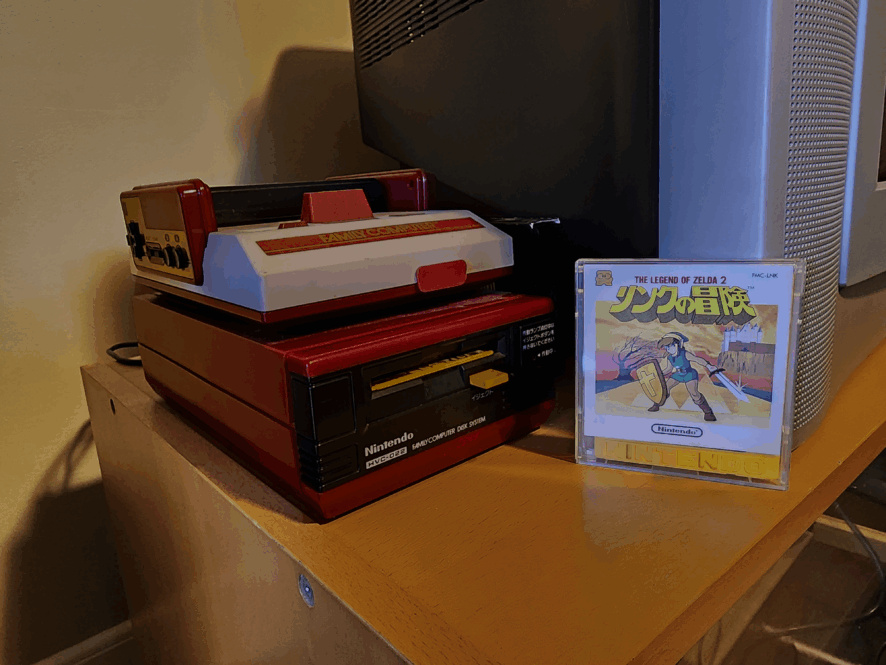
Though I may prefer the NES version, a little variety never hurts
As the game progresses, the encounters start putting the player at a disadvantage. The challenge lies in balancing spatial awareness with knowledge of the enemy and careful timing during battles; with a good balance of all three, encounters that once seemed insurmountable can be optimized, but the battles are tightly tuned enough that they never become trivial. This results in engaging combat for the majority of the experience, and a great way to naturally communicate to players where their power levels should probably be at any given point.
The progression system is also well-tuned, as it doesn’t allow Link to become overpowered by the end of the game. Grinding is more of a choice than in most RPGs since random battles can largely be avoided, and levels are paced well enough that it is mostly an option for careful or efficient play — one of the ways Zelda II gives some slack in the early game to anyone still getting used to the gameplay. By the end, the game expects anyone still playing to be in it for the long haul, and doesn’t hold back.
I appreciate the game’s unwillingness to rob the later levels (and especially the final dungeon) of high stakes because certain players might be more powerful than expected at any given point, so most who make it to the end will have had a comparably difficult experience. The life and magic meters can also be extended with hidden items to both encourage exploration and to tip the scales of some of the later challenges. There is more than enough to provide the player with a strong foothold, so it’s refreshing to see the game ramp up to an appropriate difficulty level in response.
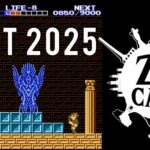
Dungeons contain the most carefully designed platforming challenges and enemy encounters in the game, and as a result are generally the most punishing areas, but also where Zelda II is at its best. Given the horizontal nature of the stages, labyrinthine design and puzzle solving mostly take a backseat to more demanding moment-to-moment gameplay. This works because the rooms and enemies within test the player’s skills in multiple ways at once, with every new enemy adding another variable to the equation. Enemies are less predictable than in something like Castlevania, so there’s an added element of on-the-fly reaction that encourages attentive planning and execution while punishing bad habits and reflexive play. The limited availability of health and magic restoration deters imprudent spell use, especially since magic power is usually advisable or downright necessary for boss fights. This also ties into the most controversial aspect of Zelda II: the three-life system.
Zelda II gives players three lives to start with and, after the game is over, puts Link back to the starting area, though players aren’t forced to redo any significant content (maybe regain a level or two in the Famicom Disk System version). It is undeniable that the threat of having to start again, even somewhat, fundamentally changes the dynamic of a game’s difficulty. This alone has probably made more players quit playing than any other part of the game, but friction in game design is sometimes part of a game’s intended experience, and through this lens the difficulty starts to make much more sense. The feeling of being in the middle of a dungeon, one life left, low on magic or health, hoping for a point bag or potion to drop, carefully planning routes and moves to avoid dying is a level of tension and engagement that no other title in the series comes close to matching.
Sometimes damage feels unavoidable, but that’s generally an indication that not every possibility is being considered, seeing how this game can be and has been completed without taking any damage whatsoever; clever thinking and experimentation can lead to surprising results. I don’t believe the three-life system is in the game to punish players. Rather, I think limiting the amount of easy tries creates a viable scenario for the player to take the challenges of the game seriously, and it is best enjoyed locked-in and engaged. The final dungeon notably has a continue point at its entrance, which is evidence enough that this sort of experience was intended.
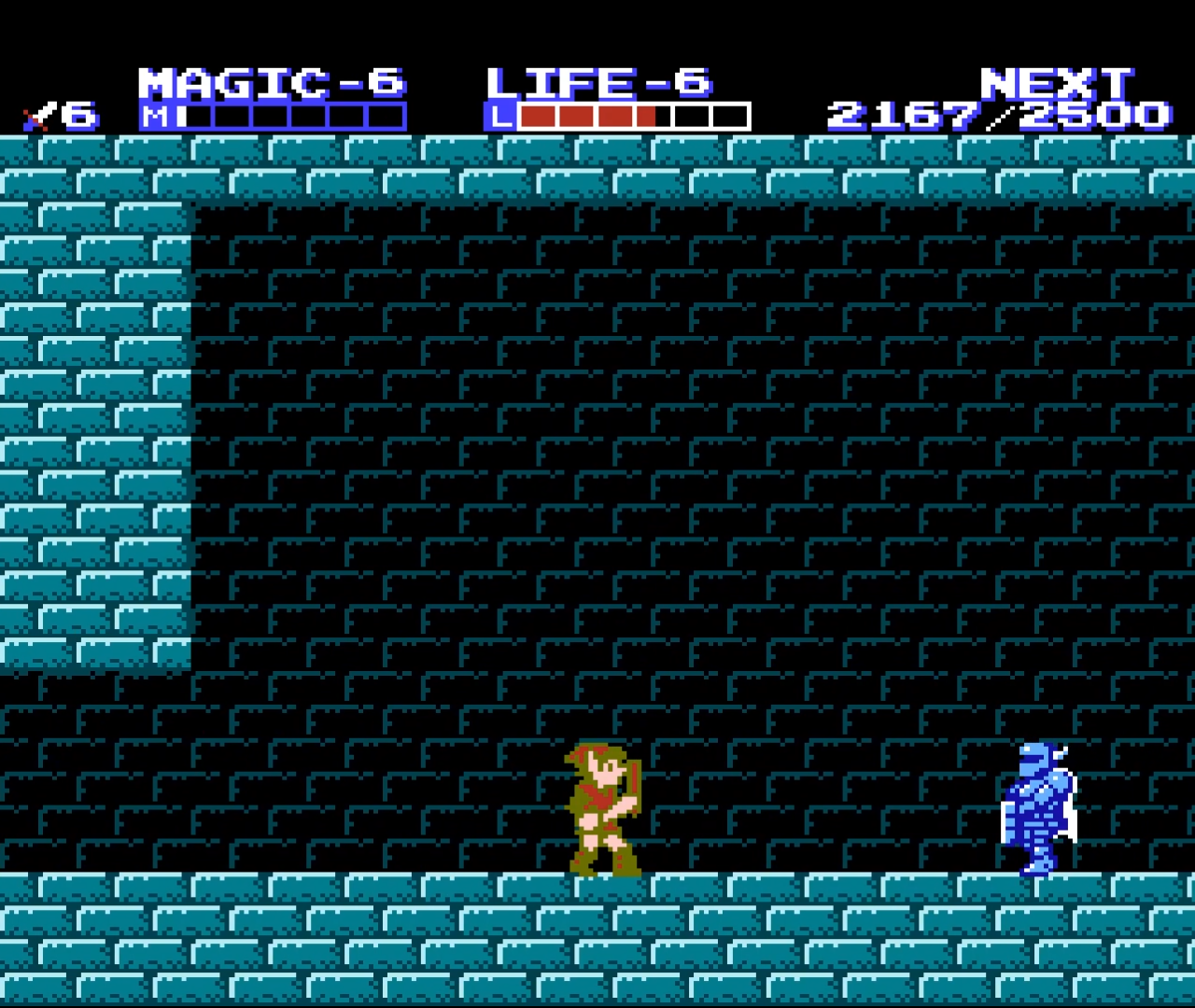
No easy way out of this one. Back off, study the patterns, and execute a plan.
I would be remiss if I didn’t address a few common problems people have with the game. In regards to backtracking after a game over: there are plenty of shortcuts and beaten paths on the map that open up as the game progresses, and it doesn’t take very long to get to any specific area. I would argue that if a significant percentage of play time consists of these sorts of treks, that might be a clue to try powering up, searching for Heart Containers or Magic Pots, or just trying something different. Moving on, Death Mountain is absolutely a difficulty spike, but exists to drive home just how unsustainable careless play will become, and it comes just early enough so the player (ideally) gets the message.
Even the range of Link’s attack feels designed specifically so it isn’t possible to attack from a safe distance, to encourage learning and punishing enemy movement up close and personal. Some spells or even just careful use of Link’s range of motion can be used to circumvent enemies altogether if damage seems unavoidable. Finally, I think the word “cryptic” has been erroneously applied to Zelda II. There are secrets and hidden passages the player must find, but most overworld secrets are pointed out rather explicitly by townsfolk, and hidden passages in dungeons are hinted at well enough for attentive players to figure out simply due to their location or surroundings. If it seems like there’s more to a room or area than is immediately obvious, there probably is.
The Legend of Zelda is no pushover in terms of difficulty, so it’s surprising to see its sequel dismissed to this day due to the level of challenge on offer. While I would argue that it is the more difficult of the two, I think the real reason for this disconnect is its lack of options for preparation. No longer can two full heals be carried at any time, there are now ways of instantly losing a life, it’s easier and quicker to die, money can’t be used to stock up on items, and core gameplay takes precedence over item use and exploring for secrets. It is fundamentally a different sort of experience — less about preparing for what comes ahead and more about being in the thick of it. It’s the “Adventure of Link” because Link grows stronger, both through the progression system as well as the ability of the player to overcome the challenges ahead. In that sense, the final boss couldn’t be more thematically appropriate, and I recommend fighting that boss the way it was intended to be fought.
I realize that difficulty is subjective: what is a rich and rewarding experience for some can be a frustrating and futile exercise for others. I could never say I don’t understand why people have dismissed Zelda II as outdated or unnecessary, I only wish to argue that this is not the game’s fault. Upon release, it was met with a warm reception and sold well; for all intents and purposes it was considered a great game. It hasn’t changed since those days, the only thing that’s different is player expectation. Difficult games have seen a massive surge in popularity in recent years, though, so now is the perfect time to challenge the conventional opinion on Zelda II: The Adventure of Link. Nothing so clearly well thought out should be judged based on criteria it isn’t even trying to meet. With the right mindset going in, a bit of patience, and a willingness to learn and adapt to the game’s various obstacles, Zelda II can be a thrilling and memorable experience. All it takes is the wisdom to accept it for what it is, the power to challenge one’s own perceptions, and the courage to keep trying.


 by Alexander Callaghan on August 6, 2025