The Legend of Zelda series has an extremely rich, diverse, and oftentimes confusing timeline. Throughout the series’ life, players have been able to experience different versions of Hyrule and its inhabitants’ lives as they adapt to each iteration of the land. A seafaring people in the drowned world of Wind Waker; a population dealing with the fallout of mass catastrophe in Breath of the Wild; an idyllic community above the clouds acting as the progenitors of the series in Skyward Sword. Reflecting on this, I began to wonder how these varying portrayals of Hyrule informed the phenotypes of their inhabitants.
This feature aims to take a speculative look at how the environments of different Zelda games could have influenced the biological design choices of the species within them. This is far from a scientific inquiry (and I am absolutely not an expert), but rather aims to relate the design and evolution of species within the Zelda series to the environments in which they appear.
The fish and the bird
Laruto and Quill from The Wind Waker
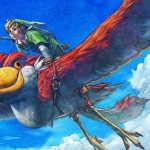
No piece on evolution and adaptation within Zelda could be complete without discussing the Zora. The descent of the Rito from the Zora has been one of the most-discussed cases of evolution within the series, and rightly so. At first glance, it seems like a fantastical stretch, but evolutionary biology states that birds did eventually evolve from fish. If we consider the Zoras as amphibious due to their ability to live out of the water and their offspring’s visual similarity to tadpoles, the steps between this evolution become shorter. While there may not be the hundreds of millions of years required for this sort of evolution to occur in the real world, it still has roots in reality, and could have been propagated by extreme changes in the water ecosystem following the Great Flood.
A great deal of variation is also seen in the Zora race within individual games. Consider Lord Jabu-Jabu and Princess Ruto in Ocarina of Time, the Indigo-Go’s in Majora’s Mask, or Mipha and King Dorephan in Breath of the Wild. Given that the Zoras return in Breath of the Wild and live alongside the Rito, it’s possible that different evolutionary pathways developed following the Great Flood, which may be indicated by the presence of River Zora as Zora Warriors and Geozards in Phantom Hourglass and Spirit Tracks respectively. This would be similar to the way in which amphibians evolved into reptiles and then birds, but we still see each of these classes in the world today.
In Breath of the Wild, the Zora and Rito live side by side.
The situation of the Zora and Rito may reflect an evolutionary phenomenon known as lineage-splitting. Distinct divergences within the Zora population with varying genetics means that they would likely be less prone to extinction than other populations with less diversity, and it is unlikely that the Zora and Rito share enough genetic material to any longer considered the same species.
Adaptation to harsh environments
At the time of writing, Breath of the Wild takes place as the final piece of a timeline where all of the previous tales have faded into myth. There is markedly less civilization than in other worlds and, generally speaking, Hyrule is a more hostile environment, and its creatures have adapted accordingly.
There are many examples of adaptation in Breath of the Wild. The first, most striking one is the Lizalfos. In Breath of the Wild the Lizalfos are seen with eyes reminiscent of the chameleon’s: stereoscopic eyes that are highly specialized, with movement independent from one another. These are used for both hunting prey and detecting predators, and they may suggest an adaptation to a less hospitable Hyrule. Lynels are more hostile and formidable than ever before. Octoroks now hide in snow in the tundra. Bokoblins possess pig snouts, a feature carried over from Wind Waker and its sequels. This type of nose is used for heightened smell for locating and digging up food, a useful trait in more difficult environments. Moreover, there are much more powerful Bokoblins in Breath of the Wild than ever before seen in the series.
Concept art for Breath of the Wild‘s Bokoblin types
Also of note is that there are fewer distinct species of enemies in Breath of the Wild than are found in other Zelda games, but most enemies have subspecies: Moblins, Chuchus, Bokoblins, Wizzrobes, and Octoroks all have variants that have adapted to their environments. Are these the products of natural selection and survival of the fittest — the creatures that have survived through the years to develop strong adaptive traits?
In Breath of the Wild there is another design callback to Wind Waker: the Koroks are seen for the first time since their debut. It is mentioned in-game that the Kokiri children seen in Ocarina of Time took on the form of Koroks–potentially through magical means–following the Great Flood. This is not strictly an example of evolution or adaptation but is instead a more acute and active change. Despite this, the benefits of a lighter body and energy metabolism through photosynthesis are clear in the vast Hyrules seen in Wind Waker and Breath of the Wild. While of course not reflective of real-world evolutionary conventions, these are benefits that would serve the Koroks well when no longer confined to a small forest.
The Kokiri became Koroks following The Great Flood.
Some things change, some stay the same
There are contrasts to the drastic and subtle changes mentioned above. The Gorons are a race in Zelda that have changed very little in terms of design throughout the series, and this likely reflects their propensity to thrive in harsh environments. Not only do they eat rocks, but they have been portrayed as being capable of living at great climate extremes, from Death Mountain to Snowhead. There has likely been little need for the Gorons to adapt: tough skin protects them from otherwise inhabitable climates, and sources of food are usually easy to come by. A similar real-world example might be the tardigrade, a supremely adaptable microscopic animal that has existed for hundreds of millions of years.
The Gorons have changed very little throughout the games.
In a similar vein, Hylians and Gerudos have remained consistent throughout the series, perhaps reflective of our own human race’s ability to transcend the environment to build and thrive in societies across the earth. Hylians are depicted as living in civilizations across all manner of environments, and even the Gerudo had a coastal stint in Majora’s Mask as a change from their usual desert locale.
Parella from Skyward Sword
There are also the species that make only one appearance in the series. Kikwi, Loftwings, Parella, and Mogma only appear in Skyward Sword and are absent from any later timeline entries. This could indicate their extinction or dormancy. Perhaps the Kikwi are simply hiding; the Parella are in underwater caves inaccessible to the player; the Mogma are thriving underground. Perhaps they are set to be revived in later series entries. Regardless of what happened to them and whether they will return, it is always exciting to see new additions to Hyrule’s biodiversity.
A Changing World
The versions of Hyrule that we explore as players are often monumentally different from game to game, so it follows that their inhabitants adapt to their respective environments. Whether or not these design changes are intended to reflect adaptation to a specific ecosystem, or are purely visual choices, it’s interesting to consider what might have informed in-game designs to reflect real-world function and biology.
Cal Birks
I've been playing Zelda for the past twenty years. You can usually find me somewhere arguing why the GameCube was the greatest console of all time.