The year 2000 gave the world plenty of reasons to celebrate, between the welcoming of a new millennium, society having avoided the potential technological disaster that was Y2K, and perhaps most importantly for Nintendo fans, the beginning of the beloved Paper Mario franchise. The original game in the charming RPG subseries debuted to Japanese audiences in August of 2000, where it was known as “Mario Story.” The game would see an international release the following year, serving as one of the last big hits for the Nintendo 64 console.
One of Mario’s very best outings
It’s been 20 years since Paper Mario first unfolded, and to this day it remains one of the most delightful adventures that Nintendo has ever taken us on. Mario’s journey to rescue the seven Star Spirits leads into the depths of Dry Dry Desert, across the ocean to Lavalava Island, up to the celestial Star Haven, and even into a gigantic Toy Box where all the Shy Guys you can count make their home. The many partners he gains along the way are memorable takes on popular Mario enemies, like the chatty young Goombario, the hard-working mailman Parakarry, the sassy Lady Bow, and many more who offer their own unique abilities and their own amusing quirks.
As the first entry into what would go on to be a long-running subseries, Paper Mario’s debut on the N64 established that endless humor would be one of the key elements to its identity. The original Paper Mario set the bar high for its followups with a hilarious script that lobbed one laugh-out-loud moment after another at players. Gags like Professor Kolorado insisting that a talking whale is a giant tuna, the Koopa Bros. being an obvious riff on the Teenage Mutant Ninja Turtles, or the secret tape that Koopa Koot has you find for him (and is subtly implied to have some racy content on it) are only a sampling of the comedy that is found in Paper Mario’s first outing.
Then there are the ridiculous situations that Mario and co. consistently find themselves getting roped into. In Paper Mario, you’re tasked to prepare a cake to appease the refined tastes of a rather rotund Shy Guy (otherwise known as Gourmet Guy) not once, but twice! Mario’s exploits in Shiver City revolve around solving a murder mystery of the town’s mayor — who actually turns out simply to have knocked himself unconscious after a box fell on him. Why would you scour the jungles of Lavalava Island to find missing Yoshi babies? Because those little rascals just had to get away from their parents to play hide and seek, of course.
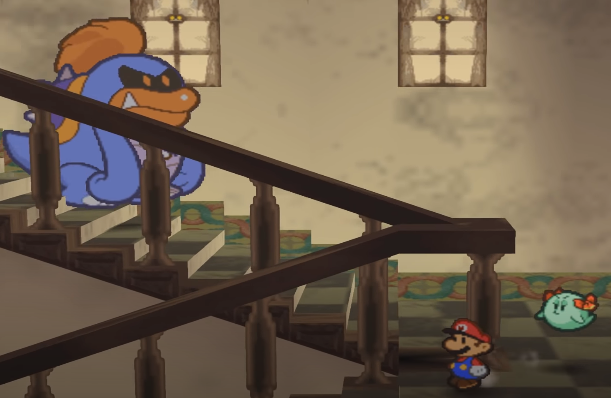
Paper Mario feels like one great variety show of an adventure. During the journey across the Mushroom Kingdom, Mario must overcome any and all challenges that come his way. There are turned-based battles, boss encounters, puzzle-solving, platforming, exploration, stealth sequences, quiz shows with Bowser and his minions, perilous escapes from the monstrous Tubba Blubba — Nintendo threw everything but the kitchen sink into the N64 classic.
The chase sequence through Tubba Blubba’s Castle was not very kind to our heart rates as kids.
Even when later titles like Super Paper Mario and The Origami King deviated from the turn-based RPG roots, they kept the tradition alive of a Paper Mario game featuring superbly diverse scenarios. Paper Mario on N64 laid out a perfect formula for an eclectic adventure that always had new surprises and fresh obstacles in store for the player.
When it comes to variety, Paper Mario titles have few peers, but one of those illustrious few is a fellow Nintendo franchise — The Legend of Zelda. When placed side by side, the two series are fascinatingly similar to one another. Paper Mario and The Legend of Zelda have quietly shared a number of design philosophies over the years, and it goes much deeper than simply a love of diverse gameplay. Paper Mario clearly took plenty of inspiration from Zelda, and should Zelda ever venture in the realm of RPGs, it stands to gain a lot from taking after Paper Mario‘s methods.
Great franchises think alike
If you avoid mentioning any of the character names when describing Paper Mario, it suddenly sounds like a premise that’s very familiar to The Legend of Zelda fans. It’s an adventure through a variety of fantastical environments where you meet plenty of colorful characters, all with the goal to find seven mystical guardians so you can save a princess whose castle has been commandeered by an evil villain that’s stolen a relic of supernal power. Said villain has a witch-like advisor, to boot.
That description has A Link to the Past and Ocarina of Time written all over it. Maybe Paper Mario was repaying the favor for Ocarina of Time’s various Mario references, seeing as how it has a few different nods to the very first 3D Zelda, among other titles in the fantasy action/adventure series. The path through Forever Forest to get to Boo Mansion is a spookier version of the Lost Woods. Mario must help the aforementioned talking whale by going inside its stomach to deal with a creature that’s bothering its guts. Wise Wisterwood in Flower Fields looks like he and the Great Deku Tree could meet each other at a family reunion (maybe an Entmoot?), and his mustache is just as impressive as the arboreal guardian of the Kokiri. The leader of an underground, honorable group of thieves in Dry Dry Outpost (Moustafa), masquerades under the alias “Sheek.” There’s a lengthy trading sequence that asks Mario to be a courier for an array of oddball items between a motley crew of characters.
Ocarina of Time had seven Sages, while Paper Mario had seven Star Spirits.
Paper Mario’s and The Legend of Zelda’s common ground doesn’t end at clever Easter eggs and obvious references to one another. Paper Mario definitely has the spirit of a Zelda game with its commitment to a well-balanced mix of gameplay concepts like combat, puzzle-solving, and platforming — all of which show up in the game’s dungeons. The finale to just about every chapter in Paper Mario sees the mustachioed hero venture into a bastion of enemies, puzzles, traps, and hazards, culminating in a boss fight against a mighty foe. The Koopa Bros.’ Fortress, Dry Dry Ruins, Tubba Blubba’s Castle, Mt. Lavalava, the Crystal Palace, Bowser’s/Peach’s Castle all serve the same purpose for Mario as the temples do for Link during his quests.
Mario even has a selection of items that allow him to solve puzzles and step foot onto previously out-of-reach areas. They just look a little different from what you normally expect of items in video games. Mario’s partners are the de-facto equipment in Paper Mario, the various companions’ unique abilities granting new means of combat and new means of overcoming environmental hazards or puzzles. Kooper’s Shell Toss can grab items and strike distant targets the same as the Boomerang and Hookshot. Parakarry’s Air Lift is the equivalent of the Hover Boots. Bombette’s Bomb attack is, well, that one goes without saying.
The Paper Mario partners are walking, talking versions of Link’s many items from The Legend of Zelda.
Although the player can choose which partner is alongside Mario for most of the adventure, every companion character is vital. Much like how the challenges inside Zelda dungeons typically become themed around the most recently acquired item, the partners in Paper Mario conveniently join the party right before the oncoming obstacles can only be cleared using their specialized abilities and attributes.
Mario and Link are both silent protagonists, meaning that Mario’s partners are the ones who do the talking and offer guidance on how to proceed, no different than Navi, Midna, Fi, etc. Later Paper Marios emulated Zelda even more closely when it came to your allies, as they veered away from large parties of playable characters in favor of a single guide character who tagged along from start to finish. Whether it was Tippi in Super Paper Mario, Kersti in Sticker Star, Huey in Color Splash, or Olivia in The Origami King, all were also integral to their games’ overarching plots, their purpose going well beyond merely game mechanics.
Let’s not even get into how the endings to Paper Mario tales can be as brutally bittersweet as Zelda endings when it comes to the goodbyes between Mario and his best buddies.
The Origami King made it blatantly obvious what fellow video game franchise it was paying tribute to.
With how many ideas that Paper Mario and The Legend of Zelda share, it’s easy to look at Paper Mario as a different genre take on Zelda’s philosophies just as much as it was for Super Mario Bros. With the last few entries, Paper Mario has embraced an action/adventure identity that’s complemented by light RPG elements. The latest release, The Origami King, paid one giant homage to Zelda with an entire chapter that could have fit right into The Wind Waker.
More The Legend of Zelda spinoffs are inevitable. Breath of the Wild launched the series so far into the mainstream eye that Nintendo almost has to capitalize on its unprecedented appeal. Hyrule Warriors and Cadence of Hyrule were cases where Zelda was rewarded for stepping outside its comfort zone. Both spinoffs were commercial successes and earned plenty of love from fans — there’s a reason why another Hyrule Warriors is just months away and Cadence of Hyrule is receiving substantial DLC well over a year after it first launched.
Zelda has successfully dabbled in other video game genres — why not take a shot at a turn-based JRPG?
Zelda’s transition to a turn-based RPG would be rather seamless. As proven by Paper Mario, staples of Zelda’s game design are more than possible in the RPG genre. In fact, Zelda would retain far more of its identity in becoming a dedicated RPG than it did when entering the Musou sphere of Hyrule Warriors or the rhythm roguelike realm of Cadence of Hyrule. All of the puzzle-solving, exploration, dungeon crawling, platforming, NPC interaction, and boss battles that fans have held dear over the years could easily carry over into the new genre. Heart pieces would be the replacement for Heart Points, and the Magic Meter would fill the role of Flower Points. Zelda’s gigantic catalog of items from over the years would undoubtedly be able to make up the vast inventory that is a staple to role-playing titles.
A Paper Zelda would most likely tighten down on Link’s mobility, limiting just how much players could traverse the environment (especially compared to what was established in Breath of the Wild), but that seems like a small price to pay for an art direction that pairs so well with Zelda. A spectacular fan video by 64-Bits showed just how natural Link and the gang look when brought to life through the paper-craft visuals.
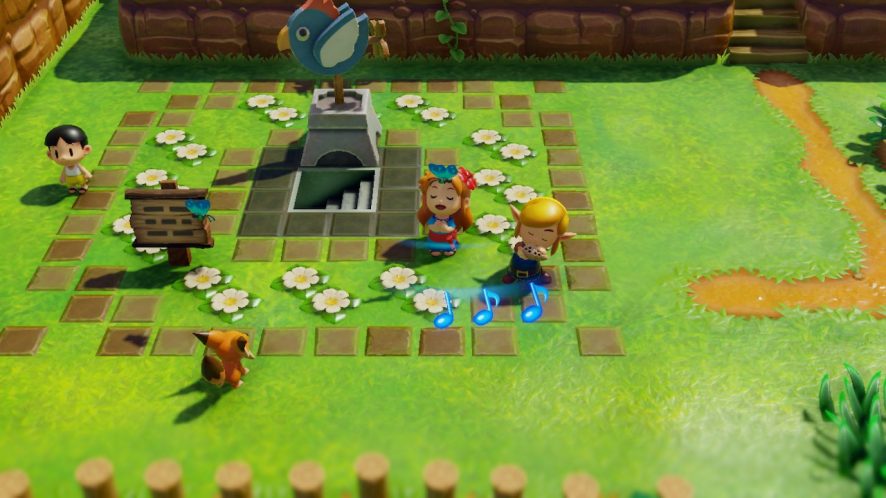
It’s not far removed from what the Link’s Awakening remake for Switch did last year. The plasticine, diorama-inspired techniques in Link’s Awakening was Zelda‘s own attempt at an arts and crafts inspired appearance — one that fans ended up adoring. Flip the perspective to make it a side-scroller, and Zelda might be well on its way to creating a hit RPG for itself the same way Super Mario Bros. did with Paper Mario.
What about other iconic Nintendo franchises? Are there more that could thrive as a 2D, turn-based RPG like Paper Mario? When you size up some of Nintendo’s most popular series, potential starts to emerge.
Plenty of influence to go around
Paper Mario’scharm is in its simplicity. Its combat mechanics are anything but convoluted, offering you lots of options, yet they remain easy to figure out. There’s also something to be said about the appeal behind the smaller, rounder numbers that it uses for stats. They’re a shining example of how less can be more. If your hit points are measured in the tens, and your attacks are most likely to deal damage in the single digits, those totals actually feel more meaningful. It’s easier to recognize which are average values and which are truly significant values within the game. When you’re doing hundreds upon hundreds of damage points with every blow and the totals of your attributes resemble a credit score, as is the norm in most RPGs, your attacks and statistics start to feel superfluous. Fire Emblem is another Nintendo brand that champions easy-to-digest numbers, with its stats rarely, if ever, treading into triple-digit territory.
Ease of access would be crucial to a Nintendo franchise testing the RPG waters for the first time. Most fans would check out the game for the curiosity factor, not so much for complex game mechanics with a steep learning curve.
Taking on the paper art direction also calls for the franchise in question to fit its colorful, whimsical tone. Those adjectives apply to numerous Nintendo worlds other than Mario, but two that immediately jump out are Kirby and Donkey Kong. Those respective franchises are already firmly entrenched in the 2D perspective and have large casts of recognizable characters who could fill the role of partners. Instead of Watt or Vivian, imagine taking Diddy Kong or King Dedede into turn-based battles with you.
Change the camera angle a bit, make the combat turn-based, and you might have the perfect blueprint for a Zelda RPG.
A Paper Kid Icarus might be the ideal way for that criminally underutilized series to finally return to the spotlight. Think of just how many different attack options that were at the player’s disposal in Paper Mario, between the partners’ abilities, items, and Star Spirit powers, and then think back to the dizzying number of weapons available in Kid Icarus: Uprising. If any other Nintendo series could match Paper Mario’s hilarious scripts laugh for laugh, it’s got to be Kid Icarus with all of the banter it provides between Pit, Palutena, Viridi, Phosphora, Dark Pit, and the rest of their pals.
There’s still plenty to borrow from Paper Mario without using its vibrant visual style. Perhaps one of Nintendo’s more realistic franchises could successfully experiment with the accessible, simplified RPG mechanics seen in Paper Mario, while simply dressing in a suitable art direction. Imagine a Metroid, Fire Emblem, or Xenoblade Chronicles game that looked just like a Vanillaware production (Odin Sphere, Muramasa: The Demon Blade, Dragon’s Crown), or something made by Frozenbyte (Trine).
That’s the real sign of a timeless classic. Paper Mario already secured its legacy and left an indelible impression upon Nintendo fans twenty years ago when it introduced itself to the world, yet it’s barely even begun to offer all that it can to its peers in the video game medium.
Jeffrey Pawlak
Jeffrey Pawlak is the Features Director for Zelda Universe, and has been a member of the website's community for more than 20 years. He is also a high fantasy author and an aspiring comic book artist.


 by Jeffrey Pawlak on September 13, 2020