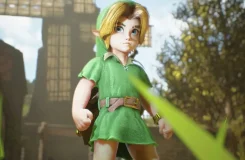
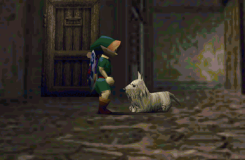
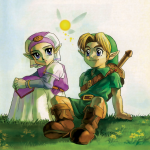
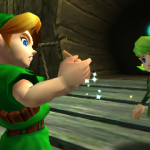
Ahh, Ocarina of Time, the Zelda game I watched my brothers play before daring to give it a try myself, the game I replayed several times before I had even turned ten years old, and the game I loved so dearly (and still do!) that I pictured Epona race along car rides and even carved a toy ocarina from a tree branch I found at school. It’s the game that sparked so much imagination and joy in my childhood that I, nineteen years later, decided to give an education in game design a try. I remember it so well even though I haven’t touched it for several years now; how the grass would fly in the air when cutting it, the Cucco noises at Lon Lon Ranch, the fear I felt when stepping inside the Forest Temple. It’s a game that’s very dear to me and I’d like to think I have a picture perfect memory of it, but when I recently made a revisit I thought that it’s… kinda ugly?
Don’t get me wrong, without Ocarina of Time, I wouldn’t be this Zelda obsessed fangirl I am today, and I understand that the technical limitations that existed back then is the reason why the game looks like it does. It’s just that, in my mind, I still remembered it as being a block-y game but… maybe a little less cube-y and a little prettier than what it really was.
My classmates and I sometimes joked that it’ll be impossible to play video games without analyzing them now that we know how a game is made but, while there is some truth in that, I haven’t been unable to enjoy playing a game for that. But it was when I wrote a piece about Kakariko Village‘s Skulltula House earlier this year and revisited the game when I realized how wrong yet right my memory of the game’s graphics was.

Since my minor was in game graphics, I couldn’t help but to stop and look at Kakariko. Really look at it, not just at a surface level like I did when I was a kid but with new eyes. The houses had seemed so realistic to me when I was a child but now, twenty-or-so years later, I realize they were simply boxes. The windows weren’t even given some depth in the walls, like the doors, but were really just textures, or simple images if you so will, slapped onto the boxes! The houses are fine, they do what they’re meant to do. They’re meant to look like homes and they do, although perhaps a bit too simple. Almost like a child’s drawing of a house, with four walls, some windows and a door, and with a pointy rooftop. Simple homes for a simple life in sleepy Kakariko Village. Nothing special at all, but they work well.
The fences found across the village were paper thin and the stair steps were, to my amusement, just triangular boxes. It was the textures that gave the illusion of depth in the steps! It was a clever solution for the time because everything in Kakariko Village, from the homes to the wooden crates and the plants, are 3D models consisting of squares and triangles. And the more triangles a model is made of, the more time it’ll take for a game console or a computer to read and interpret.
You might have noticed a slight lag when navigating in Korok Village in Breath of the Wild – that’s because all the plants with their squares and triangles are a bit too much for the Switch to handle at once. This performance issue was something that had to be taken into consideration when Kakariko was built for the Nintendo 64, so it makes sense why the stairs were triangular boxes instead of more complex models with each step carved out. It’s simple and minimal, but it creates an idea of what the village looks like, and it worked wonderfully for little me and fired my imagination, without compromising performance.

Despite my minor being in game graphics, I don’t consider myself an environment artist at all. I can create some facades and buildings and various objects in 3D but I’m still a beginner. I might not be the greatest 3D artist but I’m quite confident I’m able to replicate the Kakariko homes and make them look a little bit more, well, let’s say remodeled and updated. I’m not the only one who must’ve had the same thought because if you search online for fan projects, you’ll find plenty of examples where Ocarina of Time‘s Hyrule has been reimagined and given a refreshing makeover.
But it’s funny to think about, don’t you agree? How something that looked so realistic in my childhood was stored as a beautiful image in my mind, kind of with a blurring selfie filter, yet when I went back, it turned out to not be exactly how I remembered it. It makes me wonder, how will video games look in the future, 25 years from now? How will I remember Tears of the Kingdom? I’d like to think I’ll recall it perfectly, with its vivid colors and impressive physics, but who knows? Maybe I will be wrong yet right again!

November 21st, 2023 marks 25 years since the release of Ocarina of Time! Join us in celebrating this nostalgic gem with an entire week of dedicated articles!