I didn’t have a religious upbringing, so throughout my childhood, I found it difficult to understand why many of my peers derived such profound comfort from spending time in churches. Sure, the structures themselves were pleasantly spacious, cool, and quiet, with dazzling stained glass windows I could lose myself in for hours, but that soul-stirring sense of reverence, that unwavering conviction that I would be protected from the ills of the world, was something I craved but ultimately failed to acquire. It wasn’t until I started visiting Buddhist temples and Shinto shrines while abroad in Japan that I began to grasp this elusive concept. Every time I stepped through a torii gate, a veil of tranquility and wonder would drape across my body, sending chills up my spine; I really did get the sense that I was stepping into a sacred sphere, guarded by unseen entities. And somewhere along the way, I realized that there was one place – albeit a fictional one – that I considered a divine refuge as a child: the Temple of Time from Ocarina of Time.
I may not subscribe to the beliefs of the Hyruleans, but I can’t deny that the secluded cathedral situated on the outskirts of Castle Town Market struck a powerful chord with me from the first moment I stepped inside. The towering monument, with its high ceilings, sleek marble interior, and pools of sunshine streaming in from multiple ornate windows, came across as an indestructible sanctuary, a warm and welcoming refuge where the Golden Goddesses could ensure Link’s safety. But in the end, it was the music that really sealed the deal for me. That beautiful, haunting choir melody echoing through the chamber makes the holy center thrum with energy, as if the spirits of Sages past are solemnly watching over both the Master Sword and the young boy destined to wield it.
Now, I knew pretty early on that “The Temple of Time” was composed with synths rather than actual voices, so I’ve wondered for the longest time: what would this piece sound like if a real men’s choir decided to tackle it? Well, I finally got my answer just two months ago, and I am thrilled to say that it was definitely worth the wait.
Munx Gregoriana is a Finnish vocal ensemble group that specializes in Gregorian-style chants, recording in real cathedrals around capital city Helsinki in order to capture the acoustic characteristics of these spacious structures. Naturally, they focus their attention on choral hymns as well as video game soundtracks that feature Gregorian chants, covering pieces from Halo, Final Fantasy X, World of Warcraft, and Skyrim (the last of which will be released soon). And to celebrate the then-upcoming release of Tears of the Kingdom, five of the group’s core members – William Häggblom, Joonas Pajari, Niklas Taanila, Tuomas Tenkanen, and Joel Ward – gathered together in the Church of Suomenlinna (and captured footage along the rocky coastline of Suomenlinna Island) to produce their own incredible acappella rendition of “The Temple of Time”.
I tend to underestimate the sheer raw strength of the human voice, so whenever I hear an acappella performance like this one, I am astonished by the fact that we humble bipeds are capable of producing sounds of such depth and sonorousness. These men’s voices, magnified by the acoustics of the church, reverberate like thunder from a distant storm, shaking a person to their very core. And the tone is so pure and rich that, during the quieter moments of their chant, I am momentarily fooled into thinking that there must be a synth track backing them up. Without a doubt, it is the perfect musical backdrop to what is simultaneously the most enthralling and excruciating moment in Ocarina of Time.
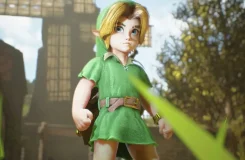
The beginning of the piece is arranged much the same way as the original song, instantly drawing us back to the moment when the green-clad child from the Kokiri Forest tentatively enters the temple’s main chamber for the first time. To me, this opening prelude is reminiscent of gently rolling waves on a calm day at sea: one is lulled by the smooth, steady cadence of the notes, but captivated by the imposing grandness of the voices and the energy that pulses just below the surface. As the blonde youth slowly approaches the altar that will serve as the final resting place for the Spiritual Stones, he drinks in this new environment, surely overwhelmed by all the intricately-carved columns and archways that masons must have labored over for years or even decades. Every crack and pore of this ancient cathedral is permeated with mysterious heavenly power, yet the more time he spends here, the more it feels like a comfortable refuge where anyone, from the most devoted Sage to the earthliest creatures that dwell in the deep woods, can find shelter. Little does Link realize that this place will, indeed, serve as his home for the next several years.
Suddenly, the men’s voices swell to new enrapturing heights as the arrangement becomes more layered and complex, and every time, without fail, I feel my breath catch in my throat. I picture the Door of Time, and with it the gates of the Sacred Realm, swinging open, and Link settling his gaze upon the lone sword in the middle of the dark room. Somewhere in the depths of his soul, he comprehends the gravity of this moment, as if the heroes of the past are whispering in his ear, urging him to step forward and claim the legendary blade that only he is permitted to wield. But the closer he draws to the sword, its otherworldly glow filling him with a sense of purpose and awe, the more uneasy he feels. After all, he’s just a kid; is he even worthy of this blessed artifact? What if the spirit of the sword finds him wanting? Destiny tightens its grip on Link’s shoulders, and the choir roars in his ears as doubt claws away at his heart. Finally he grasps the hilt, and, with one quick skyward thrust, the entire world fades into nothingness.
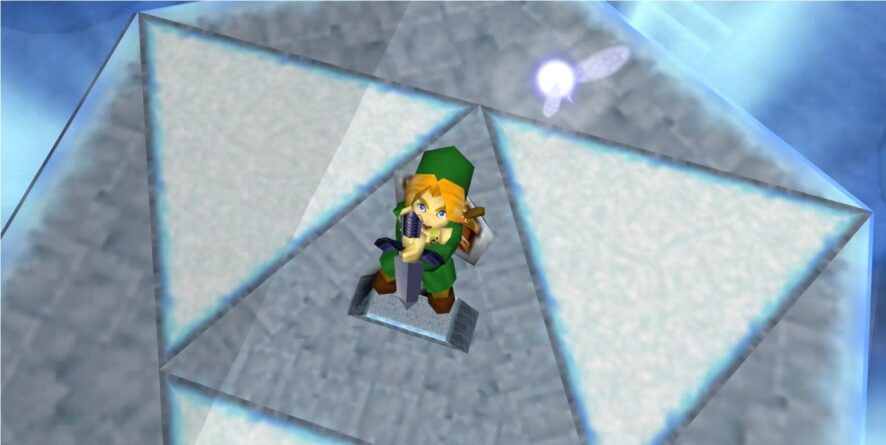
In the brief but deafening silence that follows the song’s climax, I see Link awakening in front of the now-vacant Pedestal of Time, reeling with disbelief and horror. Seven years have passed in that still, silent temple since Link claimed the Master Sword, but from his perspective, it was only a matter of seconds, not nearly enough time to process what had transpired. The poor boy, now a stranger in his unfamiliar adult body, has just received earth-shattering news: Ganondorf obtained the Triforce during his absence, and the Hyrule that he once knew has been ravaged, transformed into a wasteland crawling with evil entities. How could this possibly be true? The Temple of Time looks exactly the same as before, still standing as tall, sturdy and majestic as ever. But upon closer inspection, he realizes that something has changed: the windows once brimming with sunlight have now gone completely dark. Indeed, the billowing black clouds from Zelda’s prophetic dream are now a part of cold, hard reality, leaving their own indelible mark on this holy sanctuary.
Thus we come to the end of Munx Gregoriana’s vocal cover, a reprise of the soft, soothing opening infused with a sense of somber finality. The era of innocence has come to an end, and as much as our hapless Hero of Time may wish to stay in this marble oasis, pretending that his world isn’t crumbling to pieces, he knows that he will eventually need to confront the sprawling desert of darkness that awaits him on the outside. The one bright spot in all of this is that Link now possesses the Sword of Evil’s Bane, whose shimmering light will help him recall that feeling of warmth and comfort even in his bleakest moments. With that in mind, he sends up one last prayer for strength and takes his first bold step into the swirling tempest, determined to return to the Temple of Time as a hero worthy of the goddesses’ divine protection.
Be sure to check out the live recording session as well!

November 21st, 2023 marks 25 years since the release of Ocarina of Time! Join us in celebrating this nostalgic gem with an entire week of dedicated articles!