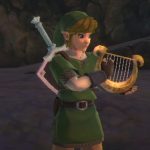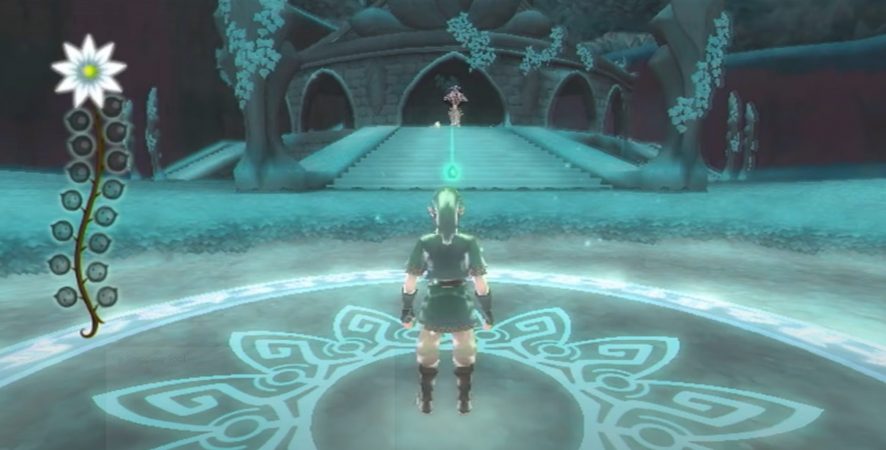
Faron Woods is a pretty lively place in Skyward Sword, thanks to its silly little Kikwi inhabitants. The area’s music is also quite cheerful until you enter The Silent Realm, a dark reflection of the forest that acts as a trial for the Hero of the Sky. The Silent Realm is quite a dangerous dimension, with a strict no-equipment policy and terrifying Guardians that will stop at nothing to get you out of their home. The musical theme adjusts to this drastic tonal shift magnificently, and in order to hear how, we’ll have to check out how the standard Faron Woods tune sets the stage.
Right off the bat, we get a string section firmly placing us in the key of A. It’s clear that A is the root note here, but the actual musical mode is a bit ambiguous. The flute’s melody outlines the entire Dorian scale (much like Midna’s Lament), but the bass-line gives me the signature playful vibes of Mixolydian (more like Goron City). The deciding factor, the chord’s third, is conveniently left out of the strings’ harmony. Key signature shenanigans aside, the rest of the arrangement is quite simple. Earthy woodwinds such as clarinets and the bassoon fill in the void left by the melody, and a glockenspiel occasionally chimes in to add a touch of whimsical flavor. This all comes together to make a silly, upbeat tune, matching the forest’s lighthearted atmosphere. However, as you already know, the less peaceful version of Faron Woods comes with a radically different rendition of its theme.
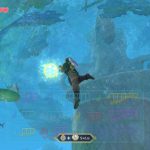
Upon entering the Silent Realm, you’ll instantly notice its ominous energy. This is largely due to its distorted visuals and eerie blue color palette, but another major factor is how the music puts you on edge. Rather than a cheery flute, the melody is played by a set of xylophones and glockenspiels. The melody is exactly the same as it was when the flute played it, but now it’s lonely, having little to no accompaniment throughout the loop. There is a soft, reverb-heavy piano and a subtle choir to add some creepy tension, but the woodwinds and strings are nowhere to be found. Due to this lack of bass tones and general harmonic content, the key’s root is left unestablished. The melody could still be heard in A Dorian, but since A is no longer the song’s obvious root, I’m more inclined to feel it in E minor. The same notes are played, but it feels much less goofy and a whole lot more unsettling without the familiarity of the chord progression and stability of the bass.
One of Skyward Sword’s greatest features is its soundtrack and the contrast between these pieces is a show of artistic genius. It’s a perfect example of how a song’s emotional core can be completely overturned just by using arrangement techniques. It could be a whimsical romp, a spooky ambience, or anything else you could imagine. The chilling atmosphere they created even mirrors the story spectacularly, as the theme becomes much lonelier when Link leaves all the Kikwis (and even Fi) behind to tackle the goddess Farore’s sacred challenge. Going in alone is definitely for the best though – I doubt that Oolo would ever be the same if he caught even the slightest glimpse of the Silent Realm’s guardians.