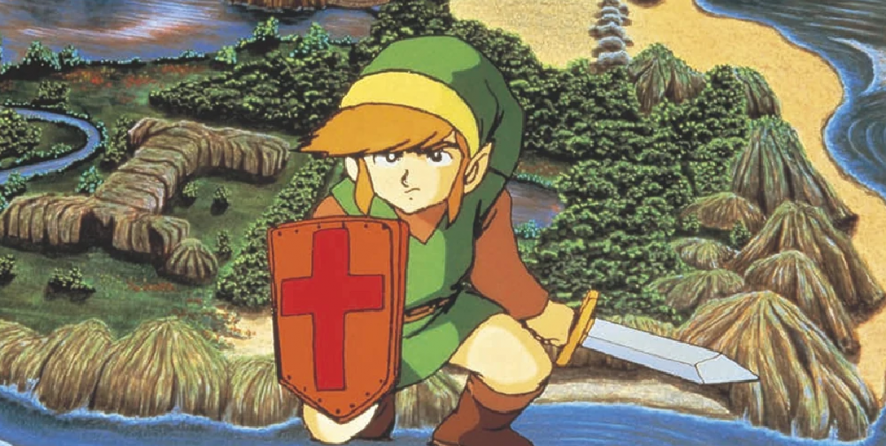
The point of the Tingle’s Maps column is to write about fun and interesting places present throughout the Zelda series, and this article is no exception, as I intend to discuss some cool locations present in the very first Zelda game. Now, the graphics in The Legend of Zelda are clearly reflective of the time, with the minimalistic 8-bit goodness we’ve come to associate with the 1980s. So for a change of pace, I thought it would be fun to explore some locations as they appear in official artwork of the game.
Some riveting information that I uncovered during the research phase of this article is that the entirety of The Legend of Zelda takes place on Death Mountain — the very same Death Mountain that appears in A Link to the Past. I also discovered that the Legend of Zelda map covers a small portion of the map from The Adventure of Link. That means that the first three Zelda games all share the same Hyrule, which is something that I didn’t know!

Let’s start with the first picture. Here we see Link kneeling on a cliff overlooking what is presumably Death Mountain. Link is carrying a sword, so it’s safe to assume that his adventure has already begun. When I first began to research this image, I thought that Link was traveling around the base of Death Mountain before the start of his adventure, but he wouldn’t have a sword yet if that were the case. The colors show a red sunset sky, reddish mountains, and pale green foliage.

The second image features Link kneeling with a good chunk of land behind him. To his left is a rocky shoreline with plenty of plants, and to his right is a rock structure. (I thought that this rock structure was a dungeon, but I’m not sure if it’s just rocks or if it’s supposed to represent a building.) The background shows a lake and/or river as well as Death Mountain, all under a reddish orange sunset. This image comes from the eastern side of the map.

Both of these pieces of official artwork feature the land of Hyrule around sunset hours. It gives off the impression of this Hyrule is quite daunting and unfriendly compared to other versions of Hyrule from later games. For example, Breath of the Wild’s Hyrule is post-apocalyptic, but official artwork depicts it as bright and comforting. There is one piece of official artwork from The Legend of Zelda that shows Link helping an old woman, and it takes place during the day. The grass and trees look painted on, and while the background is boring, it reminds me of less interesting areas in Breath of the Wild. Interestedly, the locations shown in official artwork for The Adventure of Link seem much brighter.
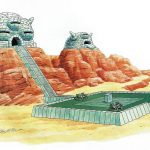
A good portion of official artwork from the first Zelda game features Link traversing a dungeon with a brown and beige color palette. In these pictures, he is being confronted by various enemies, including Keese, Lanmolas, and a Darknut. The dungeons depicted in these pieces of artwork admittedly have a somewhat boring color scheme, but they show Link solving puzzles and fighting enemies, which is pretty cool in my book! These images give the dungeons a little bit more detail, too; for example, the dungeon entrance is a mouth with long, sharp fangs, and some of the statues have humanoid faces.

The last piece of artwork presents us with Link and Princess Zelda as they try to escape a dungeon. Link is up against several different kinds of enemies, and Zelda looks overwhelmed. The colors scheme isn’t so brown this time, opting instead for a bluish gray tint. There is a statue that resembles a human face, and it also appears that Ganon is behind them. I’m actually not sure if that’s Ganon, but either way, he seems like a massive threat!
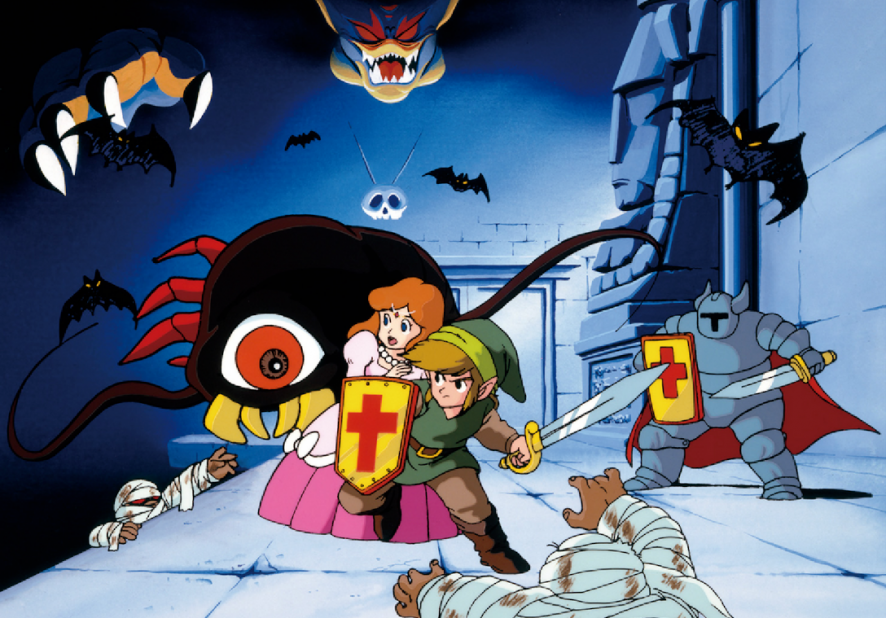
The Legend of Zelda doesn’t have as much official artwork as many newer Zelda games have, but I think the art that exists is worth talking about. The minimalist pieces convey how the developers envisioned the land of Hyrule, as well as how big or small certain enemies are meant to be in comparison to Link. These images allow us to view this Hyrule better than we ever could in 8-bit form on a small screen.
So yeah, this might not be your typical Tingle’s Maps article, but writing about how official artwork influences how we view Hyrule’s landscape in the first Zelda game was a valuable experience for me. You should definitely try comparing and contrasting official video game artwork with actual in-game graphics sometime. What you discover might just surprise you.