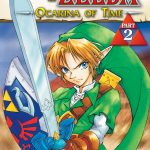
Link’s Awakening received a manga adaptation a year after the original release. Ataru Cagiva gives us a much more personal take on the events of the game. For the most part, the events are the same, but there’s more dialogue; even our silent hero is given a voice! One of my favorite dramatized moments in the manga is the midpoint at the Face Shrine, where Link opens his eyes to the truth.
At this point in the manga, Link has completed a few dungeons and is just going along completing the dungeons as he is so compelled to do, same as in the game. All he knows is that this mysterious owl continues to give him vague explanations and tasks him with going on to the next location. This annoys Link, but if it means helping the people of Koholint, he will do whatever he can. Unlike the game, Link is given a fairy companion. I guess it is too dangerous to leave Link alone with his thoughts for too long. This fairy companion is hesitant to travel to the Face Shrine, making it clear that she knows something about the dungeon. If you have played the game, you too understand the dramatic irony. The fact that Link is about to see the truth of Koholint and face the fact that none of this is real.
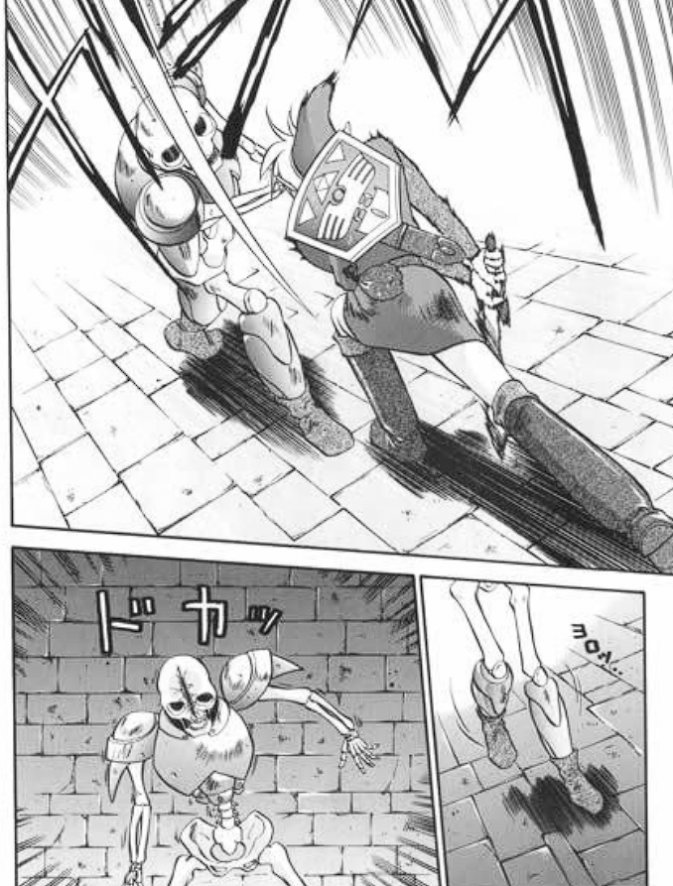
In the manga, the Face Shrine replaces what would be the Southern Face Shrine in the game. The outside of the Face Shrine resembles the same wall carvings of the Southern Face Shrine. I do not really know what the wall carvings are supposed to be, but it’s distinct, so that’s pretty cool. Unfortunately, the inside of the manga version of the Face Shrine does not use the same level of quality masonry that we find in the game. In the game, we have nice floor tiles and more complex designs for the walls. But in the manga, it seems to be pretty basic brick and mortar. It is a more realistic look, I guess. I mean why would a dungeon wall art? But I think the Wind Fish can dream up more complex dungeons.
Like in the Southern Face Shrine, there is only one enemy here. Instead of an Armos Knight though, the Hero of Legend duels with an above-average skilled Stalfos. I assume his skills are above average since it takes Link more than two panels to defeat him. When finally felled, the Stalfos uses his dying, eerie words, urging Link to question his heart, question his intentions; for Link is still unaware of what his course of action will lead to. After getting the skeleton key from the fallen Stalfos, Link goes to unlock the treasure door. These massive, hulking doors, with this tiny keyhole that hides the iconic mural of the Wind Fish. The mangaka stays rather faithful to the game with the wall. I like this scene as Link hesitates, almost as if he knows that something is wrong and that he is about to learn a truth that he would prefer not to hear. He tries really hard to convince himself that he is a hero, and whatever he is doing is for the good of the people of this island, no matter what that Stalfos is trying to say. If he goes, he sees the mural that explains the strange nature of Koholint and the fact that this island is a mere fabrication and with waking the Wind Fish the island and its residents will cease to exist. He finds that all his actions thus far have been to destroy Koholint. For the first time, it’s as if he is the antagonist.
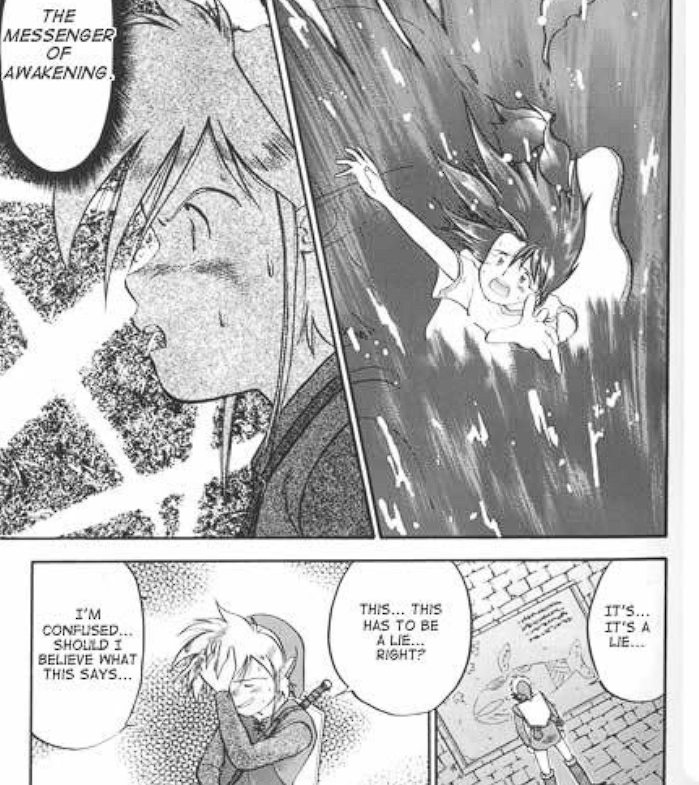
I really love the manga version of the Face Shrine because it really helps bring this tragedy Link faces to life. Of course, with Link being a silent protagonist in his games, and not even being able to display facial expressions in his little 8-bit face, we don’t really get to see how Link feels about all of this. In the game, I do really enjoy getting to feel those emotions for Link as the player: it’s what makes the video game medium so cool. But I also like actually seeing Link’s reaction. The entire manga really does a great job of making the conflict of Link’s Awakening feel much more dramatic and personal. The scene at the Face Shrine makes this midpoint hit even harder than it did in the game which is why I loved this chapter so much.