The key to any great story is a colorful cast of interesting and memorable characters, something that the Zelda series generously provides on a regular basis. Some characters are important to us because we see a reflection of ourselves within them, such as the irreverent yet sensitive Midna from Twilight Princess.
Others we take a liking to because they represent the people we aspire to become, like the confident and fearless Tetra from The Wind Waker. But if you’re a mystery-loving nerd like me, then the absolute best characters are the enigmatic outliers who hide dark secrets behind a wall of riddles. In that case, the Moon Children from Majora’s Mask are exactly the kind of conundrum you’re looking for.
After the Four Giants save Termina from a fate of fiery destruction, the demon Majora finally separates itself from the unconscious Skull Kid and retreats into the depths of the Moon, daring Link and Tatl to follow. Once inside the Moon, Link finds himself in the middle of a vast meadow, punctuated by a single large tree in the distance. Beneath this tree are five children, four of whom are playing with each other, while the fifth is sitting quietly away from the rest of them.
First, let’s focus on the four children running around the field. Each of them is wearing the remains of one of the four major bosses of the game: Odolwa of Woodfall, Goht of Snowhead, Gyorg of Great Bay, and Twinmold of Ikana. That’s rather disturbing all on its own, but based on the little that we can see behind the masks, they also bear a striking resemblance to the Happy Mask Salesman (though during a Miiverse interview, the Happy Mask Salesman claimed not to know them and seemed surprised that they look like him). One’s first instinct may be to avoid these unsettling weirdos, but the game’s true ending can only be accessed by interacting with them, so one must press on.
Upon speaking with these children, it quickly becomes apparent that they are unaccustomed to making conversation with people. They speak in short, fragmented sentences, appearing nervous as they awkwardly comment on the nice weather. But then they perk up when they see that Link has masks, asking if he plans to follow in the Happy Mask Salesman’s footsteps. After demanding that Link give them some masks from his collection, they each invite him to play hide-and-seek, leading him through miniature versions of their respective dungeons in order to find them.
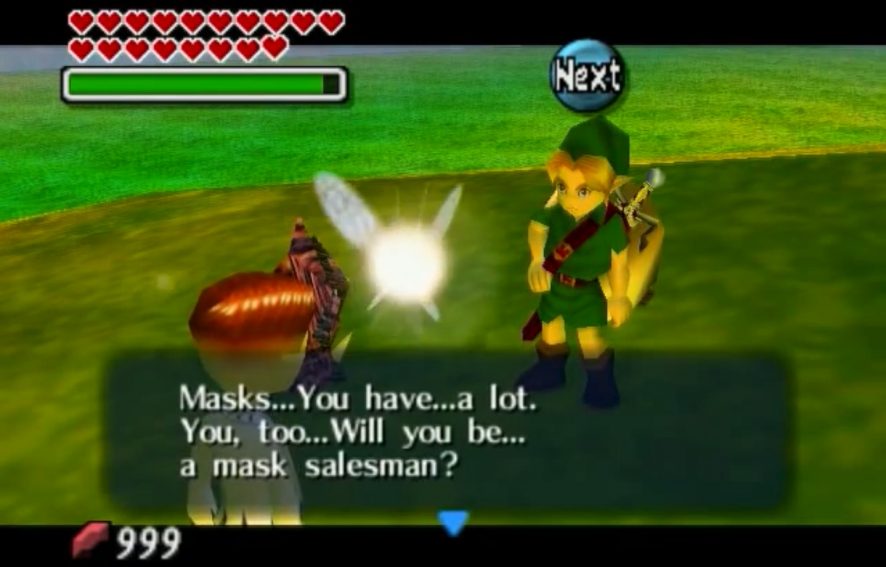
This is when things start to get really interesting. Once the children are found, they will extract even more masks from Link’s dwindling supply before asking a series of extremely cryptic questions. They ponder the nature of friendship, the relationship between happiness and morality, and whether following one’s passion truly makes the world a better place. But the Twinmold child asks the most unusual question of all, wondering what a face truly looks like when you remove the mask.
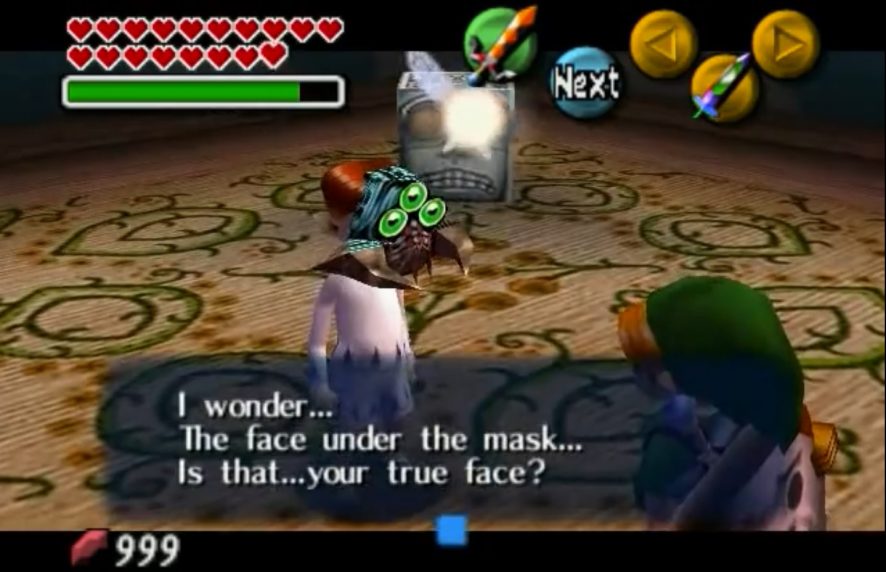
If the theory holds true that the world inside the Moon is an illusion created by Majora, it stands to reason that the Moon Children represent different fragments of Majora’s overall personality. The four boss children paint a picture of a curious, childlike entity who sincerely desires to learn about the world outside of its own sphere of existence. Majora has spent its entire mortal life as a mask, unable to separate its own sense of identity from that of the lifeless masks humans wear for fun. It’s understandable, then, why the Twinmold child would wonder what a “true” face looks like.
The only individual Majora has observed long-term is the Happy Mask Salesman, so as odd as it may seem, he is actually the most likely person the Moon Children would choose to emulate when taking on human forms. It’s also clear that Majora wants to understand why Happy Masks hold such power over people’s emotions, eagerly snatching up as many masks as possible in order to feel that “happiness”. And above all, the children’s quirky behavior demonstrates just how naive Majora is, struggling to comprehend the most basic concepts behind human interaction.
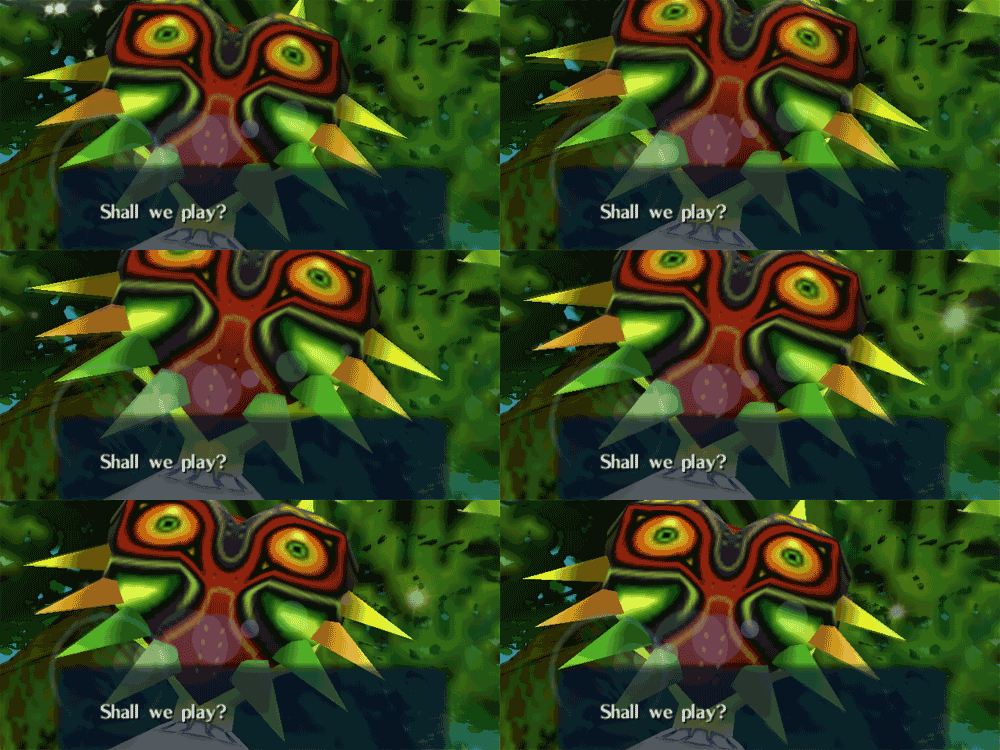
But as most of us know, this is just the tip of the iceberg. Now we must turn to the fifth child, who wears the titular demon mask that has haunted us throughout the entire adventure. Unlike the other four kids, this one sits curled up by himself, just staring off into space. If you’re anything like me, you feel a semblance of pity at the sight of this creature, as it calls to mind the quiet kids who sit alone in the lunchroom at school. So when he asks if you will play with him, you say yes in part because you want to make him feel better.

This warm feeling doesn’t last long, though. If any of the other children are still in the field, then the interaction with the Majora kid is fairly brief, quickly leading into the final battle against the demon incarnate. However, if the playground is empty, then the child will propose a game of “good guys against bad guys,” giving Link the Fierce Deity’s Mask as a way of leveling the playing field. But the child is quick to stipulate that Link is the bad guy, and all the bad guy gets to do is run.
Through the interactions with all five Moon Children, we can finally begin to grasp the true depths of Majora’s wickedness. Despite the layers of complexity the other children have added to the demon’s personality, the Majora child shows us that it is still, at its core, a cunning and sadistic predator. It wants to understand what makes people tick, for the sole purpose of knowing exactly where to throw the wrench into the works. Sowing discord into people’s lives, hitting them where it hurts the most, is all just part of the game: Majora is the “good guy”, chasing down and torturing those unfortunate enough to be ensnared in its web. And the more powerful the opponent, the more fun it is to watch them squirm. Everything this monster does is a means to a twisted end.
So make no mistake, the Majora child is not meant to be pitied. He is, in fact, the master of the playground, the bully who stands tall above all the other children. He’ll patiently watch from the sidelines as the other Moon Children draw you in with their odd mannerisms and probing questions. Then, when the time is right, he will quietly remind you that he is, ultimately, the one who is always in control.