The discovery of one’s soulmate is often classified as one of life’s greatest moments. The immediate personal connection is intense and powerful and elicits the feeling of two lost puzzle pieces joining together in perfect harmony. It is natural to be initially consumed by the infatuation; however, many couples soon search for a way to substantiate the connection that exists between the two parties. As such, the Internet is littered with compatibility tests and other quizzes designed to quantify the strength of a lover’s bond. While the results of the aforementioned tests are rarely concrete and absolute, the world remains infatuated with measuring the level of attraction between two people.
Based on an obscure Easter egg in Majora’s Mask 3D, the Professor from the Marine Research Lab might also have been enamored with measuring the strength of a couple’s relationship. The reference not only provides deeper insight into the Professor’s experiments but also highlights Nintendo’s odd history as a company.
Majora’s Mask is filled with peculiarity, but the Marine Research Lab is one of the more unique locations in the game. Located in the middle of the Great Bay, the lab is home to the Professor. While his primary focus is assisting in the hatching of Mikau and Lulu’s eggs, the Professor appears to be consumed with a variety of experiments. The giant aquarium dominates the room; however, a unique Easter egg can be discovered on the Professor’s desk in the Majora’s Mask 3D version of the game.
Hidden between two chemistry beakers lies a device called the Love Tester, which is an odd product that Nintendo released in 1969. Developed by renowned hardware designer Gunpei Yokoi, the Love Tester turned the concept of a galvanometer into a novel toy. Instead of measuring the electric current, the Love Tester proclaimed that it could quantify the amount that two people loved each other. By holding the cylinder dials and each other’s hands, two lovers would receive a reading between zero and 100, which signified the strength of their connection.
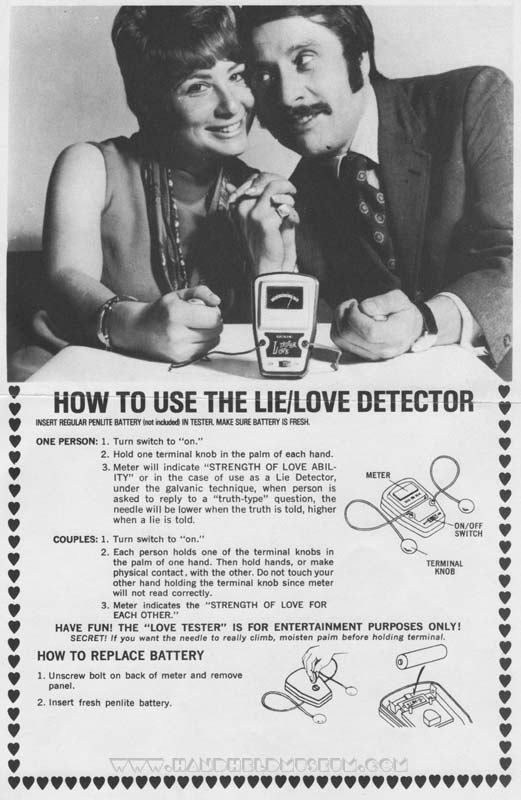
The Handheld Museum actually found an old instruction manual for the device. The manual appears to indicate that the proper way to use the Love Tester is to ask a series of “truth-type” questions to your lover. Responses would then either move the needle closer to the 100 marker or move the needle closer to the zero marker. As with any toy of this nature, the instruction manual includes a large disclaimer indicating that the device is purely meant for amusement.
Nintendo also released a short television commercial in Japan for the product. The commercial hints that the Love Tester would record a stronger reading if two lovers performed a kiss while holding the cylinder dials.
Gunpei Yokoi would go on to develop some of the most iconic hardware in the video game industry, such as the Game & Watch and the original Game Boy, and produce beloved installments in the Metroid and Kid Icarus franchises. Despite all of his success, the Japanese community had so much nostalgia for the Love Tester that Nintendo of Japan released a second version of the device in 2010.
The Professor at the Marine Research Lab might not be able to use the Love Tester to measure the strength of your relationships, but his desk is still the resting place of a fun reference to Nintendo’s odd history. Be sure to have a closer look the next time you fire up the Nintendo 3DS for another playthrough of Majora’s Mask 3D!