One of the multitudinous reasons I thoroughly adore the Zelda series is that, despite all the thematic threads that draw the stories together into one cohesive saga, each game possesses its own distinct personality that allows it to stand out from the others. A Link to the Past is a brutally harrowing trek through a kingdom overwhelmed by death, decay, and deformation, The Wind Waker is a charming and whimsical quest with a healthy balance of goofy humor and melancholic contemplation, and Breath of the Wild is a wondrously lush world of meditative beauty built on a foundation of unfathomable grief. But if I had to pick the game that I believe embodies pure, unadulterated delight, it would be Skyward Sword. Everything about it, from the mesmerizingly colorful world to the phenomenally diverse soundtrack, just screams joy. Even the stressful encounters with Ghirahim and the Imprisoned don’t upset me quite as much as other antagonistic clashes in the series; all it takes is a few minutes of relaxing in Lake Floria or drinking soup at Pumpkin Landing to wipe the pain from my memory. Without a doubt, this is the Zelda game I flock to when I want to feel happy.
However, there is an oft-overlooked extension of the Skyward Sword universe that delves into a far darker side of this deceptively upbeat game. In fact, considering all that we’ve come to learn about Link, Zelda, and their respective descendants over the years, I would sincerely argue that this is one of the bleakest, most heart-rending stories in the entire Zelda canon — or rather, it would be if not for the circumstances surrounding its creation. So to celebrate the 10-year anniversary of the beloved game’s release, as well as that of Hyrule Historia, I thought I would take a fresh look at the Skyward Sword prequel manga, one of the greatest missed opportunities this writer has ever seen.
This particular story, which is featured exclusively in Hyrule Historia as part of Zelda’s 25th-anniversary celebration, was penned by legendary manga duo Akira Himekawa, who are responsible for most of the Zelda manga we have come to know and cherish over the years. Their versions of the stories are considered by many to be superior to those of the games, as they endeavor to transform Link from a stoic avatar into a fully humanized character with flaws and aspirations, in addition to fleshing out the personalities of the people he interacts with and even changing certain story elements to help the plot progress more smoothly.
But while in the past the authors were free to write as much as they needed to fully realize their visions, they were only allotted 32 pages of space for the Skyward Sword manga. For a little bit of perspective on that, the Ocarina of Time manga is 378 pages long, and the first volume alone of the Twilight Princess manga required 200 pages to complete. So the Himekawa team was forced to tell a far more compact story than it would have otherwise, resulting in a final product that is, to put it bluntly, a bit of an undercooked mess. The utterly gorgeous drawings characteristic of Himekawa’s work cannot compensate for the rushed pacing, underdeveloped characters, and significant lack of context that trample all over the beautifully rendered panels. And I can’t begin to express how much it pains me to say that, because buried underneath the glaring flaws is an astonishingly poignant narrative that, if allowed to properly grow and flourish, could easily have been considered Akira Himekawa’s magnum opus.

Like I said before, this manga doesn’t retell the Skyward Sword story as the others do for their respective games, but instead acts as a prequel that focuses on Demise’s savage attack on the Surface. We begin with a very brief introduction to a young Skyloftian Link, who spots a majestic Crimson Loftwing gliding through the sky and ponders why the sight of the bird gives him a sudden urge to fly himself. Then we abruptly shift to thousands of years in the past, where we see Link’s ancestor, the original Chosen Hero, cruelly chained up in a cold, filthy prison cell. Judging by the tattered clothes, the bruises inked across the young man’s arms and legs, and the jaded gleam in his dull blue gaze, it quickly becomes clear that Link has been imprisoned here for quite some time. Like a sickening punch to the gut, we realize that this Link is far different from those in his long line of successors. While they have the luxury of starting off their stories as innocent forest children or carefree pastoral farmers, our broken warrior already has so much bitterness and despair etched into the shadows under his eyes.
However, it’s when Link’s fellow countrymen come to release him from prison that we encounter our first major problem with the story layout. One of the villagers explains that a man named Lord Dagianis, who framed Link for some unknown crime for some unknown reason, has been murdered by Demise, and that they were wrong to ignore Link’s vision of impending disaster. It feels as though we’ve skipped the first 100 pages of a novel and dropped right in the middle of the book, without any knowledge of how the plot unfolded prior to that point. Similarly, it only takes a little bit of prodding from the villagers for this brutally battered soul to regain his fortitude and throw himself wholeheartedly into the conflict. While this does align with Link’s courageous nature throughout the Zelda series, it doesn’t feel earned here because it undermines the suffering the man has clearly endured over the last few years, lessening the impact of what they just established about his character.

After Link successfully rallies the denizens of the Surface to battle Demise’s army, Her Grace Hylia suddenly rides in on a Crimson Loftwing, who is revealed to be a sentient guardian spirit seeking a hero worthy to be her rider. But because the soldiers initially mistook them for monsters instead of gods, the Loftwing haughtily proclaims that they wasted their time, leading Link to argue that humans make up for their lack of divinity with an abundance of courage and integrity. This is actually an amazing concept, as an ongoing conflict between Link and the Loftwing could organically evolve into a strong bond built on compromise and mutual understanding, thus justifying the powerful relationship that Link has with his Loftwing in Skyward Sword. That kind of character growth requires a lot more time than this manga is allotted, however, so the next time we see the Loftwing during the climax of the battle, she has already reached the point where she accepts Link as a hero and declares that they will “fight together for eternity.” So there’s another casualty of the rushed pacing in the story.

The goddess tells Link that the Master Sword was originally forged by the gods, so in order for the chosen hero to wield it, he must melt it back down and temper it with his own two hands. There are no Sacred Flames mentioned here, so the implication is that Link’s kind, courageous spirit is enough to imbue it with the power to repel evil. I personally love this spin on the story, since it always bothered me that the Goddess Sword and Fi were more closely connected to Hylia than they were to Link. Having the sword reforged from the original hero’s suffering not only strengthens Link’s personal connection to the Master Sword, but it could also do wonders for Fi’s character development in Skyward Sword by making her a bit more empathetic towards her Master. I did like Fi in the game, but the potential is there in the manga for her to be so much more interesting down the line.
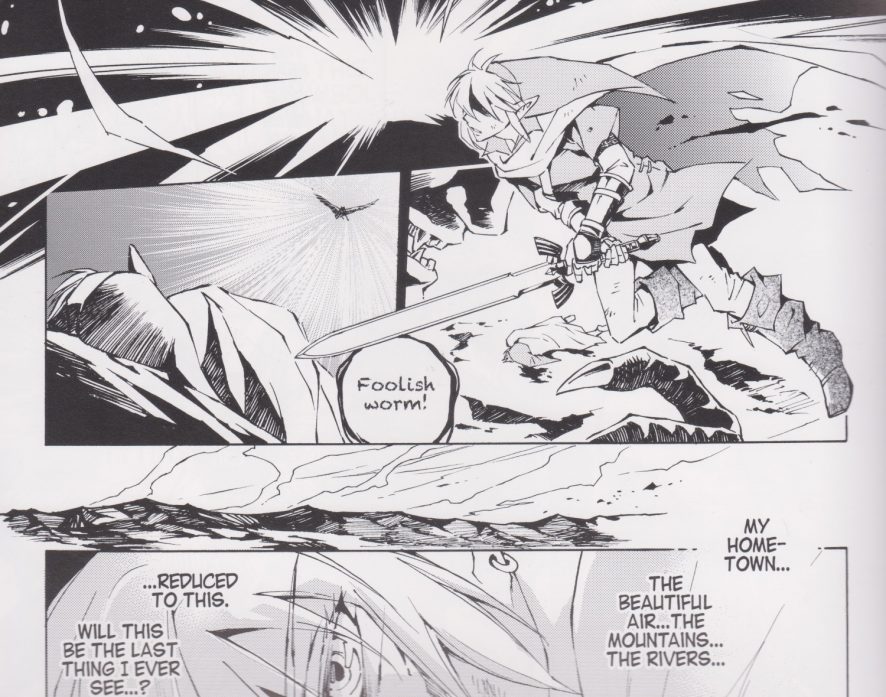
From here, the rest of the story plays out the way you might expect. Demise’s army launches an assault on the Surface, and despite the best efforts of all the ground dwellers to fight him off, the Demon King overpowers them and mortally wounds Link. In their hour of despair, Hylia and Link use the Master Sword to cleave through the earth and send a group of surviving humans skyward, taking the Triforce to safety beyond the clouds. Though his friends beg for him to come with them, Link is too weak to follow, succumbing to his injury after proclaiming his everlasting love for his land and his people. Stricken with grief over his noble sacrifice, Hylia promises that Link’s spirit will live on forevermore, and she vows to sacrifice her own immortality to be reincarnated as a human by his side. Thus we return to the beginning of the story, as the Crimson Loftwing approaches the child of Skyloft and reaffirms her bond with the spirit of the hero.
Considering how bruised and world-weary the original Chosen Hero was when we first met him, I think that having him die in battle is a poignant yet perfectly fitting ending to his story. Building Link’s legacy on a foundation of struggle and loss makes for a far more emotionally compelling origin story than starting off with a boy who lives a pretty carefree life until the day he has to save his best friend. But at the same time, this ending highlights the manga’s most damaging flaw: The relationship between Link and Hylia is painfully rudimentary. Given how vibrant and spunky Zelda is in Skyward Sword, and how charming and sweet her bond with Link is, I fully expected a similar kind of intimacy to develop between their ancestors in the manga. At the very least, this would have justified Hylia’s grief when confronted with the death of her chosen hero. However, the two of them only have one very formal conversation when they meet for the first time, and then we never see them speak again before Link passes away. I guess it’s possible that Hylia’s deep compassion and sympathy are what prompted such a strong reaction to his sacrifice, but at the end of the day, it just feels like their relationship was left to languish on the sidelines in order to make room for the other parts of the story.

I realize that my harsh judgment has probably led you to believe that I despise the Skyward Sword prequel manga, so please let me make one thing clear: At the center of all that I have criticized, I can see a kernel of an absolutely phenomenal tale. This has all the makings of a beautifully somber, achingly poetic masterpiece, and to see its potential squandered is such a crushing disappointment. But I don’t blame Akira Himekawa for that; it’s obvious to me that they were truly passionate about this manga, and they simply had too ambitious of an idea to fall in line with the 32-page restriction they were given. It’s just a theory, but I wouldn’t be at all surprised if this experience is what inspired them to expand the Twilight Princess manga far beyond the typical length of their Zelda series. I do have the deepest respect for these gifted and insightful women, and I genuinely hope that one day, they can return to this manga and help it blossom into the emotionally rich origin story it truly deserves to be.


Skyward Sword is 10 years old on November 18, 2021! We’re celebrating with dedicated articles all week.