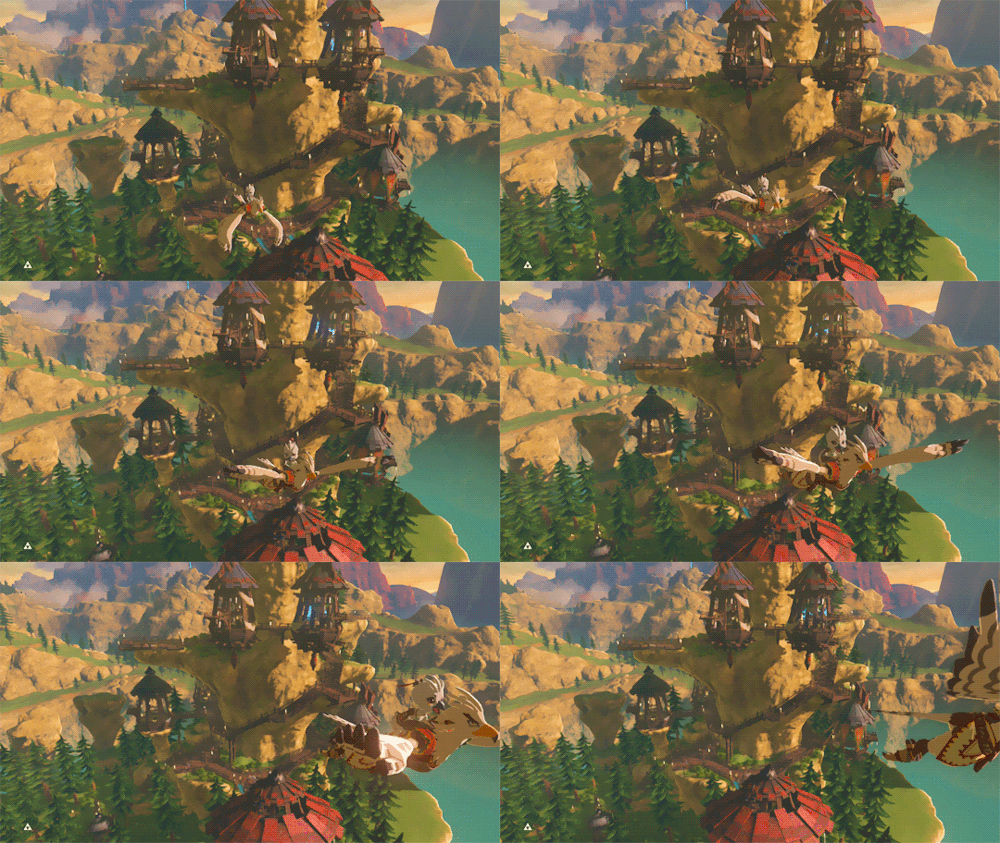
I was very excited to discover and explore Rito Village in Breath of the Wild. Since their first appearance in The Wind Waker, the Rito have been among my favorite races in the Zelda games, and I highly anticipated their return to the series. I was not disappointed. Rito Village is a beautifully colorful and uniquely designed location built on a mesa rising to the sky. I always look for reasons to return here and wander. Based on the design and music from Dragon Roost Island, I shouldn’t have been surprised to learn that the attractive design of Breath of the Wild’s Rito Village took heavy inspiration from Latin American culture, particularly a well-known Peruvian song.
In the Breath of the Wild art book Creating a Champion, Lead Structural Artist Manabu Takehara explained that, as he and his team were nearing completion of the design for Rito Village, “I had the traditional Andean song ‘El Cóndor Pasa’ repeating endlessly in my head. Needless to say, that is why there is so much colorful cloth used in the village’s design.” The cloth had an added benefit. Takehara continues, “Another big reason is that was a good way to express wind along with the windmills.”


“El Cóndor Pasa” (Spanish for “The Condor Passes”) is an orchestral piece from the zarzuela (a Spanish-lyric musical drama) of the same name written by Peruvian composer Daniel Alomía Robles in 1913. The song is based on traditional Andean, particularly Peruvian, folk music, and includes Peruvian instruments like the charango (which resembles a small guitar) and flutes. Globally, it is the most well-known Peruvian song, due in part to a 1970 cover by Simon & Garfunkel. It has become an important part of Peruvian culture, being declared part of the country’s national cultural heritage in 2004 and currently considered the country’s second national anthem.

The effect of the Andean culture on Rito Village’s design is clear in the colors of the buildings, the cloth that hangs from many of the structures, and even in the carpets and pottery that are found on the floors. While I appreciate how “El Cóndor Pasa” helped shape this design, I can’t say I would prefer any other music than that composed for Rito Village. The reimagining of the Dragon Roost Island melody was a wonderful surprise and part of the reason I always find myself back meandering up and down the spiral staircases of this town.
Real-life locations and visual art often serve as inspiration for video game design, but this example shows that music can also serve that purpose. Often I find myself listening to music and imagining a scene based on what I am hearing. While this usually remains in my head, Takehara and his team were able to use their creativity to make a delightful addition to an amazing game.