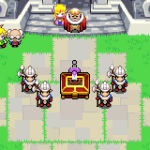
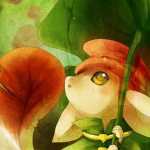
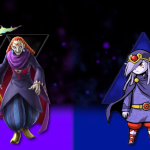
The Legend of Zelda: The Minish Cap creates one of the most charming versions of Hyrule in the series. It introduces the drastically underused Picori who are simultaneously the cutest creatures in the series (sorry, Sidon!) and also extremely wise. It fleshes out the character of Vaati and finally brings us a villain who can stand toe-to-toe with Ganondorf. Most importantly, it has one of the best versions of the “two worlds” mechanic in the series: shrinking.
Unlike the Dark World or the conquered Hyrule of Ocarina of Time, which are veritable hellscapes, the miniature settings Link finds himself in after shrinking are simply charming. Book spines become ladders, puddles become uncrossable lakes, and Chuchus become towering, gelatinous bosses. Finni’s piece of art, “Falling Raindrops,” perfectly captures this charming feeling as the viewer watches a minuscule Link trying to escape a life-ending light drizzle.
As is often the case with Zelda art, our eye is immediately drawn to Link. In this piece, he has one eye squinted as he dashes through the titanic raindrops falling around him. This simple detail is so meaningful in how relatable it is. Anyone who has been caught in the rain without an umbrella can sympathize with Link’s mad dash to find some shelter.
The leaf Link is using as a makeshift umbrella only adds to the cuteness of this image. Not only does the idea of the hero using a teeny tiny leaf to shield his eyes from the rain invite a chorus of “aws,” but the positioning of the leaf to Link’s face also calls to mind another group of Zelda characters. The orientation of the leaf and the way it is next to Link’s face calls to mind the Kokiri of The Wind Waker and Breath of the Wild. This connection to the fan-favorite race (despite Hestu’s “gift”) only serves to endear us to the Link shown in this image more.
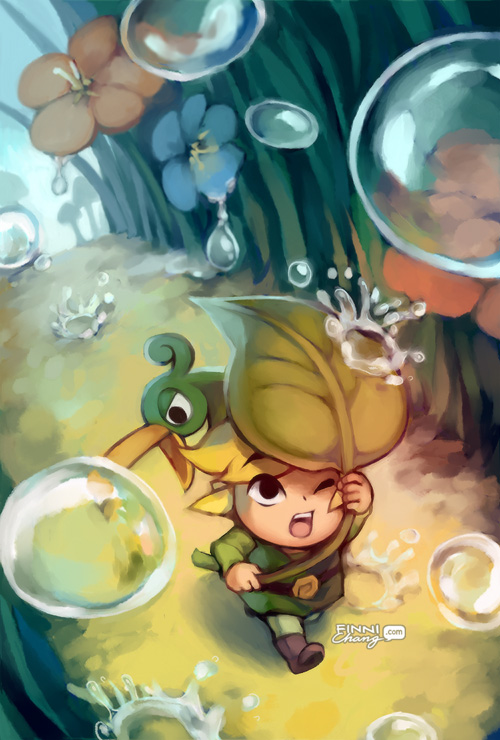
Moving on from Link, the background that the hero is traveling through invites careful inspection just as it does in the game. On the upper right are blades of grass that tower over the green-clad adventurer, forming a lush, foliage canyon for him to rush through. Larger-than-life flowers embellish the greenery and drip with moisture. All the while drops of rain the size of exercise balls fall through the air, shining with light, and promising danger for the adventurer and his cranky cap. While some of the drops remain mostly spherical, those that have impacted the ground have turned into beautiful, wet explosions. Each one threatens to drench Link just as surely as the spray from a quickly moving car would do to us. In his reduced size, even a light rain could end Link’s quest real quick and make him the laughing stock of the “Soul of the Hero” convention. He would be the hero who was drizzled to death. The ridiculousness of this danger adds to the charm of it. While a mortal danger to Link, these same drops would merely dampen our eyelashes and bedew our clothing.
Of course, I cannot finish analyzing this art without looking at Ezlo. Not only is he important to the image, but his voice would likely lecture me from beyond the game! Throughout The Minish Cap, Ezlo (and his constant nagging) is your companion. Finni’s art calls all of these moments to mind and creates an image we can hear. “You’re a fool of a Hylian getting us caught in this deluge! Your mind must be as runny as these droplets!” The vicious insults dropped by Ezlo’s beak might not hurt Link’s body but surely would hurt his soul. Poor Link!
All throughout The Minish Cap, the player encounters moment after moment that oozes charm. Finni’s “Falling Raindrops” invites us to experience a moment that, while unseen in the game, is just as enchanting as entering a mushroom that’s been turned into a home or climbing the spine of a book to continue the adventure.