‘Tis a quiet, moonlit night in the vast kingdom of Hyrule. A soft breeze rustles the leaves of the trees ever so gently, and the clouds above part every once in a while to reveal a pocket of glimmering stars. You’re just passing the time harvesting Silent Princesses and collecting honey from beehives when suddenly, you spot something rather unusual: a hazy, sea-green aura surrounding the peak of the distant Satori Mountain.
Upon investigation of this strange phenomenon, you discover a beautiful spring full of clear, sparkling water near the top of the mountain, awash in the otherworldly glow. Delicate, bunny-like Blupees are gathered around the perimeter, gazing reverently at the large, breathtaking entity taking a drink in the middle of the spring. Its strong, equine body shimmers with pale blue light, and two owlish faces, framed by a lustrous white mane and topped with two golden antlers, calmly observe the surrounding environment. But its serene countenance belies the razor-sharp attention it pays to every little movement, lest any unwanted interlopers disrupt the peace. Indeed, this majestic creature lives up to its regal title: the Lord of the Mountain.
The eponymous guardian of Satori Mountain is definitely one of the most fascinating creatures I’ve encountered in the Zelda series. Though it only plays a very minor role in the world of Breath of the Wild, its ethereal beauty has thoroughly captivated my imagination. But while I mostly see people lamenting the fact that Satori cannot be registered as a full-time steed at the Stables, an entirely different quandary has been plaguing my mind: Why does this creature look so familiar?
As is usually the case when I encounter an enigma in the Zelda universe, my first instinct was to investigate East Asian mythology and attempt to trace the cultural origins of the Lord of the Mountain. And sure enough, I came across one remarkable creature that aligns almost too perfectly with our lovely equine friend. Ladies and gentlemen, allow me to introduce you to the “Qilin” of ancient China.
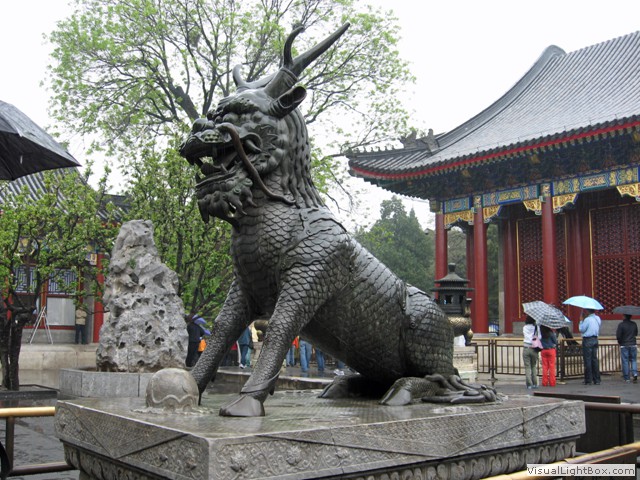
The Qilin (麒麟 in Chinese) is a revered chimerical entity said to be the third most powerful in the entire pantheon of Chinese mythological animals. Each depiction of the beast varies to some degree, as some artists choose to elaborate on the dragon anatomy more than others, but the one feature they all have in common is the body of a large ungulate with cloven hooves. In addition, most versions possess one or more horns/antlers, leading to the rather erroneous correlation between Qilin and the Western concept of a unicorn. But the similarities don’t stop there: like unicorns, Qilin are good omens known for their gentle and pacifistic nature, abstaining from meat consumption and taking care not to crush even a single blade of grass beneath their hooves. They are said to only show their ferocious side when a pure-hearted individual is threatened by malice.
In Japan, the Qilin becomes the Kirin (きりん in Japanese), a benevolent Yōkai whose dragon-like features are often toned down in favor of a more elegant, deer-like appearance. Interestingly, “kirin” is also the Japanese word for “giraffe,” which traces its origins back to the Ming dynasty when giraffes were brought back to China after a trade mission in East Africa. The graceful, herbivorous nature of the giraffes led the locals to equate them with Qilin, and that comparison persists in the Japanese and Korean languages to this day. But other than the appearance modification, Kirin don’t differ that much from Qilin in terms of their status and behavior.
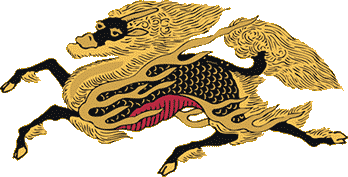
Kirin are popular entities to feature in Japanese fantasy films and video games, particularly when it comes to the creature’s connection to the story’s main hero. For example, in the 2005 film The Great Yokai War, the young protagonist is chosen to be the next “Kirin Rider,” a warrior destined to battle bloodthirsty demons and purify the land of evil. This aligns with the actual mythology, as taming a Kirin is considered the ultimate test of a true hero’s power. So in Breath of the Wild, it makes sense that the Lord of the Mountain is the most challenging steed to tame since only a true hero chosen by the gods should be capable of mounting such a divine beast. With that in mind, it really is a pity that Calamity Ganon can’t be defeated while atop this magnificent creature. Imagine the amazing cinematic screenshots that could have emerged!

Perhaps the most famous example of a Kirin-like entity in modern Japanese cinema (and the primary reason the Lord of the Mountain looked so familiar to me) is the Great Forest Spirit from Studio Ghibli’s Princess Mononoke. In this movie, the spirit is a god of life and death whose power extends to every single living creature, including other gods who walk the earth. With every step, flowers blossom and die beneath its feet, an entire life cycle completed in mere seconds. Just as Satori is usually seen surrounded by gentle Blupees, the Forest Spirit’s presence is felt through the “Kodama,” the playful tree spirits that frolic through the forest. And both entities serve as the protective guardians of their respective lands, only appearing in front of humans when absolutely necessary.
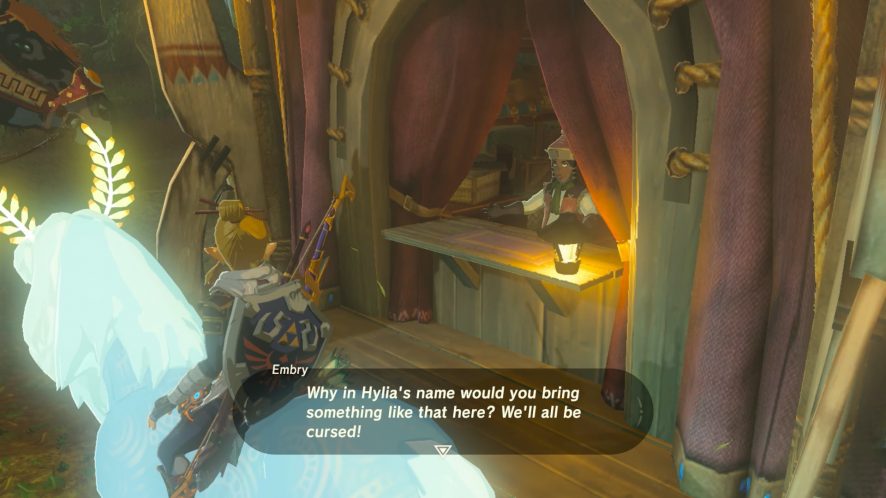
Unfortunately, there is quite a dark side to this particular story. Convinced that the Forest Spirit’s head grants immortality, the power-hungry Lady Eboshi succeeds in cornering the creature and beheading it. This causes the god to undergo a truly terrifying transformation, its tainted essence spreading like a plague and instantly sapping the life from everything it touches. Though I haven’t found any mention in East Asian mythology of what happens to those who harm Kirin, I would fully expect the consequences to be just as grave as those of mortally wounding the Forest Spirit. Maybe that could explain Embry’s strange reaction when Link shows up with Satori in Breath of the Wild?
But above all others, there is one key similarity between the Lord of the Mountain and the Kirin that convinces me beyond a shadow of a doubt that they are connected. According to Hyrulian legend, the creature arrived shortly after a wise sage passed away on Satori Mountain, suggesting that Satori is the reincarnation of that sage. Fans have speculated that this was intended as a tribute to Satoru Iwata, the beloved president of Nintendo who passed away in 2015. And as it turns out, the rarely seen Kirin is also believed to appear “with the imminent arrival or passing of a sage or illustrious ruler.” Indeed, only a truly extraordinary individual like Mr. Iwata would be worthy of such a great honor.
So the next time you see that luminous aura swirling around Satori Mountain, take the time to visit the spring near the peak and pay respect to the wondrous entity that embodies such grace, wisdom, and quiet dignity. Even in a world as expansive as Breath of the Wild, the littlest things can sometimes hold the deepest significance.