If you stay in the video game music scene long enough, you will probably hear the term “leitmotif” tossed around. It’s a music theory term that describes a short musical idea that is meant to symbolize something in a broader work, like a character or place or event. However, there’s also a broader term for a short musical idea that is repeated within a composition regardless of narrative (or, to use the musical term, “programmatic”) significance. This is simply called a “motif” or the more plain “motive.” A motive doesn’t have to be complex to count as one either; a famous example that you’ll probably get in theory class is the four-note “dun-dun-dun DUN” from Beethoven’s Symphony No. 5. And making a good motive is something that I’ve noticed that our beloved series composer Koji Kondo is very good at.
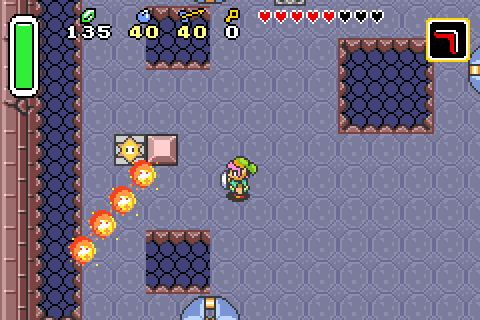
Take, for instance, our highlighted song for today, the “Dungeon of Shadows,” which plays in the Dark World dungeons of A Link to the Past. One day, I was listening to the game’s soundtrack and on this particular listen I decided to pay closer attention to the melody, perhaps to play along for myself. As I did so, I had an epiphany: It’s all descending half-steps!
It’s already one thing to put the melody in the lower strings, which makes it interesting on its own. But the melody itself is shockingly simple in its construction. Each second note in a pair of notes is just a half-step (or a minor second if you want to get technical) down from the first. A half-step is the distance from a white key to the nearest black key on the piano, or a single fret on the guitar. It’s the smallest interval between notes in western music notation, and it’s also one of the most dissonant. Playing them together by themselves, without other notes for context, doesn’t usually sound very pleasant. And yet, every single pair of notes in this song’s melody does this!
Another important interval that lends to this song’s unease is the tritone. You can hear it most readily in the upper strings, as they incessantly saw away at this interval (this time harmonically instead of melodically) throughout the piece. It is another incredibly dissonant interval, at one point called “the devil in music” by scholars and generally avoided unless the composer was going for a particularly sinister feeling, which is very suitable for the harder dungeons from the latter half of A Link to the Past. Listen even closer, and you will find that these upper-string tritones also come in descending half-step pairs!
Combine all this with a triplet rhythm in the melody that keeps coming back, and you see that the recipe for this song doesn’t have very many ingredients. However, I think that’s what’s so genius about it. Limiting the melody in this way allows the song to take the listener on a very disorienting path, one where you can’t tell if you’ve been going in circles or not. From its simple motives, Kondo was able to get great results in this and other songs throughout the series.