Majora’s Mask is a pretty depressing game. It’s great, but it really grabs at your heartstrings and twists until every vein and artery pops with feelings. Nowhere is this shroud of fear felt more than in Snowhead. As you enter the region, it feels as if nature itself is clawing at you. Wolfos pop up out of the ground while the bitter wind and snow bite at Link’s face.
For all the physical dangers you face, the greatest dangers are the multiple places where hope has been lost. The Gorons are trapped inside their village, slowly waiting as they freeze to death or starve, all the while being driven mad by the constant crying of the Goron Elder’s son. The Elder himself has been frozen by the unnatural wind, the hero Darmani has been lost, and even the fiery furnace of Zubora and Gabora has been frozen.
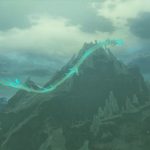
Hope is gone, but throughout the series, Link is a harbinger of hope. It’s this dichotomy between despair and hope that artist Jaikart captures in his piece titled “Majora’s Mask – Snowhead Temple.”
One of the first things viewers of this piece will notice is the titular temple’s icy crags thrusting upwards towards the sky. The deadly, angular edges of each of these crags look like blades shooting out of the mountain, warning of the danger present there. These pointy peaks also remind me of something a little more hopeful, though: The way that they reach upwards towards the sky reminds me of the hands of the Goron people. Just as the peaks stretch towards the heavens, so too do the Gorons reach out for someone — be it Darmani, a giant, or a small boy — to save them.
The plight of the Gorons is also shown by an interesting rock face in the upper left of the painting that actually looks like, well, a face. The stony face reminds me of the frozen Goron Elder, as the snow drapes down over the rock much in the same way as the elder’s own white hair blankets his face. This connection between rock and Goron helps convey the severity of not just his situation, encased in ice, but also of all the Gorons. Without help, they will soon all be just like the rocks: still, silent, and without life.
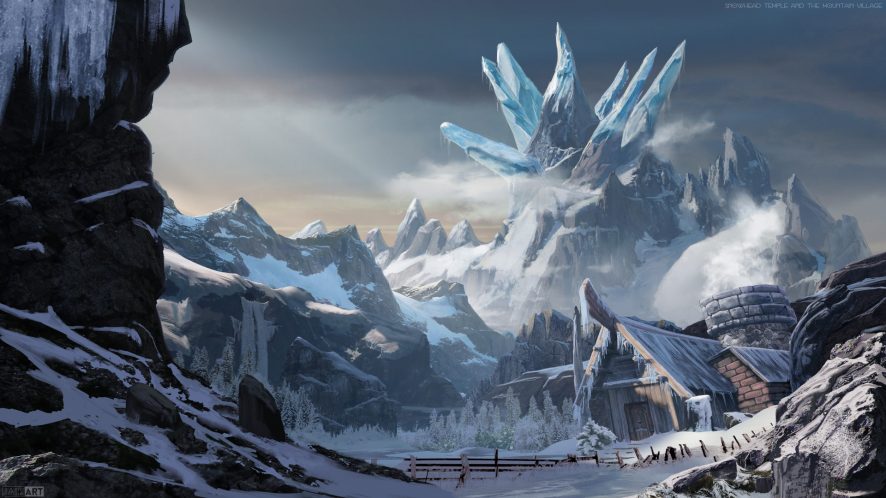
Just like Majora’s Mask itself, Jaikart’s image isn’t without hope, though. Rays of light break in from the upper left and point straight towards Snowhead Temple. Despite the raging surrounding nature, the light can’t be dimmed, and it points Link towards the source of the region’s problem.
There’s also the matter of Zubora and Gabora’s smithy. When Link first enters Snowhead, the pair’s furnace is frozen solid, unable to help anyone. If we look at the chimney of their smithy in Jaikart’s piece, smoke is billowing out. Link has already returned hope to two souls in Snowhead. Throughout the night, the sounds of steel being forged will echo up the mountain, putting the region on notice that hope has come to lift the veil of despair.
Jaikart’s piece perfectly captures the core of Majora’s Mask. Through a mixture of light and shadow, pointy mountains and stony portraits, he conveys both the desperation of the people living in this area and the delivery of hope that Link is in the process of bringing.