I had to stop and read the sentence again. My book had just made an off-hand reference to a roc as some kind of bird flying over the mountain pass. I laid the book down as the gears began to shift in my head. Every time I played a Zelda title where Link acquires an item belonging to Roc, I always wondered who he or she was, but would forget about it as I continued on my quest. I had been asking the wrong question: Not “Who is Roc,” but “What is a roc?” Research enlightened me about a massive mythological creature that served as inspiration for numerous items and enemies across the Zelda series.
In Persian and Arabic folklore, the roc (alternatively spelled ruk, rukk, rokh, or rukh) is a stupefyingly big predatory bird, generally resembling an eagle. It is large enough to carry away elephants or ships with minimal effort. Based on descriptions in two Sanskrit epics, historians believe the roc myth originated in India and traces back to nearly the dawn of the Common Era. Due to their size and sightings in often unexplored terrains, stories involving rocs tend to elicit a sense of mystery and wonder. They are said to nest atop mystical mountains and lay enormous eggs, making me wonder if Mount Tamaranch is also inspired by the roc.
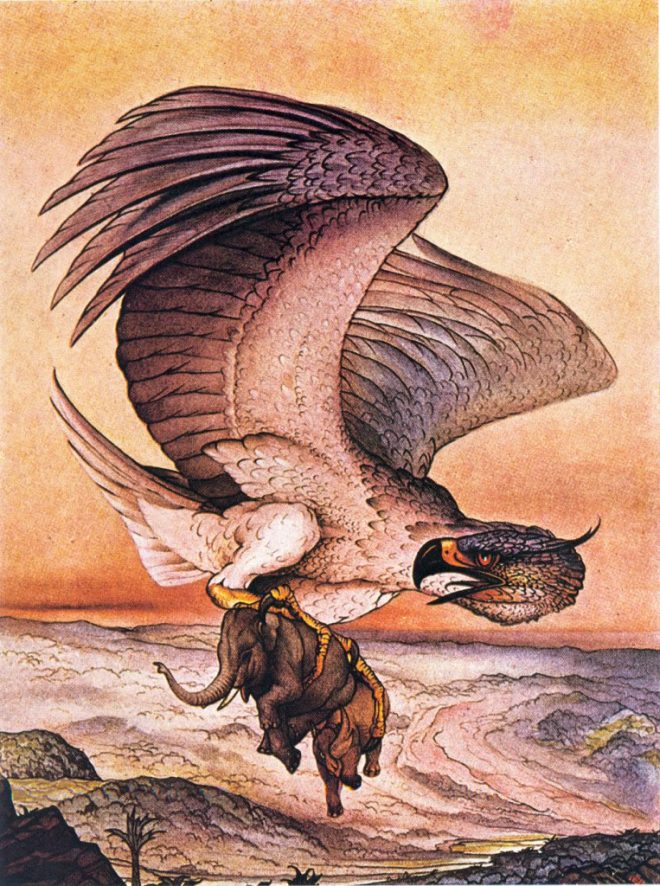
Famous accounts of roc sightings include that of world-renowned explorer Marco Polo, who claimed to have spotted a roc on his travels to China in the late 13th Century. The bird would swoop in front of his caravan and “seize an elephant in its talons and carry him high into the air and drop him so that he is smashed to pieces; having so killed him, the bird swoops down on him and eats him at leisure.” Upon telling this story to Kublai Khan, the ruler dispatched troops to look for the bird in Madagascar. The troop returned with what they claimed to be a roc feather but was most likely a palm frond.
Other famous stories include the legendary sailor Sinbad, who clings to a roc’s legs for passage to safety after a shipwreck. While a guest in the roc’s nest, Sinbad destroys one of the eggs. The enraged roc retaliates by destroying Sinbad’s ship with massive boulders — and they all lived happily ever after. Rocs have appeared in various tales of Sinbad and other adventure tales and games over the years, so it’s not surprising to see its influence in the Zelda series.

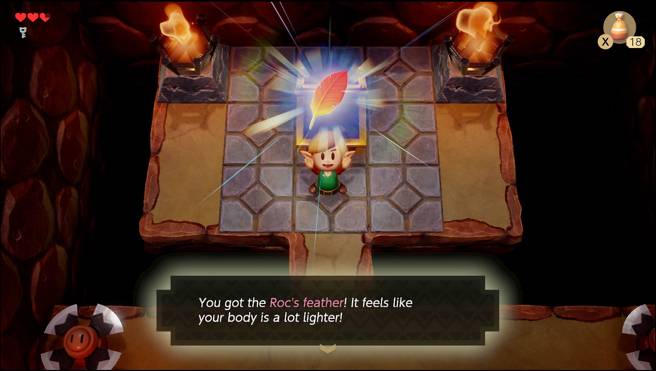
Link first acquires the Roc’s Feather in the first dungeon of Link’s Awakening. Unlike Kublai Khan’s, this feather appears to be the real deal. The item allows Link to jump over enemies and small gaps, becoming a useful combat and puzzle-solving tool. When combined with the Pegasus Boots, Roc’s Feather gives Link Olympic long jumper talent, extending his jump up to three times further. The plumage returns in both Oracle of Ages and Oracles of Seasons and offers the same abilities, but the dungeons require new uses to solve various challenges. Link(s) also obtains Roc’s Feather from item podiums in Four Swords Adventures. Like its predecessors, Link gains the ability to jump when he takes the feather, but he can also upgrade it to perform a double jump.


From left: Roc’s Feather artwork from Oracle of Ages and Oracle of Seasons, Roc’s Feather from Four Swords Adventures, Roc’s Cape from The Minish Cap, and Roc’s Boots from Hyrule Warriors Legends.
Link also discovers the Roc’s Cape in various games, which I am assuming is a cape made from roc feathers, not a cape that a roc wore (I dunno, maybe he’s a fancy bird). Link first finds it in Oracle of Seasons, then in Four Swords and Minish Cap. In all three, the cape bestows gliding ability, allowing Link to clear even bigger gaps.
Oracle of Ages and Oracle of Seasons also include Roc’s Ring, which prevents floors from cracking under Link when worn. Phew, that’s a weight off. Finally, Roc’s Boots are a weapon that Linkle can wield in Hyrule Warriors’ DLC and Hyrule Warriors Legends. Their appearance is like the iron boots from Twilight Princess with two blue-and-gold feathers like those from Four Swords Adventures. The feathers make the iron boots light enough to run in. It’s science.
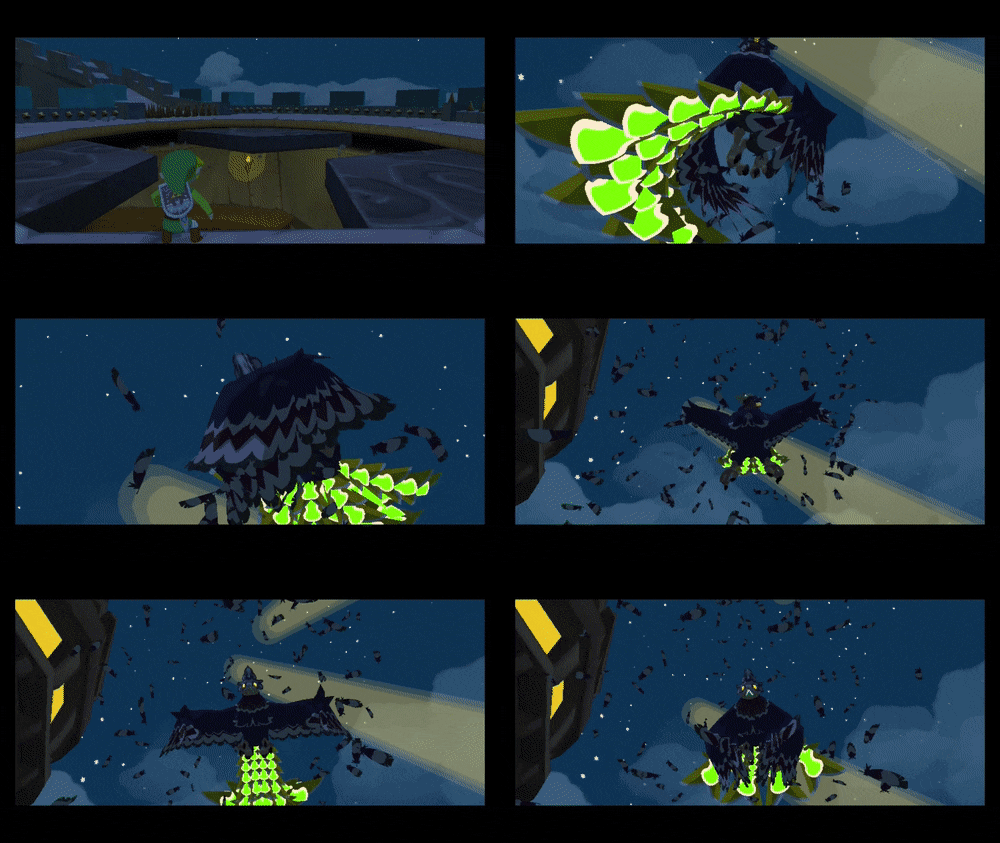
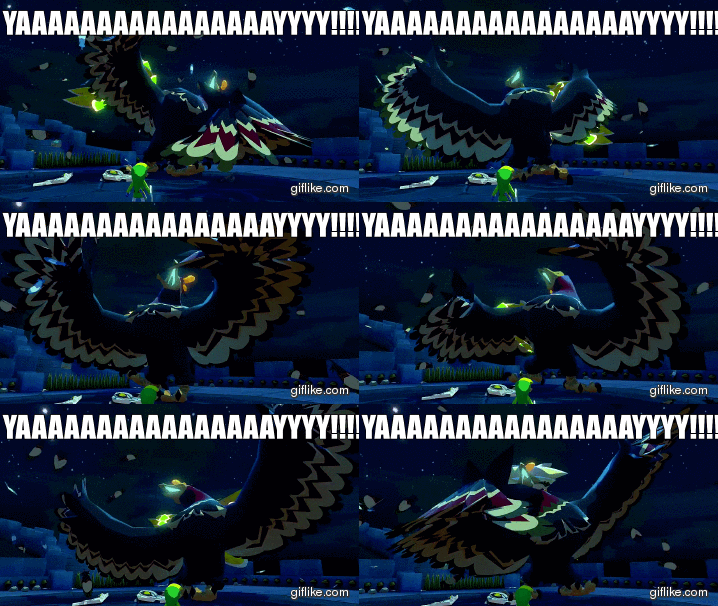
In addition to the many items, several enemies were inspired by the legendary bird. In the Wind Waker, Link encounters two. The Helmaroc King is an enormous avian who kidnaps young girls at Ganondorf’s behest. Link eventually squares off with the great beast and gives him a close look at his new hammer. “Helmaroc” is a mashup of “helmet” and “roc:” an apt name for a big bird with protective headgear. The added “King” may be a reference to Shahrokh (Shah=king, rokh=roc), a regal version of the roc with its own mythology and commonly used in Persian art in the Middle Ages. The Helmaroc King also appears as an enemy in Four Swords Adventures and Hyrule Warriors Legends, and Helmaroc Plumes are collectible treasures in Phantom Hourglass (although the bird himself does not appear).
Also found in Wind Waker are Kargarocs, large, noisy birds who don’t like visitors. Their name is a mix of “cargo” and “roc,” likely because they often carry Moblins or Bokoblins into battle. Link can collect golden feathers from these enemies, but the feathers do not give him any abilities.


From top left: The Helmaroc King and a Kargaroc from Wind Waker and a Kargarok, Shadow Kargarok, and Argorok from Twilight Princess.
Kargaroks return in Twilight Princess, with a different spelling (“k” instead of “c”) and a very different appearance. They now resemble enormous bats with turkey heads (waddle included). If you thought that was a departure, wait until you see the Twilight Realm counterpart. Shadow Kargaroks’ heads are concave, red circles that somehow bellow trumpet-like sounds. Kargarocs most recently appeared in Cadence of Hyrule with an appearance similar to Wind Waker’s.
Twilight Princess also features Argorok as the boss of the City in the Sky. His name is likely a play on “roc” and “Argo,” the award-winning 2012 film directed by and starring Ben Affleck. I’m just kidding. Argo likely refers to the ship Jason sails with his Argonauts to retrieve the golden fleece in Greek mythology and was selected to invoke sentiments of ancient Greece to match the City in the Sky’s architecture. The Argorok also appears as an enemy in Hyrule Warriors.
The great Middle-Eastern roc has provided inspiration for wondrous stories over millennia and has come home to roost in the Zelda series. It’s always interesting how creators find ways to make thousand-year-old material fresh again. We’ll keep an eye to the skies for the roc’s next appearance. In the meantime, I need to do a better job at researching questions before they fly out of my mind like an elephant in the clutches of a roc.