Among the differing opinions surrounding The Legend of Zelda series, there seems to be one thing we are all in agreement on: the official timeline is dumb. It’s a downright mess that’s made many of us wonder why we begged Nintendo to give it to us in the first place. We can try to tie together a timeline ourselves, but the fact of the matter is that it’s never really going to make sense. Only in rare circumstances are games directly related to each other, and the games themselves are diverse enough in both geography and biology to make a progressive analysis of the games all but impossible.
But while we mock Nintendo’s efforts at a timeline and struggle with our own, we forget that it is but the continuation of a trend that’s as old as the N64. While nearly every Zelda title has at least one force or element that you can manipulate, the series as a whole has messed with time more than any other; roughly half of the entire series. Each one brings up questions regarding continuity, the integrity of the “timeline,” and the sheer logic (or lack thereof) of traveling through time.
Ocarina of Time
Everyone is familiar with Ocarina of Time‘s game’s time travel shenanigans, the sole lynchpin in the Zelda timeline. To most fans, the concept of Link creating a timeline split in this game is common knowledge. Upon drawing the Master Sword, the Sacred Realm seals Link away until his body can wield it. Seven years later, Link is now an adult and through his continued adventures defeats Ganondorf and saves the Hyrule. Later, when he returns to his original time, Link warns Zelda of Ganondorf’s impending attack and together they stop it from happening. Ganondorf is stopped twice in two different time periods, thereby creating the split.
Nintendo then threw us a curveball in their official timeline by establishing not just the two splits that we had deduced, but a third branching timeline. What is even stranger was that the inciting incident for this split was something no one had considered: a failure. If Ganondorf wins the final battle instead of Link, then the entire world falls into darkness, requiring other actions to take place. Immediately, the fandom was enraged over this. Why in the world would Link lose? That’s not possible! It’s never implied in the game that such a thing could happen, and if you die in the final battle, there is nothing different about the end screen than if you were to die at any other point in the game.
How does this create a timeline split?
This opens a lot of uncomfortable questions for not only Ocarina of Time, but the series as a whole. If Link’s death — whether in the final battle or anywhere else — causes evil to ultimately triumph, just how many timeline splits are we actually making here? After all, thanks to our less-than-perfect gameplay, Link has died in a lot of places. Does the story change if Link dies in Jabu-Jabu’s Belly, in the Shadow Temple, or from being hit by the rock rolling that’s constantly around next to the Kokiri Sword? What about extending this to the other games? You could have at least one split in every game, depending on if you win or lose. What happens to all those timelines?
Majora’s Mask
With as short a development period as Majora’s Maskhad, it is incredible how much depth and excitement it offers us. The intricate ways that characters and events line up and interact with each other is impressive, to say the least. Obtaining every mask and helping each person in Termina is a gratifying experience, and the usage of the three-day cycle puts a unique spin on the Zelda formula. Use of the Ocarina of Time is essential for setting everything right, but in the process, it creates a horrible strain on the timeline.
As the first three days are essentially the prologue to the story, you can almost treat it as a “failed” timeline much like how the “Fallen Hero” timeline from Ocarina of Time is designed to be. Nothing happens, the Moon falls, everyone dies. From there, the repetition of the three days should subvert this doomed timeline and save everyone, but unless you plan out your route carefully and act with complete precision, you aren’t going to be able to stop the Moon in a single three-day cycle. That’s a whole slew of potential “fallen timelines” where certain groups survive while others die.
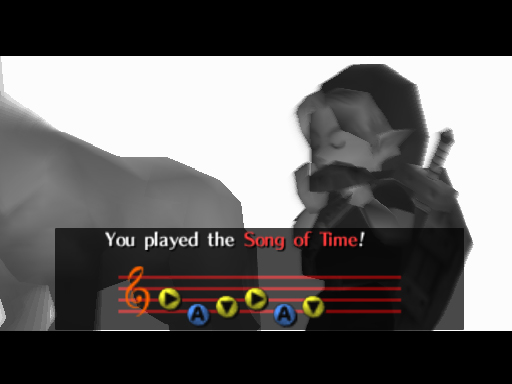
With every iteration of this song, you’ve essentially created a brand-new timeline with its own implications.
And that doesn’t begin to take into account the various people who not only have needs and desires outside of escaping the falling Moon. Some people also have needs that are in direct conflict with one another. Take for example Kafei and Anju. In order for that tear-jerker of a reunion to occur, Kafei must chase the thief Sakon after he comes to the Curiosity Shop on the second night. The thing is, Sakon comes to the shop to sell the Bomb Bags that he stole on the first night. If you stop Sakon from robbing the Bomb Shop woman on night one, you prevent Sakon from having anything to sell. Sakon doesn’t come, Kafei can’t chase after him, and therefore, Anju and Kafei don’t reunite. But leaving Sakon along on the first night still means that the Bomb Shop is robbed. Two timelines, both of them with a positive and a negative end, and you were complicit in both. Which is the correct one? Or are they both right together? Another split with no smooth answer.
Oracle of Ages
Take the timeline issues with Ocarina of Time and Majora’s Mask and merge them across seven centuries to get an idea of what’s going on in Oracle of Ages. The primary mechanic of the game has you zipping across time on a frequent basis, altering events and seeing their repercussions far down time’s stream. With every time warp, there’s a breach in the timeline that has the potential of causing catastrophic repercussions.
Moving beyond timeline breaks are the blatant paradoxes that run rampant all over the Labrynna. While Ocarina of Time had the famous infinite loop that is the “Song of Storms,” Oracle of Ages brings multiple items from the future back to their own origins. There is no real “start” for those items, it’s an endless cycle with no beginning or end. From treasured heirlooms to magical items, you end up creating more problems than you solve.
Twilight Princess
Twilight Princess’ flirtation with time thankfully is restricted to one specific area: The Temple of Time. In almost every respect, it remains isolated. You go in, go through the dungeon, and you get out. Left by itself, you could almost treat it as a portal to a separate reality; its initial layout only reminiscent of the Lost Woods ruins you start in.
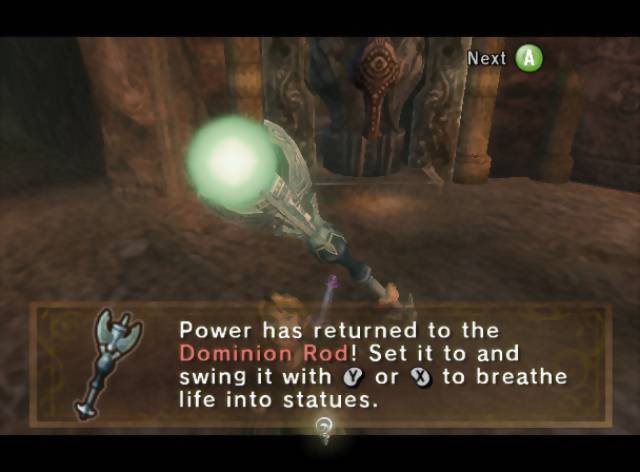
Making the Dominion Rod age outside of the temple calls into question the nature of the time travel you underwent.
That all changes, however, when you consider the Dominion Rod. Obtained in the Temple of Time, this rod takes control of specific statues inside the temple. But as soon as you take it out, it ages thousands of years in an instant, becoming rusted and powerless. This creates a plethora of questions regarding how this portal works. Why is it only the rod that ages? Why did it age as it came through the portal? Why didn’t Link age? Are there specific rules? And how does that affect the timeline?
Skyward Sword
These questions take on absurd proportions as we move into Skyward Sword. The Timeshift Stones of Lanayru Desert creates a fun dichotomy between the sands of the present and the lush greenery of the past. But in terms of time continuity, it makes absolutely zero sense. Under the influence of the Timeshift Stones, environments return, ancient machines come to life, and monsters are revived, with all of them restricted to a specific area.
Yet Link jumps in and out of these areas with no effect on him whatsoever, and any rupees or treasures he obtains in these time pockets suddenly goes from not existing in the present time to maintaining their form when taken out of the time distortion. How is any of this supposed to work? What determines what can enter and leave the distortions. Is it time travel? Is it a power source? And how much does it affect the timeline?
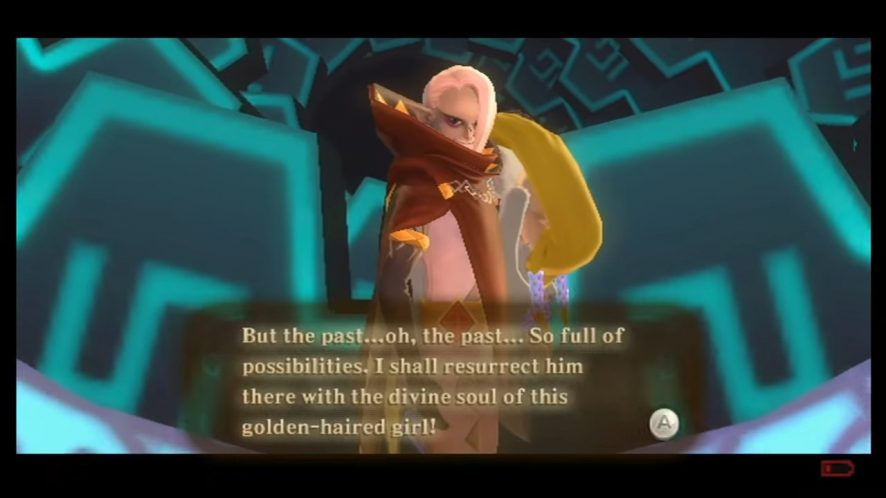
All of this discussion leaves out the glaring timeline error at the end of the game. Upon destroying the Imprisoned after making a wish on the Triforce, you are forced to go back in time to ultimately defeat the beast’s real form, Demise, in the past. But a defeated Demise in the past means there’s no Imprisoned in the future, meaning there’s no reason for Link and Zelda to come down to the surface.
By forcing Link to go to the past to defeat the enemy, you eliminate the presence of the enemy in the present, thus creating the ultimate paradox of any time-traveling adventure.
I’m sure you can continue the paradox from there. From the very beginning of the “timeline,” we have a major split and a weakening of the time-space continuum that can more or less account for why time itself is loosely played with throughout the entire series.
Hyrule Warriors
All of this considered, it’s no surprise that the original Hyrule Warriors used time travel to account for all of the different characters interacting with each other. We can probably use the time magic of Lana and Cia to at least explain the stability of the world while eras of time are coexisting. But the concern isn’t while the various characters are together, it’s what happens after they separate. Time travel knowledge is a dangerous thing, and there have been multiple science-fiction stories based on this type of situation before. It often creates a break in the timeline and rarely does it end well.
Thankfully, the massive length of time between eras would limit the amount of damage that could be done (what knowledge about Darunia and Ruto could benefit Fi?). But there’s still a risk that having such knowledge could still have implications. Battle tactics and technology are a couple of examples that would be readily available. But there’s also the matter of our time guardian. There’s no indication that Lana’s abode resided anywhere other than Hyrule. An overzealous being in the past could very easily decide to take matters into their own hands and try to subvert future events before they happen.
Our only source of relief here is the knowledge that Hyrule Warriors is confirmed as non-canon. And it’s so outside any real connection with another Zelda title that it makes it hard to shoehorn it into the timeline.
Age of Calamity
The issue of confusing continuity brings us to the latest installment. Some fans who have played through Age of Calamity were initially upset that what we were expecting as an in-canon prequel turned out to be only somewhat canon, but not really. The reason for that (spoiler warning) falls once again to time travel. The opening sequence begins with time travel, the information brought from the future informs the Hyrulean forces on timelines and deadlines that they must prepare for, and the ultimate salvation of every key player on the field comes down to time travel. To add even more complexity, the entity that facilitated the time travel in the first place does not return to the future period it came from, which means there are two copies in the same world at the same time.
Time Travel is introduced from the very beginning, creating a host of questions and concerns that cannot be smoothly answered.
The developers (after the fact) called this an “alternate timeline.” Well, they didn’t just create an alternate timeline, they burst the continuum in a tradition that is almost as old as the series itself. The exact same issue is seen with Champions from the future coming to aid Champions in the past. This not only breaks the first timeline but affects the later timeline the newer Champions came from. If we encounter them in the sequel, a change in personality, attitude, or confidence thanks to this adventure might drastically change how those interactions progress. And if those interactions proceed as if time travel did not occur, then we have not two timelines, but three, circling us back to the issues that started the entire timeline crisis in the first place.
I, like many other fans, am dissatisfied with the official timelines as they are constructed. I keep telling myself that one day I’ll make a timeline that makes sense to me and is hopefully a bit less of a mess. But the more I look at what has happened — at how much of a mess the flow of time actually is in Hyrule — the more I believe that “simple” is not something you can apply to this series. The timeline is a mess, and considering all that has happened, it’s really Hyrule’s own fault that it ended up that way.
Connor Schultz
Adventurer, Traveler, and lifelong resident of Hyrule. With a love of immersion and lore, there is always another world to see and another story to be told.
You can join the adventures at https://www.twitch.tv/conterez


 by Connor Schultz on March 1, 2021