If there’s one thing that defines my interest in games, it’s immersion. I love being drawn into an adventure and losing myself in the world and story of the game. From the early NES days The Legend of Zelda has provided that immersion in a way unlike anything else. I play and replay every game in the series constantly, finding joy every time.
Over these many years of immersion, I’ve discovered that I am also a shameless completionist. When I love a game, I want to experience everything that game has to offer: Explore every nook and cranny, find every secret, and attain every achievement. Even if I only do it once, I want to be able to say “I did it.” That desire builds the more I enjoy a franchise, so naturally, The Legend of Zelda has been front and center in that drive. I’ve collected Heart Pieces, hunted Poes, and conquered nearly every challenge across the series. I’ve walked every inch of Hyrule across more than 20 iterations. And yes, I’ve collected every single Korok “Seed” across both Breath of the Wild and Tears of the Kingdom.
But my completion of the Zelda series is not, well, complete. There are two games where I have yet to hit that 100% mark. The first is The Minish Cap, which requires farming random drops to get the Kinstones needed to unlock everything. The second held me back by its sheer volume of content: Literally days’ worth of challenges and tasks that seem never-ending. A Sisyphean task that had defeated me multiple times and appeared insurmountable. Until now.
The Odyssey Begins
Back in 2014, Nintendo released in partnership with Koei-Tecmo, a spin-off to the Zelda series unlike anything the fanbase had seen before. Following the format of the Dynasty Warriors franchise, this new title placed the heroes and villains of Hyrule amidst swarms of enemies and invited you to decimate them all. The game was fittingly titled Hyrule Warriors. Released on the Wii U, it was unsurprisingly passed over by many. Two years later, the game was brought over to the 3DS under the name Hyrule Warriors: Legends. While not as dense as the original, it did add a few additional characters and an extension of the main story. Then in 2018 the game was ported again, this time to the Nintendo Switch as the Definitive Edition, combining the content of the previous two games and adding a few new features as well.
I bought the first one…then the second…and then the third. I automatically eat up anything Zelda related, the gameplay is unique to the franchise, and it is legitimately a fun time. I enjoyed the game as soon as I started playing. But as I said before: if I love a game, I want to 100% it. But I quickly discovered that I had bitten off more than I could chew. With the original version, I was stunned by how much there was to do and eventually dropped off. When Legends was released, I saw it as my opportunity to redeem myself by completing this new version. Again, I was eventually worn down by the sheer volume of content, and other obligations soon took priority. When the Definitive Edition was released, I again took up the 100% task, and again I succumbed to the load, twice.
Then in December of 2023 I decided to stream the story portion of Hyrule Warriors as part of my usual Zelda Monday activities. From the outset I asserted that I was not going to go full completionist for this run, as I had other plans for my Zelda streams going forward. But even the main story has much to invest in and enjoy, and I was happy to come back to this tale.
Legend Mode
This is the section that players will be most familiar with. It’s the story, the epic clash, the war between the Kingdom of Hyrule and the monster horde commanded by an unknown force. The conflict soon leads to an encounter with the sorceress who watches over time, including the many conflicts over the Triforce. Time is soon traversed, leading to battles with allies and enemies across multiple Zelda titles, and culminating in a grand finale to determine the fate of Hyrule.
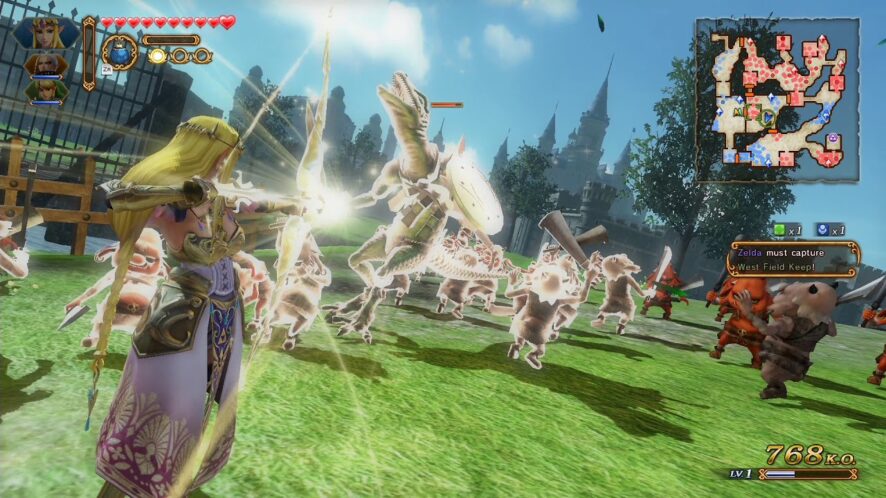
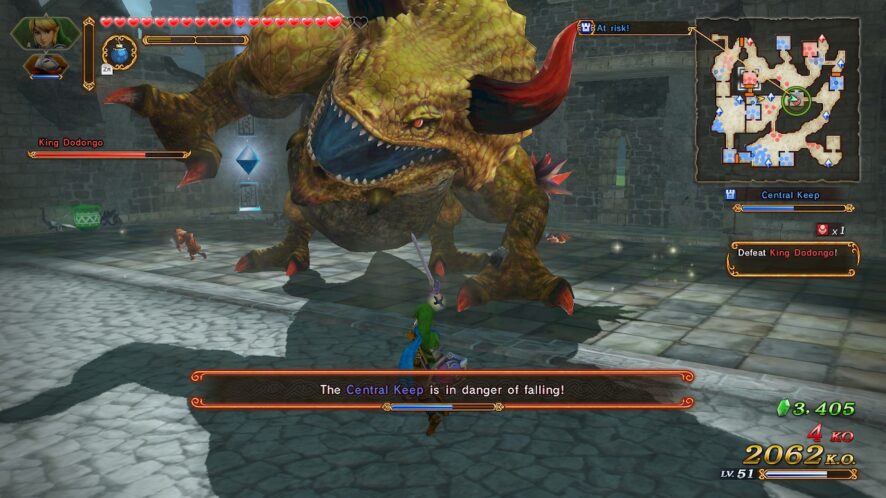
The plot itself is very “Zelda,” but the gameplay is anything but. There is no exploration aspect to this adventure. Instead, you progress through the story one scenario at a time. Conflicts take place on set maps primarily adapted from various locations across the Zelda franchise, where opposing armies do battle with each other. Primary objectives for each battle involve capturing key locations on the battlefield and defeating specific enemies while preventing the opposing army from doing the same.
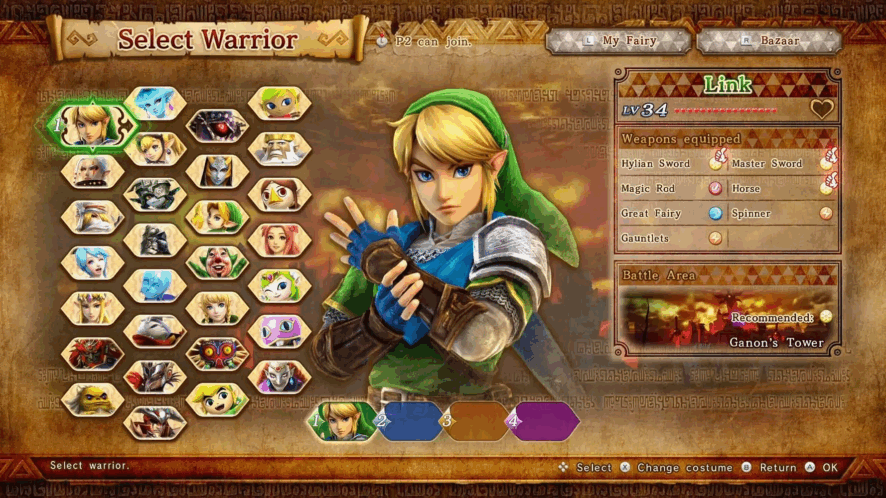
But instead of commanding forces or developing strategies, you’re on the front lines; boasting more power than all your armies combined. Facing literally hundreds of enemies at once, you unleash skills and abilities that can take groups of them down at a time. Each of the 29 potential characters has at least one unique weapon, providing over 40 different playstyles for you to master and annihilate your foes.
It’s a very different atmosphere from your usual Zelda game –- the quiet, ominous exploration is replaced with the sheer chaos of priority management in a war zone. But that chaos combined with the flashy, over-the-top moves your characters can pull off makes for a very entertaining experience, especially when it’s filled with the most overt Zelda fanservice you can ask for. The characters, locations, and music draw you in and leave you wanting more.
With 24 characters across the Zelda series and 5 new characters, you’re sure to find someone you love to use.
Like I said, I was only planning on playing through Legend Mode, but as the story neared its conclusion, I felt that I should give a proper demonstration of what the game had to offer and play just a snippet of what came next.
Adventure Mode
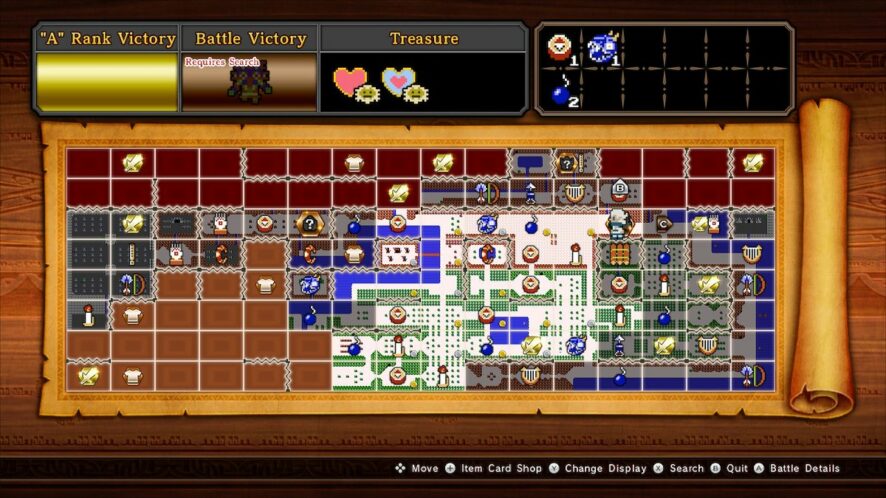
Open Adventure Mode and you will see a series of map options. Click on the first one and you are greeted with the layout of the original Legend of Zelda map, complete with a retro-style overworld theme. Each square of the map represents a challenge to overcome. As you complete one challenge, more become available, allowing you to eventually explore the map in full. The challenges themselves are pretty straightforward: defeat a certain number of enemies, protect an outpost, don’t get hit, etc.
Challenges and rewards await across adventure maps if you can find them.
But while the story mode simply requires you to win, Adventure Mode grades your performance, giving you rankings from C to A based on time completed, enemies defeated, and damage taken. Certain squares on the map can only be unlocked by achieving a high enough rank on the adjacent square. More importantly, additional heart containers, stronger weapons, new characters, and character skins can only be obtained by achieving the required rank. To increase the complexity further, most of those rewards have to be “discovered” before the challenge will yield them, which is done by utilizing items that are obtained as challenges are completed. Those items aren’t found linearly, so often you will have to replay challenges or divert your progress to another section of the map entirely before you get to where you want to go.
The whole system is surprisingly engaging. None of the challenges are overwhelming, nor do they take anywhere near as much time as any of the Legend Mode events. Before you know it, you’ve cleared out a quarter of the map and are eager to keep going. The problem is it does keep going. Forever. Ten maps spanning eight different games, totaling 970 different challenges. And with the amount of backtracking and repeat challenges you have to do, the total required easily eclipses a thousand, and that’s assuming you get everything done on the first try.
This might be the sixth time I’ve been here. I lost count ^_^;
This is where I had always faltered. I had faced this never-ending labyrinth several times and eventually had to turn back. It was the reason why I said at the outset I wasn’t aiming for 100%. But that initial rush of completion kept me going longer than I had planned. But this time, one small difference kept me going.
Despite my passion for streaming, it is not my full-time job. What’s more, I have multiple games that I play and stream regularly. To make sure I have room for it all, I only stream Zelda games on Mondays. That limited my playing of Hyrule Warriors to only about 4 hours or so a week. By being forced to space out my playtime from the beginning, it made every section more bearable, and allowed me to celebrate each map’s completion instead of worrying about how much I still had to do.
Bazaar and My Fairy
Because of course there’s more to do than just the maps. Characters earn experience as they defeat enemies, growing in strength and health, but they can be built and improved further in multiple ways. And to progress smoothly through the game, you’re going to want to do them all. At the Bazaar, you can spend money and resources to boost under-leveled characters, manage weapon features, and give your characters temporary benefits.
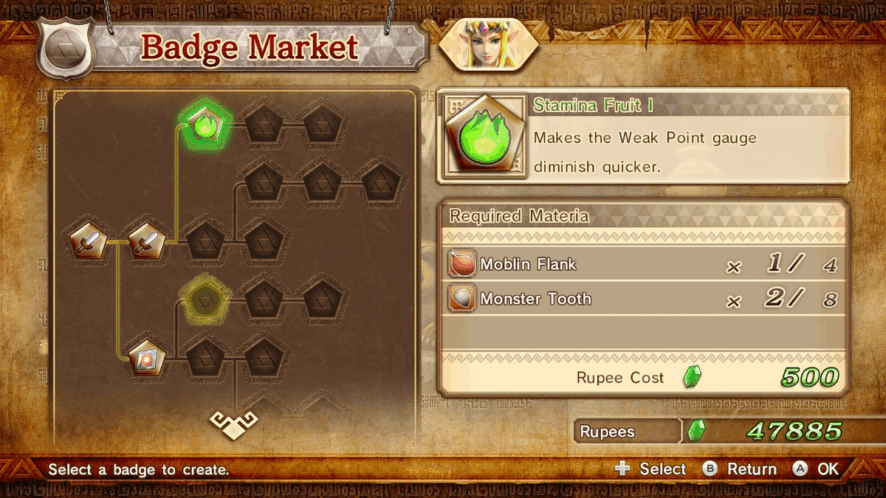
The Badge Market gives permanent boosts to a character
The badge market in particular will take much of your time. Defeated enemies have a chance of dropping materials that are automatically collected at battle’s end. Specific materials can be used on a character to purchase badges that improve their abilities. But not every material is easily obtained. Most enemies that drop meaningful materials only appear a limited number of times in a challenge, and the odds that they’re going to drop any material, much less a rare one, is finite. But while you may only need six or so gold materials from a Gohma for a character, it can take 30+ silver materials from something like a ReDead to fill up the skill tree. Needless to say, I spent a lot of time grinding several key challenges to gather everything I needed.
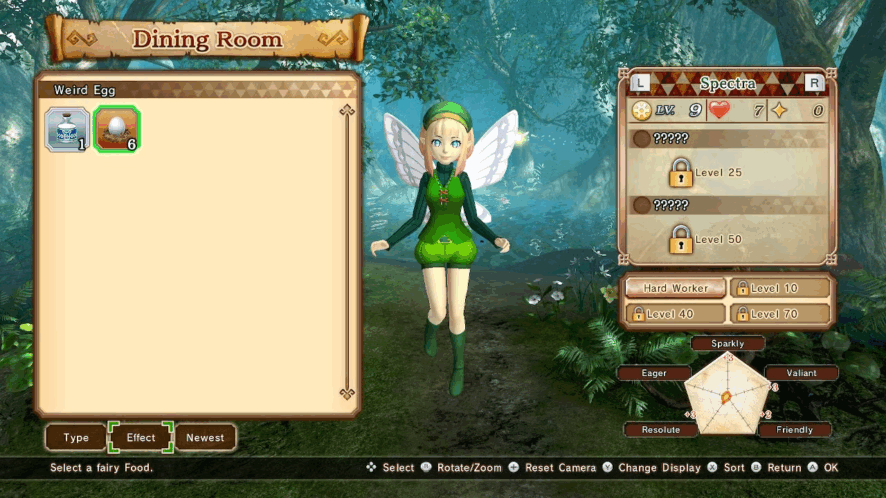
And if that weren’t enough, yet another wave of material grinding of another nature waited just around the corner. We’re all familiar with the likes of Navi and Tatl following Link around. In Hyrule Warriors (at least in the Definitive Edition), you can obtain and build fairy companions of your own. Pieces of fairy clothing provides general buffs, while food can unlock abilities that you can use in battle to give you an added boost.
Fairies can be named, clothed, fed, and provide aid to you in battle.
Unfortunately, to get the skills you want requires some extensive work. 39 different types of fairy food exist on the maps -– not counting the degrees of quality each food can have (which puts it near 120). Each one can increase or even decrease any of the ten stats a fairy can have. Reaching a certain level of those stats unlocks the skill in question. Seems simple enough, except you’re only allowed to give them so much food before they’re “maxed out.” You then have to essentially reset the fairy to level 1, carrying over only a small percentage of your accumulated stats over to the next cycle. Complicating matters further is the fact that only five of the ten stats are active in any cycle, and you’re only allowed to switch one stat out every reset. If you want to get every skill, you’re going to have to farm a lot of food or utilize other fairies to farm gratitude crystals (which is an entirely different process that I’m not going to detail) in order to obtain the achievement.
Achievements
Because of course there are achievements. 62, to be exact. Like many games, most of those achievements are obtained through normal progression. But to get them all requires dedication to every facet of the game. Completing the highest difficulty in Legend Mode. Getting a character to the maximum level (which in a fun nod to the original Legend of Zelda, is 255). There’s even an achievement for cutting grass! And if that weren’t enough, there’s one that demands amiibo use –- a full hundred worth –- which I didn’t realize I needed to do until I was a year into the odyssey.
Crossing both Legend and Adventure Mode is both a map and an achievement involving Gold Skulltulas. Over the course of your adventure, you’ll get notifications that a Skulltula has appeared, along with a mark on the map indicating a general location. When it does, you better hope you can drop everything and find it before it vanishes. Half of them are easy to get: simply reach a point in the story or defeat a certain number of enemies. The other half have specific requirements unique to their scenario (which thankfully you can look up in-game to determine what they are). Each Skulltulla defeated grants a piece of an image which, when completed, reveals a new challenge on the rewards map, yielding another reward to collect.
And yes, there’s an achievement surrounding them as well.
Challenge Mode
With the final achievement medal obtained, I was ready to consider my odyssey completed. But there was something still nagging at me. Right below the Adventure Mode was another category titled “Challenge Mode.” Yet despite such an obvious section for achievements, none of them were associated with the category and so up to this point I hadn’t even touched it.
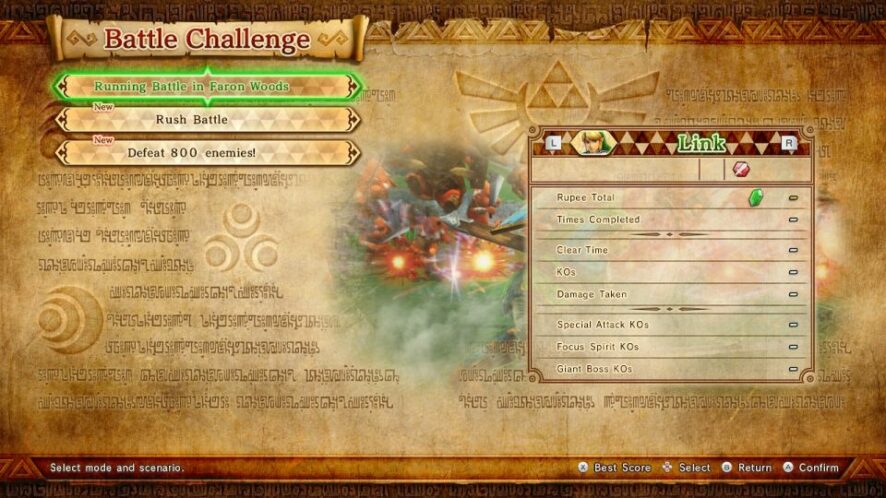
What begins as a small group of challenges turns into a marathon all its own.
Open the menu, and you are met with a surprisingly small selection of challenges: Battle challenge, and Boss challenge. The names by themselves seem exactly like what you would expect from a challenge mode, and the challenges you’re met with are similarly nothing too surprising. Along with each challenge is a table of statistics meant to keep track of your best result. It makes sense: The challenge mode is there to show off how well you can perform in game. So, I picked a character I was great with and breezed through the first challenge.
It was then that I discovered two things about challenge mode. First, the ranking system from Adventure Mode carries over to Challenge Mode. That wasn’t bad in itself -– keeping time, health, and KOs in mind is easy when you’re using a character you’ve taken up to max level. But then I learned that the records (and more importantly, the rankings) are separated by character. To fully complete this odyssey, I would need to get an A-rank on every challenge, with every character.
To make matters worse, the challenges that I saw were not the only challenges available. As you achieve an A-rank on one, additional challenges reveal themselves. Timed challenges, KO challenges, each at varying levels of difficulty and each available for every character, totaling 377. Of particular note were the survival challenges: wave after wave of enemies and bosses targeting you with increasing numbers and increasing chaos. It got to a point where I was either mute with focus, or screaming my head off.
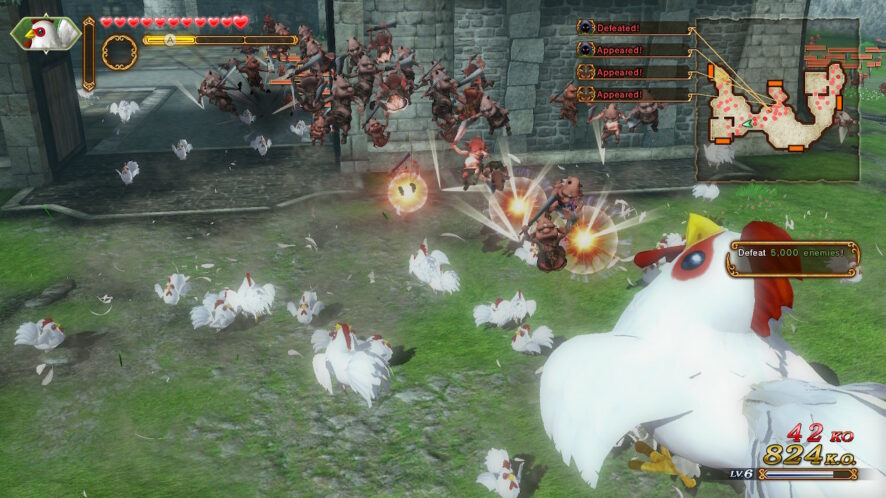
And if that insanity wasn’t enough, two additional sets of challenges awaited at the end. The Dynasty Warriors franchise doesn’t shy away from letting you play as the bad guys, and up to this point I had plenty of experience working with Ganondorf, Ghirahim, and the other villains. But despite all that time with them, it never occurred to me that they could take it even further. None of the countless hordes I had obliterated could compare to rampaging around as the Dark Beast Ganon. And if that wasn’t enough, I then had to go through the exact same challenges with an even more feared beast: The Cucco! Going from all that terrible power and might to only being able to peck things was a case a whiplash I will not soon forget.
Fear the Cucco!
And so it was, after 15 months, nearly weekly sessions, several separate days of independent grinding, over fourteen hundred different challenges, and a gameplay time totaling over 12 days, I felled Ganon for the final time and completed the Hyrule Warriors 100% Odyssey.
After that ultramarathon of an experience, do I still enjoy Hyrule Warriors? Surprisingly, yes, I do. The gameplay is fun, the plot is engaging, the character designs are second to none, and you’ll never get more Zelda fanservice anywhere. I don’t expect to 100% it again, but I’ve done it once, and that is enough.
At some point I’ll get to The Minish Cap, but I need a healthy break from this kind of completionism first.
Connor Schultz
Adventurer, Traveler, and lifelong resident of Hyrule. With a love of immersion and lore, there is always another world to see and another story to be told.
You can join the adventures at https://www.twitch.tv/conterez


 by Connor Schultz on May 9, 2025