Plato once said, “Music gives a soul to the universe, wings to the mind, flight to the imagination, and life to everything.” This quote directly embodies the importance of music in almost every game, including one of the most beloved Nintendo 64 titles of all time Ocarina of Time.
The game’s title even reflects the importance of an instrument that seemingly has the power to manipulate time itself, and even that is just scratching the surface of how important an instrument is on Link’s journey. We are going to be taking a closer look into the world of Ocarina of Time and just how important music, musical terminology, instrumentation, and the various songs themselves are to the experience of the game and its lore.
The memento that started it all
The emphasis of just how impactful music will be on the adventure is brought to light as soon as Link makes his way out of the Kokiri Forest. Saria gives him the Fairy Ocarina, and the game instructs the player that this memento between friends is indeed a fully-fledged instrument. Suddenly, your controller becomes the interface for a functional ocarina that can extend through different notes, octaves, and can even vibrate the pitch (something called vibrato, for those not familiar with musical terminology). The item doesn’t simply play a jingle or a preset song but rather gives the player total control of what comes out of wind-like instrument. This level of control is meant to be explored, played with, and used throughout the greater course of the journey.
Suddenly, your controller becomes the interface for a functional ocarina that can extend through different notes, octaves, and can even vibrate the pitch.
Once Link explores the world past Kokiri Forest and makes his way to meet Princess Zelda, he learns about an even greater instrument of importance: the Ocarina of Time. The item is a treasure that has been passed down throughout generations of the Royal Family and is crucial in opening the Door of Time, which is a stone wall that separates the outside world from the Sacred Realm. In conjunction with the three Spiritual Stones, one can use the Ocarina of Time to raise the wall and gain access to the Sacred Realm, where the Triforce lies in wait for whomever can claim it as their own.
After learning of the importance of the Ocarina of Time and the power it holds, Link is entrusted with a particular melody, taught to him by Impa, the Sheikah protector to the princess. The tune, appropriately titled “Zelda’s Lullaby,” has a mystical power behind the notes of the song. The game lets you know just how important this song is going to be, as well as any other songs you will eventually learn throughout the game, in that you’re not allowed to proceed until you are able to replay the song back to whoever is presenting it to you. Once you manage to do so, a magical aura encompasses the area surrounding Link. The young boy is also informed that the song can identify his connection with the Royal Family should it ever be in question as only those of the Royal Family can actually learn the tune. The song’s powers are indeed mysterious as it plays a larger role than just identification of Link’s role in Zelda’s grand scheme. The melody can clear passages that are covered or hidden, it can raise the water level in the Water Temple, and even helps Link gain access to Zora’s Domain, which is obscured by a waterfall barrier before playing the song.
Childhood tunes
This isn’t the only song our young lad can learn as he tackles the trials before him in order to acquire the Spiritual Stones. After reuniting a sleeping Talon with his beloved Lon Lon Ranch, you’ll meet his daughter Malon. Once shown her the ocarina, she will teach you a melody called “Epona’s Song” that can do two things: It can call Epona to you within Hyrule Field, and, if you play it in front of a cow, it will produce Lon Lon Milk for you to drink.
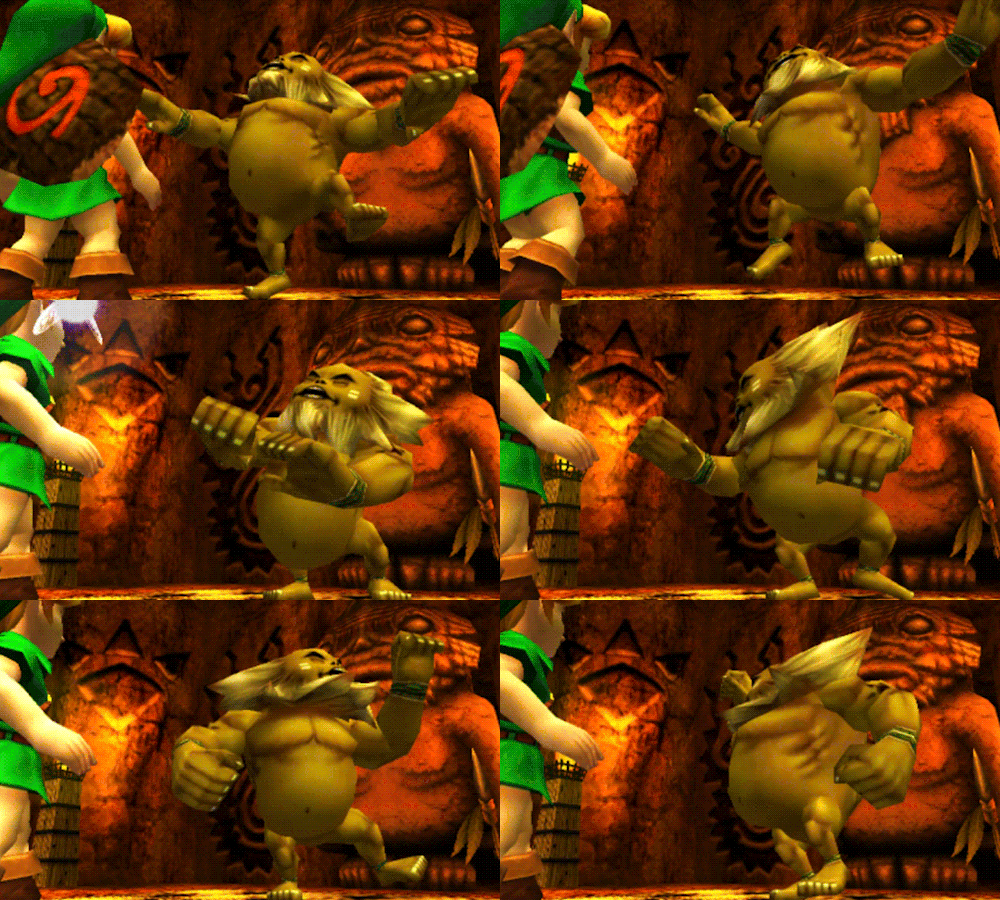
“Saria’s Song” can be learned if you go back to visit with Link’s childhood friend. This song is essential in providing Darunia with a sick jam to dance to and being granted access to Dodongo’s Cavern. (This is by far the most magical song of all; just look at those dance moves!)
The “Sun’s Song” can be learned by entering the Royal Family’s tomb, reading the poem inscribed by the Composer Brothers, and seeing the melody written on the bottom of the epitaph. The song itself has the mysterious power to forward time by a cycle, turning day to night or vice versa. It also has the ability to stun undead enemies, such as Redeads, making them easier to tackle and taking away their advantage of freezing you in fear.
Learning the “Scarecrow’s Song” is actually very easy, as you are allowed to make up your own song as long as it doesn’t contain any notes that repeat. Bonooru, a sentient Scarecrow, gives you the chance to play a song for him that he will never forget. When you visit with him as an adult, it gives you the ability to summon his brother Pierre at certain spots to reach further ledges or platforms in various areas.
Lastly, there is a bit of a paradox in the “Song of Storms.” As Adult Link, if you visit the windmill in Kakariko Village, you’ll learn the “Song of Storms” from the Windmill Man that he apparently learned from you seven years ago. The song has the power to make it rain, and quite literally it does make it rain.
Enter the Ocarina of Time
After acquiring the Spiritual Stones and racing back to Hyrule Castle, Link is forced into the possession of the Ocarina of Time and learns the “Song of Time” through a telepathic message from the princess, who is fleeing on horseback from a pursuing Ganondorf. Aside from having the magical melody to enter into the Sacred Realm, the song also can make blocks disappear or appear in certain locations. These blocks also seem to have a similar materialistic build to whatever the Ocarina of Time is made out of.
Sadly, as the story goes, Link does indeed gain access to the Sacred Realm, but not without first allowing Ganondorf to enter right on his coattails and claim the Triforce of Power for his own. Fast forward to seven years in the future, and adult Link now has to awaken the power of the sages so that they may seal Ganondorf away and undo all the damage he has done. This is where some of the more interesting musical aspects of the game come into play.
Sheik, aim, fire
Sheik, a mysterious youth who happens to be at each respective temple as you make your way there, is able to teach you a set of songs that will warp you to the respective temple that you wish to go to. What is more interesting, aside from the magical powers of teleportation, is the naming of each song and the musical aspect behind each one.
Starting with the “Prelude of Light”, the song will warp you back to the Temple of Time whenever you want. The musical term for a prelude can mean an introduction and this is certainly fitting as the Temple of Time is the introduction for the heft of your quest as Link. The song itself is very airy and light, not resolving totally to allow for further sections or interpretations.
Once you make it to the Secret Meadow, you are taught the “Minuet of Forest”. This song allows you to teleport back to the entrance of the Forest Temple. A minuet in musical terminology is a social dance performed in France for two people. The term refers to the musical form for the steps taken in the dance and the interpretation is similar here. Not only does the harp play the musical phrase, but the ocarina answers in exactly the same fashion, like a lead and a follow. The two instruments dance with each other, in a way.
Following on towards Death Mountain, Link learns the “Bolero of Fire” at the Death Mountain Crater. Aside from allowing teleportation back to the entrance of the Fire Temple, the song also has some amusing musical connotations as well. A bolero is a slow-tempo Latin music style with a matching dance to fit. The flair of notes rises up to a crescendo before resolving peacefully. The snare that accompanies the song is also a reference to Maurice Ravel’s famous song “Bolero.”
After chilling out in an icy cavern, Link is able to learn the “Serenade of Water”. This song allows you to be spirited away to the entrance of the Water Temple, near Lake Hylia. A serenade in music is usually a light, calm piece of music that is made to honor someone or something. The calm melody reflects thematically the tranquility of water in a most effective way.
Making his way back to Kakariko Village results in Link running into Sheik once again. During their reunion, the duo are attacked by an evil spirit that was sealed beneath the well in the village. After recovering, Sheik informs Link that Impa is a sage and has went to seal the evil spirit once again, resulting in the teaching of another song. The “Nocturne of Shadow” is taught to the Hero of Time so that he can warp to the entrance of the Shadow Temple, which is beneath the graveyard of the village. A nocturne in musicality is literally something inspired by or made to reproduce the feeling of the night. The creepy vibe and unsettling tones help to lend a somber mood, giving off a shadowy presence in the song.
Trekking through the desert, Link meets Sheik at the Desert Colossus where he learns the “Requiem of Spirit.” The song will transport him back to the entrance of the Spirit Temple but it also has some of the best connections to actual music theory. The phrase requiem means “of rest or repose.” In the Roman Catholic Church, it can literally translate to a repose for the dead, or a song to help them rest in peace. This song hits home rather hard because Link had just witnessed Nabooru being kidnapped by the evil magic of Koume and Kotake. The song essentially mourns the Sage of Spirit being held captive by evil forces.
Encore, encore
Lastly, it’s important to note how music is used as a means to increase atmosphere within the game itself. Players can hear the Lost Woods theme at the correct tunnel they need to take within the overgrown maze, whereas the song goes silent at an incorrect passage. Likewise, as Link ascends the staircase to have his fated confrontation with Ganondorf, the volume of the organ the villain manically plays grows in intensity and bellows out even louder and more sinister the higher Link climbs. Ocarina of Time also made music instrumental in solving puzzles, something that was a first in the series.
While having a brilliant soundtrack never hurt Ocarina, it certainly wouldn’t be nearly as impactful had players not had the option to play the songs themselves, learn the melodies, and see what the power of music did in the physical realm as they played. Just as Plato discovered that music was much more than a collection of notes, players of Ocarina were introduced with an instrument that was mystical, magical, and perhaps most import of all, memorable.
Brian Pope
Brian Pope is a loving father of two, a musician, writer, and all around Zelda enthusiast. When he isn't writing, he is playing games, writing music, or enjoying life with his two sons. Oh, and he likes Pokemon.


 by Brian Pope on August 23, 2019