As much as I love stories and fantasy, I’m always hesitant to jump into a new one. I tend to be a bit picky when it comes to new games or movies, and rarely does a trailer get me excited enough to just jump in. I need to throw myself into a story to fully enjoy it, and that’s not something I’m willing to do with just any game. Well, as soon as I saw the trailer for Kena: Bridge of Spirits, I was immediately interested. The visual style and the premise that the trailer introduced were more than enough reasons to give the game a shot, and boy am I glad I did.
Full Disclosure
Ember Lab graciously gave Zelda Universe a review code for Kena: Bridge of Spirits.
Guiding the Spirits
The premise of the game is clear from the trailer and is easily explained within the first few minutes. You play as the game’s namesake, Kena, a spirit guide tasked with helping lost and troubled spirits find peace so they can move on to the next world. Although young, she is uniquely gifted through family ties, as Kena’s father was also a spirit guide. Kena’s presence in this land is apparently one of personal meaning, as she is intent on reaching a special shrine located on the mountain that towers above the land.
However, it appears that prior to Kena’s arrival, something ran afoul in the countryside below the mountain. The usual vibrant forests and fields surrounding the mountain are infested with large patches of poison and corruption. The village that lays at the mountain’s base has faced its full fury, wiping out the residents and leaving their spirits full of sadness, regret, and, sometimes, fury. As a spirit guide, it’s up to Kena to overcome this corruption, find the relics that bind the spirits to this world, fight the spirits that have succumbed to the corruption’s poisonous influence, and put these souls at peace.
A Beautiful World
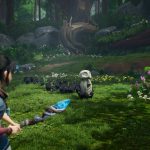
The first thing I noticed about this game is just how gorgeous it is. The designers took full advantage of the technology available to them and created a vibrant world full of color and energy. It makes the contrast between the normal, healthy forests and the dead areas of corruption stark and meaningful. The blue lights of the spirit energy are probably my favorite, and the way those lights bounce and radiate off of various sources have an amazingly ethereal air to them. The cutscenes are particularly breathtaking, but even the normal gameplay graphics are sharp and clean.
Magical Animations
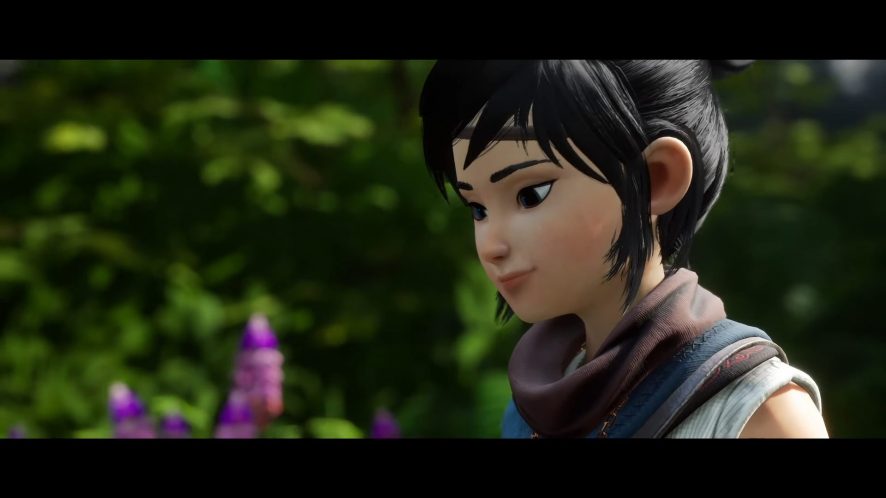
The character designs are wonderfully expressive and perfectly fit the world. Gamers are more used to seeing high-end graphics like this dedicated to making everything as hyper-realistic looking as possible. Instead, the game is much more akin to a 3d animated feature. Every character is wonderfully expressive, and the graphics allow for subtle emotions to show themselves just as well as wide-sweeping gestures. I love watching Kena meditate (the method used to increase your health) or as she sets a group of spirits free, just to see her soft satisfied smile.
Subtle emotions are beautifully displayed just as much as dramatic ones
Amazing, though limited, music
The music gives an ethereal atmosphere that fits the supernatural story of the game. The quality is at its highest during the intense moments, either in battle or during an emotional scene. You become enveloped in the scene, and the music goes a long way into making that happen. Outside of those moments, however, the more you focus on the music, the more repetitive you suddenly notice it can be. I spent one section searching for an important object and noticed the music was a tad too repetitive for my liking.
Controls and Gameplay
The gameplay is split up into two general sections: exploration and combat. While the two do mix to some degree, enemies are generally restricted to specific areas. The rest of the land is up to you to run, climb, and explore. It’s difficult to get lost in the paths you travel, but even still, there are plenty of secrets and points of interest hiding behind trees, inside homes, and down every little side path.
Being in Full control of the adventure
Movement in this game is typical for your normal action-adventure title. Walking and camera directions are controls that anyone will intuitively be able to handle. Running and jumping are also simple, and while you do gain abilities as you progress, the instructions are explained in ways that make them easy to understand. In the field, specific interactions with items are labeled on the screen so it’s never a question of what you have to do. All control instructions are easily accessed in the menu, so you never have to worry about forgetting how to play.
A Full and Eventful World
With exploration being a big part of this game, you can bet that a lot of care was put into making that exploration as good as possible. Initially, there isn’t too much to explore, as much of the world is closed off to you by the spirits you’ve yet to face. This makes initial exploration very straightforward, and as mentioned before, it’s pretty hard to get lost.
But as areas open up, you get more and more freedom to backtrack and grab anything you lost. There isn’t any real back and forth that’s required to beat the game, but there are enough hidden secrets that make going back a worthwhile endeavor if you want to find everything. Each objective must be cleared before moving to the next one, and there are full mini-bosses and area bosses that must be defeated in order to gain the required relics and ultimate resolution.
Intense and Intuitive Combat
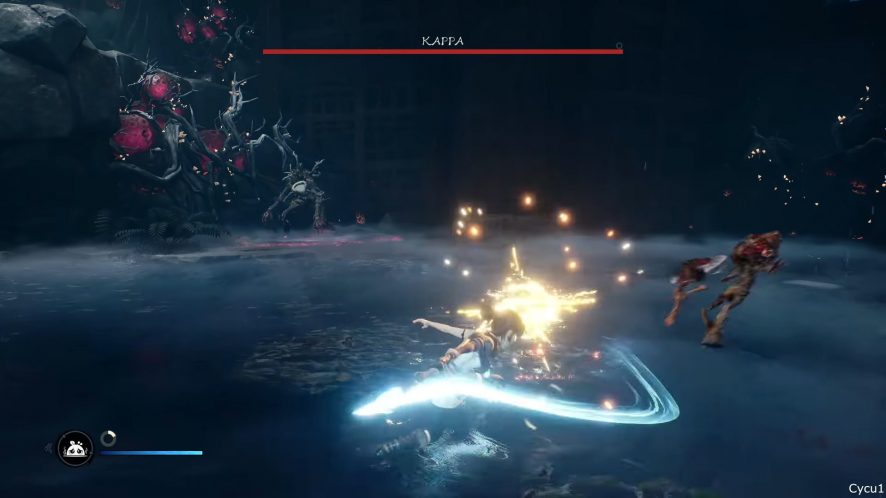
When it comes to combat, like many popular action games (e.g., Dark Souls and Code Vein) your ability to block, parry, and dodge incoming attacks is crucial to surviving. The enemies don’t hang around waiting for you to sneak up and attack but are instead alerted to your presence and appear before you. In most cases, you will recognize when you’re about to face opponents. You have two main attacks: light and heavy. Heavy attacks take a bit more time to charge and unleash. As you unlock more abilities, the light and heavy attack buttons are set up in combination with other buttons to trigger special attacks. But if your timing isn’t on point, you can easily end up only doing minor damage.
NPCs with a Purpose
Despite being the only living human in the area, you aren’t alone in your journey. The corruption hasn’t overcome every spirit, and those that remain are eager to help you save the souls of their fellow villagers. Their stories are central to your efforts, but more noticeably, they have a similar connection to the spirit realm as Kena does and have been able to shape that spiritual energy into special abilities that they’re willing to share. Much like Zelda, the primary purpose of these techniques is for exploration, allowing you to reach otherwise inaccessible locations. But they have combative use as well, especially when combined with the other spirits that you will inevitably meet.
Fans of Breath of the Wild will be intimately familiar with the forest Koroks that lurk under practically every rock and bush in Hyrule. Bridge of Spirits has a version of its own: little black blobs known as Rot (A very strange name with no real explanation is given why they’re called that). They pop up everywhere, hiding in little corners of the game, even as rewards for defeating various bosses.
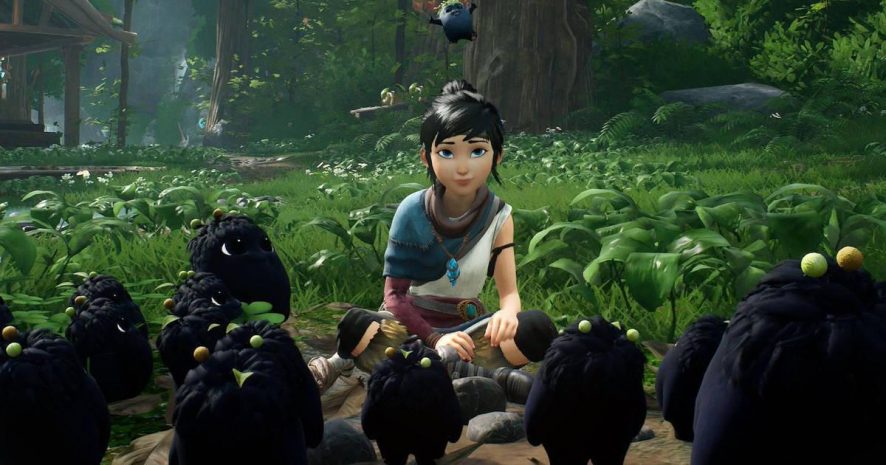
The cute little Rot help in exploration, combat, and putting things back together.
The difference between Rot and Koroks is that these oversized ants are actually useful. Advanced techniques require the power of the rot, which accumulates in battle as you land attacks and defeat enemies. They’re also key in eliminating barriers made of the land’s corruption. As a bonus, they also visibly accompany you wherever you go. Their leader (a tiny Rot that I affectionately nicknamed Leaf) rides on your shoulder wherever you go while the others follow you and pop up in random spots as you travel.
You can also direct them to perform various tasking; fixing toppled monuments and carrying large objects like a group of Pikmin. To make them even more endearing, one of the major collectibles in the game is a set of hats and masks that you locate and then buy to put on the individual Rot. It’s literally the only thing you buy with this world’s currency, but watching these little guys running around with an acorn or a little frog on their heads is oddly endearing.
Difficulty
I do not have the best gaming reflexes. When it comes to first-person shooters and fighting games, I am decent at best, and I have to re-learn how to fight enemies every time I turn on Breath of the Wild. I played through Kena on “normal” difficulty and I was sufficiently challenged. Learning each enemy’s attack patterns and mastering the timing took a lot of attempts and a decent amount of luck, but I always felt like I was learning. Even at the hardest moments, it never felt like it was difficult to the point of being unfair. For those who just want to relax and enjoy the game, there is an easy mode that focuses on the story. Those with Dark Souls-levels of masochism can look forward to a hard mode and even a Master Difficulty mode after that.
Final Verdict
I came in loving the aesthetics and I came out loving nearly every part of this game. Its story and atmosphere are exactly the kind of beautiful, pure, and emotional setting that I love –- the same kind of vibe I always expect from the Zelda series. The combat can be challenging, but in a way that makes you work, learn, and eventually succeed. I had mild nitpicks with controls and music repetition, but mostly, my biggest complaint is that I wish the game was longer. My playthrough with this game was a little over 17 hours long. This was an incredible outing from Ember Lab, and I hope to see more from them in the future.
Score: 9.5/10
Similarity Scores
Breath of the Wild – 4/5
Twilight Princess: – 3/5
Adventure of Link: – 2/5
Connor Schultz
Adventurer, Traveler, and lifelong resident of Hyrule. With a love of immersion and lore, there is always another world to see and another story to be told.
You can join the adventures at https://www.twitch.tv/conterez


 by Connor Schultz on October 9, 2021