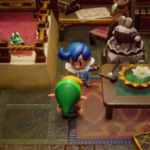
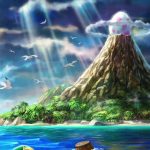
I played Link’s Awakening when it first came out on the original Game Boy. The tense opening scene immediately filled me with excitement, and I explored Koholint Island with delight. The enemies, and especially the puzzles, gave my young self a great challenge and, like A Link to the Past, a great sense of accomplishment with each trial I overcame. What Nintendo was able to do with a relatively primitive system is truly amazing.
My six-year-old self didn’t recognize, however, the significance of the game’s story. Taken in by the music and the adventure, I did not appreciate what was going on. When the DX version came out for the Game Boy Color, I picked up the game again, and, with five more years on me, I could begin to understand what was really happening. As time passes, and with the latest retelling of this 26-year-old game, I can say that — more than any other game in the series — my appreciation for Link’s Awakening has grown over the years.
With the game’s remake on the Switch, the colors and design in many ways perfectly match the enthusiasm I had as a child. But in some ways, I feel like that bright style reminiscent of a toy box diorama makes it once again easy to miss the emotional weight of the story. While not as overtly dark as Majora’s Mask or Twilight Princess, the journey on Koholint is one that makes you question the true nature of your quest, and what it actually means to be a hero.
The irony of this is that at its surface, the story of Link’s Awakening is actually one of the most colorless, lazy cliches of storytelling. But thanks to its brilliant execution, this game was able to make the dumbest plot twists possible and create something truly memorable.
A strange island
The premise of the game is easy enough to understand. After falling victim to a vicious storm, Link has been shipwrecked on an uncharted island. As you get your bearings and recover your sword, an owl swoops in and gives you an ominous warning — the only way to leave the island is to awaken a being known as the Wind Fish. Since we’re dealing with a world of mystic and divine powers, such a requirement is not out of the ordinary. The initial puzzles in both the Mysterious Woods and Tail Cave are pretty standard fare for any The Legend of Zelda adventure. As my six-year-old self could attest, you can go straight through this game without a second thought and have a great time. But that youthful enthusiasm starts to dampen as you begin to take a closer look at what is going on.
It starts with the compass, an item we have seen in nearly every dungeon and honestly never give much thought to unless we’re really lost. This time, however, in addition to giving us the location of keys and chests, we’re told that the compass tells us where the “Nightmare” is hidden. Looking at the map, the mark of a demon flashing on screen indicates where this Nightmare is located, and our clever minds figure out that the game is actually referring to the boss. With that realization, we continue our dungeon diving, searching for the next key or item.
Names and descriptors are common in Zelda, but only in Link’s Awakening are all bosses given a special title.
It isn’t long however, until that label is referred to again. When the boss key is found, it isn’t called the Boss Key or Big Key as is normal. Instead, the key is given the name of “Nightmare Key,” and once again, the boss is referred to with that same title. Although every boss in The Legend of Zelda has had a name, and the 3D entries have been pretty consistent in giving each one a description for dramatic flavor, Zelda games hadn’t ever lumped its bosses into any sort of class. To give ordinary bosses a special title is a very unique characteristic of this game, and it’s one that refuses to leave you alone. As you travel on to each successive dungeon, each boss is given that very specific designation of Nightmare.
Nightmares
The strange thing about it is that when you look at the eight Nightmares that rule these dungeons, very little actually connects them together. No distinguishing marks or indications exist that they necessarily come from the same source. None, that is, except for two. First, the argument can be made that the bosses are somewhat out of place. While Koholint as a whole is bright, vibrant, and colorful, the dungeons, and especially the Nightmares, are somewhat muted, unusual, and all represent things that are generally considered frightening. The Switch version emphasizes this with every boss, miniboss, and even regular enemies dying in an explosion of dark fire with a strangely ethereal quality.
The second feature is truly unique to this game. Unlike most of the regular bosses, who only growl, roar, or make some other kind of animalistic noise, every single Nightmare talks. Although their characters vary in intelligence and personality, all of them speak words that you can understand. Each one regards you as an interloper who must be eliminated. Perhaps the first Nightmare said it the most succinctly with the only intelligible word it utters — “Outsider.”
Taking another look at Koholint and your situation, the term “outsider” is pretty accurate. Not only are you obviously not from the island, but it becomes consistently clear that you have little idea what is going on. Owl statues that dot the overworld all give vague and cryptic descriptions regarding dreams, sleep, and the Wind Fish. None of it gives you enough information to come to any definite conclusions. Instead, they just sit there, tugging at the back of your mind, giving you the constant impression that something about this island just isn’t adding up. The Owl himself, despite guiding you to the various dungeons, never gives anything more than cryptic references. Despite living on the island for years, the residents have no idea when or how they began to live there, and only Marin dreams of the world beyond the horizon. Despite the fantasy landscape we have become accustomed to in Zelda, something about this island just doesn’t seem right. As the Slime Eel of the Catfish’s Maw states: “You don’t seem to understand what kind of island this is.”
The nature of dreams
That understanding comes soon after, as you reach the Southern Shrine, and locate a mural in the back room. Depicted on the ancient drawings are an owl, a whale (which you can only assume is the Wind Fish) and an inscription bearing this message —
To the Finder… The Isle of Koholint is but an illusion.
Land, monster, sea, sky…
A scene on the lid of a sleeper’s eye…
Awake the dreamer and Koholint will vanish much like a bubble on a needle… Castaway… you should know the truth!
The message written on the Southern Shrine’s mural revealed one of the greatest narrative twists in The Legend of Zelda’s history.
“What…an illusion?” It’s a dramatic turn of events, one that dominates the remainder of the game and has each remaining boss taunting your every move. But taken at face value, such a twist could easily be dismissed as lazy or nonsensical. In nearly any scenario, to make a journey nothing but a dream is regarded as one of the cardinal sins of storytelling. Imagine, for example, if it was revealed that Ocarina of Time or Breath of the Wild was nothing but a dream. After all, Link was asleep at the beginning of those games. Who’s to say he didn’t just stay that way, fighting demons and saving Zelda only in his dreams?
We’d all be up in arms about it. In fact, we were at times. When members of the development team postulated that Majora’s Mask was nothing more than an illusion created by the Skull Kid, it generated massive backlash from the fanbase and has for the most part been completely cast aside as a preposterous theory.
Why? Because to make the entire journey a dream or an illusion invalidates our entire experience. Dreams, regardless of how good or vivid they are, are fleeting things. They are easily forgotten and cast aside upon waking. No matter the struggle in the moment, if nothing about the journey is real, then there wasn’t actually any good done, and all of our efforts are in fact meaningless. To say that an adventure is only a dream is to say that absolutely nothing about what we went through mattered. Surely, nothing could be less satisfying.
Timing and buildup
In almost any given scenario, that would be our reaction to this kind of revelation. But due to its impressive design and execution, Link’s Awakening is able to sidestep this fate and instead give us a dramatic, thought-provoking dilemma that means more to us the more we think about it.
The first reason for this is how effectively Koholint is set up from the very beginning. Movies and shows with a plot twist will often tease that something is going to happen, placing carefully timed hints that will get viewers talking. Link’s Awakening, meanwhile, doesn’t directly hint at anything. The are certainly plenty of things to make you question, from the self-sufficiency of the residents to the strange requirement of waking the Wind Fish when you’d think a boat would do just fine. But until the end of the Catfish’s Maw, nothing is placed in our path to suggest that something is wrong.
However, as soon as the nature of Koholint is revealed, every strange aspect of the island suddenly make sense. The cryptic sayings of the owl statues now come into laser focus, talking specifically about the nature of dreams and the Wind Fish. The comments of the townsfolk, who have little idea of anything beyond their immediate situation, now fit the context perfectly. And the stranger aspects of the island, such as the Dream Shrine, no longer seem so strange.
The second reason is the timing. Usually the “twist” of making it all a dream comes at the end of the story, granting you no closure to the events described. Link’s Awakening places it just past the halfway mark, giving us plenty of time to mull it over and try to answer the questions that come from such a revelation. Questions that haunt you during the remainder of your journey. Instead of ending with “it was all just a dream,” the game taunts you with the uncertainty of what is going on, and the validity of your quest.
The dreamer
Perhaps the greatest reason why the dream world setting works is the element of uncertainty regarding the dream, because you aren’t entirely sure who’s dreaming. Obviously, the Nightmares are certain that the Wind Fish is dreaming and are desperate to keep him from waking. But just because they claim the Wind Fish dreamed the island into existence, it doesn’t explain your presence in it…or does it?
How did you end up inside of the dream? The Nightmares come to the seemingly obvious conclusion — you didn’t. You are just another part of the dream and are therefore doomed to vanish along with everything else if you complete your quest. Their sneering is but the natural conclusion of that perspective. To them, your objective amounts to suicide; why are you trying to hasten your own annihilation? But you have your memories, right? You remember the storm, the wreckage, Zelda, and everything that came before. That was all real, so you can’t be part of the dream, right?
Many of the Nightmares warn Link against proceeding further in his quest to awaken the Wind Fish.
But maybe it isn’t the Wind Fish who’s dreaming. After all, if this is all just a dream, and you know you are real, then isn’t it just as likely that Koholint is all your dream? That would explain why you know about the world beyond the island while no one else does. But if it is all just a dream, then we are back to the question we started with — why does this adventure matter at all? If it’s your dream, you should be able to wake up and move on with your life. But you can’t. So, why?
Could it actually be real? And if it is real, could the waking of the Wind Fish lead to something worse, something darker and more destructive? Could you, in a desperate bid to leave the island, inadvertently be condemning Papahl, Crazy Tracy, the mermaid, and especially Marin, to destruction? What kind of hero could do that!? The Link’s Awakening manga goes into this thought process a little deeper, with Link refusing for a time to continue the quest because he cannot bear the thought of discarding not just the island, but the people he has met and befriended along the way.
you don’t know who is dreaming, so you can’t be certain of what is the right thing to do.
That conflict does not affect us so greatly, partially because we are playing a game and know we aren’t actually causing anything so cataclysmic. But in a very similar vein, it’s also because we don’t have any other choice. After all, if the island is real, then the people on the island are in very real danger from these nightmares. And if the Nightmares are correct, and it’s all just a dream, then you know that all dreams must eventually come to an end. One way or another, you need to face reality, whatever it may be. And the only way you will answer those questions will be if the Wind Fish wakes.
Dreams and memories
After defeating the final Nightmare inside the Wind Fish’s Egg, you are brought to a platform, where the Owl meets with you one final time, revealing himself as the guardian of the Wind Fish’s dream world. With the mystery regarding who’s dream this is put to rest, the Wind Fish comes into view, recounting briefly his dream and the necessity of dreams to end. He then makes a comment that has long confused me. In the original game, the text is as follows:
“When I dost awaken, Koholint will be gone. Only the memory of this dream land will remain in the waking world… Someday, thou may recall this island, that memory must be the real dream world. Come Link, let us awaken together.”
The Wind Fish finally awakens at the game’s finale.
Whether due to a mistranslation or an effort to make the Wind Fish sound wiser, the concept of a “real dream world” is enigmatic at best. However, with the re-release on the Switch, that phrase is rewritten, making the statement much clearer.
“When I dost awaken, Koholint will be gone. Only the memory of this dream land will remain in the waking world… Someday, thou may recall this island… That memory makes the dream world real..”
That realization is what drives home the story of Link’s Awakening. As you sit amongst the remains of your ship, contemplating the dream you had, the shadow of the Wind Fish flying overhead proves to you that your efforts really were meaningful. Sure, the environment and the creatures you encountered didn’t exist in the real world, but the danger you faced, the being you needed to save, and the memories you created, do. It’s those memories that bring out the potential within us, as we realize that the power to defeat evil is not only found in physical conflict, but it requires emotional and spiritual effort as well. And it’s those traits — the wisdom and courage held by the legendary hero — that were most needed in this journey.
It is difficult to effectively communicate that message, but by crafting a world that made you question reality, Link’s Awakening is able to pull it off. Not only did it create a narrative that is both engaging and satisfying, it also showed how an “awakening” can mean much more that just arising from slumber. It can also mean rising up in the face of uncertainty, discovering the strength within yourself, and creating memories that can last decades.
Connor Schultz
Adventurer, Traveler, and lifelong resident of Hyrule. With a love of immersion and lore, there is always another world to see and another story to be told.
You can join the adventures at https://www.twitch.tv/conterez


 by Connor Schultz on December 14, 2019