The Legend of Zelda: Majora’s Maskhas been the subject of thematic analysis by gaming enthusiasts for 20 years and counting. The game has layers, multiple storylines intertwining with one another as well as deepening the overall plot. The plot is high-stakes and overwhelming, but in my mind, the sidequests and the little plot points along the way are what truly define the tone of the game.
The tone of the game is somber, of course. It is also profoundly mournful. People from all around the land of Termina are coping with some kind of loss, all in different ways. Their experiences are diverse, and at first, a player may not interpret any similarity into their stories beyond grief. However, they are similar. A particular theme is revisited several times in several characters throughout the game. It dates back to one thing they have in common: They are all fathers.
Four specific stories stand out as examples of exploring the topic of fatherhood. Three of these stories are clearly important, because they relate directly to how the player comes to find the mask of each region. They are of the Deku Butler, Darmani, and Mikau — hardly minor storylines.
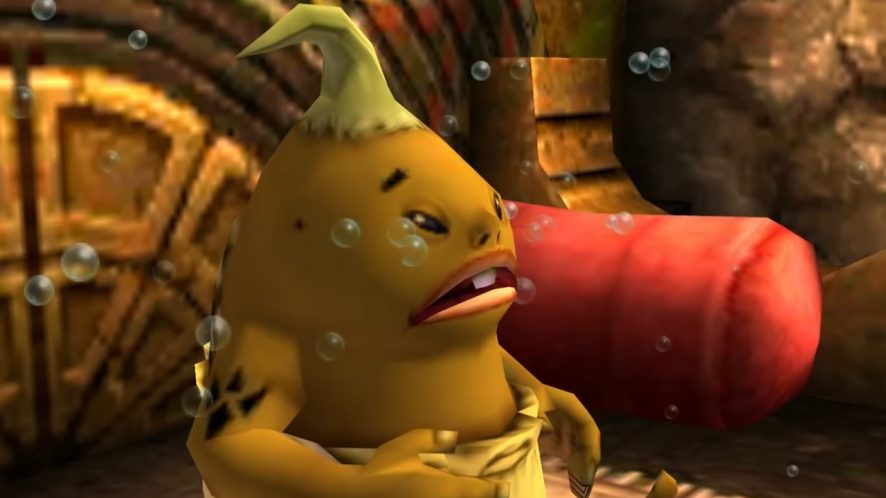
The Deku Butler after a race.
Fathers Facing Crises
One more story of fatherhood surfaces for some players when thinking of subplots within Majora’s Mask. It is that of Pamela’s father, the Gibdo man who we can help with the “Song of Healing.”
The Deku Butler at the Deku Palace in the Southern Swamp has lost his son. It is heavily implied that this son begot the Deku Scrub Mask, which the player uses for the majority of the first portion of the game.
Further along, we meet Darmani. Darmani must help soothe the crying Elder’s Son of Goron Village, whose father went off to try to stop the endless winter. The baby misses his father, and Link must soothe him and grant the entire village some peace by helping him remember him.
After that comes Mikau, the Zora man who dies in the process of trying to rescue the eggs of his beloved girlfriend, Lulu. Though it is not explicitly stated, Mikau is implied to be the father of these eggs. In a way, his exact father status is beside the point. It’s thematic, rather than specific. Whether he biologically is or isn’t, he cares for them in a very paternal fashion. This is evident by the fact that his final wish is for Link to save the eggs and make sure Lulu regains her voice.
There is one more example of this theme in another region of the game which comes to light, though it does not impact an integral character to the main story. If the player chooses to explore the Music Box Hous in Ikana Canyon, they may meet a terrifying Gibdo who tries to attack them. If the player lunges at the monster, a young girl named Pamela will stop them. She will then plead with the Gibdo to remember her, his daughter. Even as he’s turned into a mummified zombie, she begs her father to remember her.
The Elder’s Son, who misses his father.
Understanding A Father’s Grief
This theme of fatherhood reoccurs, in every region, and it always struck me as more than coincidence. For at least a decade, fans of Majora’s Mask have asserted that the progression of the game throughout the various regions represents the five stages of grief: denial, anger, bargaining, depression, and acceptance. I posit that these story elements, each of them involving fathers and their children, represent facets of a different kind of grief — failure.
The Deku Butler’s son is long gone by the time the game begins. Darmani can’t reunite the Elder’s Son with his father, and this only reminds him of a better time when they were together. Mikau never meets Lulu’s children because he dies before he can rescue them. Pamela cannot heal her father and can barely protect him in his altered state.
There are upsides to all of these sad stories, however. Though none of them get exactly what I would call a happy ending, they get something else at long last: closure. Through Link, they are healed. And the player isn’t told specifically why.
Link has no father. One may wonder, does he see himself in these sad tales? Does he see what could have been? By healing the spirits of the people of Termina, is he also healing himself?
Lulu’s Eggs, now found.
Healing That Comes From Hope
Healing is a vital theme in Majora’s Mask. It is so from the beginning when you learn the “Song of Healing.” The topic is explored through a variety of characters, all of them struggling to cope with a different kind of loss. The “Song of Healing” is suited to any instrument in the game and is often the player’s best resort in times of doubt. It soothes the souls of people all across the land, helping them come to terms with their loss and learn peace. It is only symbolic, however; Link still has to do the work to repair the damage left by such heavy loss.
This work, this closure, represents growing up. It is the loss of childhood, loss of innocence, and loss of parents and of children. The game’s healing motif demonstrates that though these losses are great, they are not insurmountable. Majora’s Mask is not so much about death as it is about healing from grief. In order to support this assertion, I cite the fact that in my high school health class I was taught an additional step in the grieving process. The model that ends with “acceptance” is now considered outdated, not quite accurate, because grief doesn’t end with simply accepting one’s loss. The new model retains many of the same stages, but it is longer. Beyond that, it’s a little more optimistic.
I acknowledge the theme of grief other theorists have pointed out as a given, but I also apply this newer model to my thematic analysis. First, there’s shock. Then, denial. Anger. Bargaining. Depression. Acceptance. And finally one more — hope.


 by Jamie Trent on June 20, 2021