A unique period exists within the Zelda series: the Satellaview games. The chapters of the BS Legend of Zelda (BS Zelda no Densetsu) were approached in a way that the series has not done since, the “BS” in the title being an acronym for “broadcast satellite,” hinting at the mechanics involved. Nintendo has a long and storied history of innovation — for better or for worse — when it comes to how video games are played. This feature is going to explore the oft-forgotten Satellaview and episodes of the BSZelda games, looking at what made them such interesting additions to the Zelda series.
What is the Satellaview?
Since the Satellaview is likely to be unfamiliar to many (given its limited release), an overview of the hardware itself is probably necessary. The Satellaview was a peripheral for the Super Famicom (Super Nintendo Entertainment System) which saw a Japan-only release in 1995 and subsequent discontinuation in 2000. It was developed by Nintendo in collaboration with St.GIGA, a company which beforehand had been largely known for its broadcasts of experimental, ambient nature sounds.
The Satellaview attached to the Super Famicom system and allowed players to utilize satellite broadcasts to download special content directly to their Super Nintendo. This naturally included games, but also expanded the SNES’s usual oeuvre through the inclusion of content such as magazines and comics, all downloadable via the satellite broadcast. This was aided by the BS-X cartridge, which was required for use of the peripheral.
The Satellaview peripheral attached to a Super Famicom system
The premise of the Satellaview follows the classic Nintendo style of design. Innovation in the way video games are played has been a mainstay of the company throughout its life — think the Wii’s motion controls, the twin displays of the DS, or the nauseating immersion of the Virtual Boy. Aside from Zelda, a number of other familiar faces made it onto the Satellaview: Wario’s Woods, F-Zero, and Fire Emblem to name a few, each coming with their own parameters of how an amalgam of a video game and a radio broadcast should play.
Certain elements of this type of shared gaming experience have re-emerged in the current day: consider Twitch streaming or online events as modern parallels to what the Satellaview pioneered. A temporal experience that to an extent can be enjoyed later, albeit diminished or with a lessened sense of community. There is a level of participation that can only happen if someone is in the right place at the right time.
The Satellaview Zelda games
Referring to the titles of BS Legend of Zelda as simply “games” is almost inappropriate, as they seem to operate in some sort of in-between space. Not quite games, not quite radio broadcasts, not quite television episodes; though they are games, nonetheless.
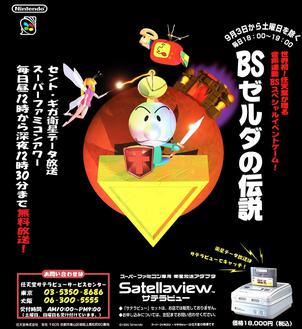
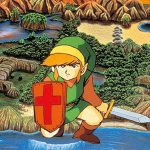
Since BS Legend of Zelda is a remake of the original Legend of Zelda, the story has elements of the series’ standard fare: Ganondorf, Zelda, the Triforce. One major element, however, is absent: Link. Instead of our usual green-clad hero, the player begins their adventure as a boy or a girl, based on the Satellaview’s avatar-mascots. The protagonist hails from the Town Whose Name Has Been Stolen, a contender for the best-named locale in a Zelda game thus far.
BS Legend of Zelda advertisement
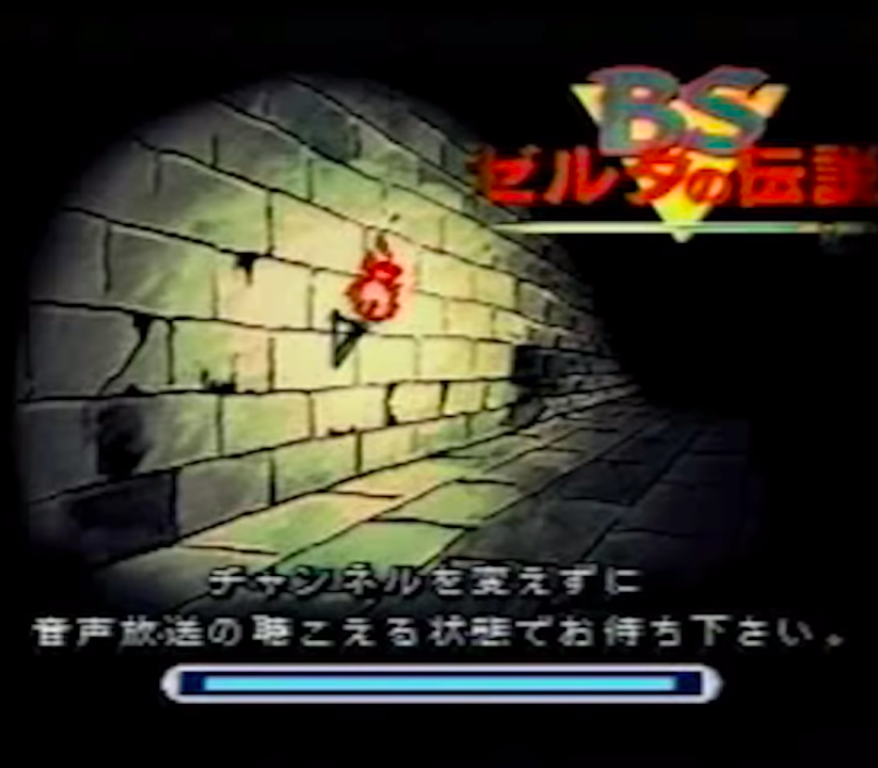
The second installment, BS The Legend of Zelda: Ancient Stone Tablets was derived from A Link to the Past and was only available to play at a specific weekly time during a four-week period in March and April 1997. Like the first BS Zelda entry, Ancient Stone Tablets was only playable for an hour at a time, with certain events happening at certain time points in-game.
In both games, the plot details, the use of abilities, and the challenge instructions were all delivered based on an in-game clock. Zelda and Ganon would even speak, voiced by Naomi Fujisawa and Seizō Katō respectively, with the second installment expanding the voice cast. Within these broadcasts, players were tasked with scoring as many points as possible, with high scores netting prizes from Nintendo. Minor changes were made to the original games that the BS Zelda games were based on, particularly regarding plot and item functionality.
The final game broadcast through the Satellaview was simply the Japanese version of A Link to the Past, going by its Japanese title Triforce of the Gods. Whether or not the first two BS Zelda entries are canon is outside the scope of this feature. It is likely they are considered as spin-offs, though they do fit in with the series remarkably well. They are largely faithful to the world of Hyrule that had been previously crafted and were themselves developed by Nintendo — there is no laughable CD-i standard quality to be found here. I would argue that each entry could be classified in the same way as Master Quest-style entries — a mod of original source material that is more of a re-interpretation of an existing legend rather than a separate canonical entity.
Locked in time
Unfortunately, there is no way to play the Satellaview Zelda chapters today in the form that they took in the 1990s. Despite having re-runs not long after their original release, and having been recreated for emulators through data dumps, the voice acting could not be preserved. Aside from the modality, this is another feature that makes these entries unique: They are trapped in time.
It is interesting to consider any video game locked in time. Does this make the game more special for those who experience it? Or is it unfair that fans are barred from a full experience of a series entry because of their place and time in history? Like event Pokémon, special Pokémon given to players at certain times, participation can act as a trophy, but invariably there will be many who miss out. There are mod playthroughs on YouTube that may be the closest thing we can get to experiencing the Satellaview Zelda entries as they were, and may even evoke some of the feeling of a shared experience that the originals held, but today’s experience of the BS Zelda entries will never quite be the same as it was in the ’90s.
The future
So why hasn’t this formula been repeated? With current technology and Nintendo’s penchant for transformation, it seems a perfect fit. As a community, we create our own parameters for shared, competitive gameplay: speedruns, or challenges such as the Three Heart Challenge or Nuzlocke challenge in Pokemon. Perhaps for Nintendo, the risk-reward ratio is unfavorable — after all, the Satellaview only sold roughly 100,000 units. But with Nintendo’s enthusiasm for other online, time-specific events in its independent properties (Super Smash Bros., Splatoon, etc.) it would be nice to see how this would extend to a modern Zelda.
BS Zelda is a unique page in the Zelda history books, and this feature only serves as an introduction to the games. I would encourage anyone interested to check out the BS Zelda Homepage, which I would like to thank for being a brilliant source of information on the series. The hard work put into the site is clear and this feature would not have been possible without it.
Cal Birks
I've been playing Zelda for the past twenty years. You can usually find me somewhere arguing why the GameCube was the greatest console of all time.