When designing a new Zelda title, Nintendo always takes inspiration from the preceding games. Whether they are trying to reach some large-scale advancement or simply borrow elements for the sake of familiarity or novelty, the developers find plenty of reasons to implement older features.
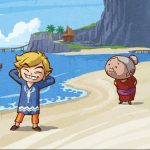
That was the case for Breath of the Wild. It borrowed heavily from many older games to create a new paradigm shift in the series, and The Wind Wakeris one of the games that offered templates and valuable assets. The Wind Waker was one of the few Zelda games that had a truly open environment, so it made sense for Breath of the Wild to look to it for guidance.
10. Using Enemy weapons
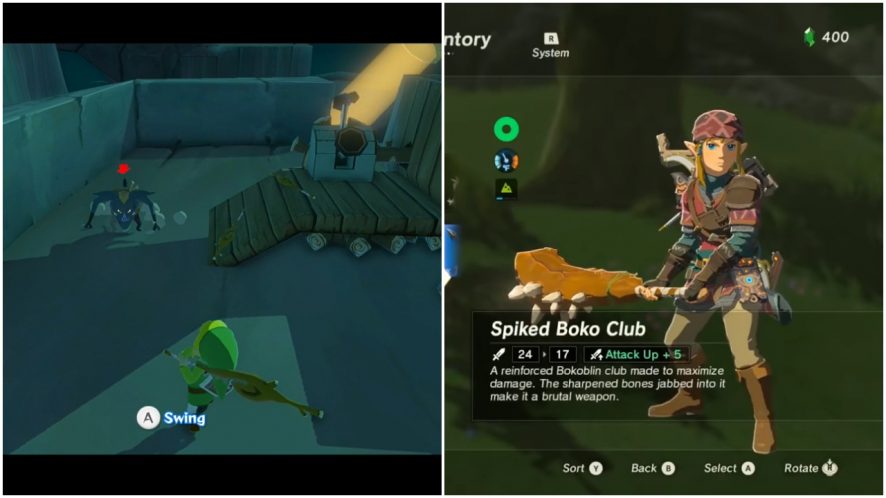
After Link lost his sword during his first infiltration of the Forsaken Fortress, he quickly realized that he would need to find a temporary weapon to use till he reclaimed his blade. Luckily, the Bokoblins patrolling various parts of the fortress provided him with an opportunity to acquire new, albeit crude, weapons.
In Breath of the Wild, one of Link’s main methods for filling his inventory was to steal his enemies’ weapons. Moblin Spears and Bokoblin Clubs were common and reliable tools that Link could use in place of a traditional sword.
9. Former King of Hyrule secretly guides Link
Throughout the first half of Link’s journey across the Great Sea, he was led by the King of Red Lions. Link at first knew nothing about him, but when given no other choice, the King revealed himself to be the last King of Hyrule and that he had been disguising himself as the King of Red Lions to avoid burdening Link with too much information.
This is similar to how the last king during the Era of the Wilds secretly led Link after the young hero emerged from the Shrine of Resurrection. While the king trained the Champion, he appeared to be nothing more than an elderly drifter. It was only after Link was ready to begin his journey that the king revealed who he truly was.
8. Beedle is everywhere
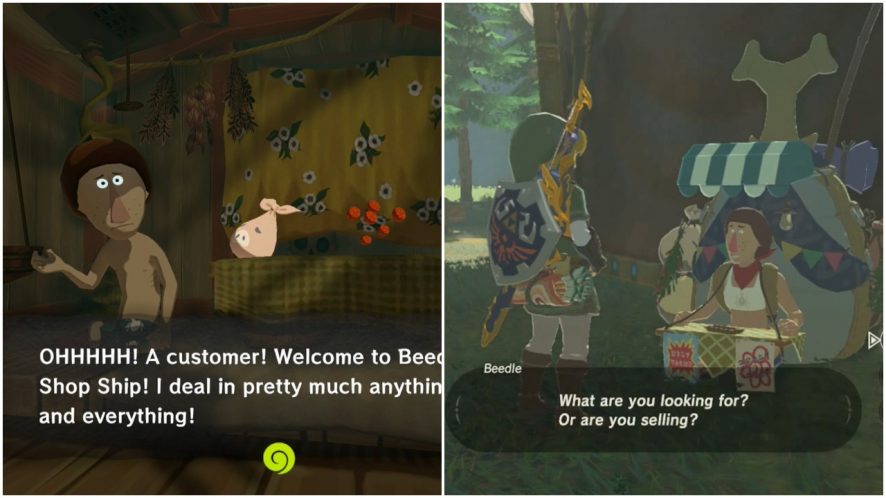
Link could find and barter with Beedle almost anywhere on the Great Sea. Wherever there was profit to be made, Link could be sure that the peculiar merchant would be close by. Beedle seemed to be everywhere at once, and he was always eager to make a sale.
A new version of Beedle exhibited the same salesman qualities in Breath of the Wild. There were multiple stables dotted across Hyrule’s landscape, and no matter which one Link visited, he knew he could find Beedle and his massive backpack full of goods waiting for him.
7. Creating potions from monster parts
The Chuchus found on nearly every island were a nuisance to deal with, but they did offer some benefits. A slain Chuchu would often leave behind some of its Jelly. This Jelly didn’t serve much of a purpose in its natural state, could it be used to create useful life and magic-restoring elixirs.
The ability to make elixirs returned in Breath of the Wild, though now Link could make them from almost any monster remains he inexplicably decided to pick up and stuff into his pants. He could either cook them on their own to make potions, or he could mix them into his food ingredients to create status-altering meals.
6. Restoring Strength to the Master Sword
The Wind Waker was the first game to show fans that the Master Sword was not without limits or weaknesses. Ganondorf had killed the Sages who were tasked with praying to preserve the Master Sword’s power, causing the Power to Repel Evil to eventually fade from the blade.
In Breath of the Wild, the Master Sword had lost its full strength after Link had nearly been destroyed 100 years prior. The sword would repeatedly lose its power, and the only way to permanently re-awaken it was for Link to complete the Trial of the Sword.
5. Using a Camera to catalog information
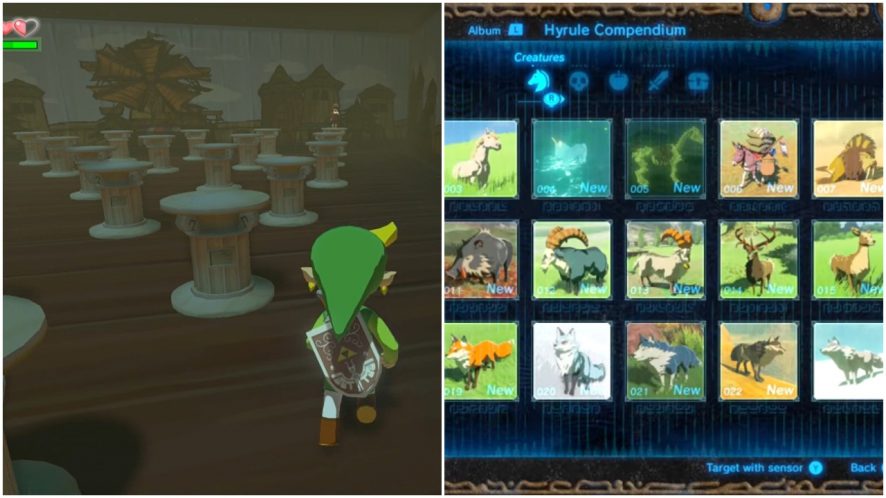
If Link felt like taking a break from his world-saving duties, he could spend some time taking perfect snapshots of people and creatures living on the Great Sea. Then, he could take his photos to the Nintendo Gallery to be turned into life-like sculptures that came with details and trivia about their subjects.
The Hero of the Wilds could do something similar, though no sculpting was involved. Taking a picture of a plant, animal, rock, or enemy with the Sheikah Slate would instantly add an entry to the Hyrule Compendium, an encyclopedia of sorts that provided detailed information on whatever Link recorded.
4. Limited Stamina
The ability to drown in The Wind Waker was the introduction to the idea that Link could have limits to his stamina. If Link strayed too far from an island’s shore or from the King of Red Lions, he could find himself in deep trouble. If his icon that showed his strength ran empty, Link would lose the fight with the waves and sink into the depths.
This mechanic returned first in Skyward Sword when they gave Link a Stamina Gauge for all of his actions, and then it returned again in Breath of the Wild. Climbing, running, gliding, and, of course, swimming all used his stamina. Wasting too much time in the water was a good way to end up reenacting Link’s water-logged fate from The Wind Waker.
3. Using an item to glide
When Link needed to save Makar from the perils of the Forbidden Forest, he first needed to figure out a way to reach forest’s entrance. The Great Deku Tree offered a solution in the form of the Deku Leaf. Using the Leaf, Link could glide on the wind and let it guide him to his destination.
This gliding ability was seen in a couple of subsequent games before fans experienced its latest incarnation in the form of the Paraglider. The difference was that Paraglider was not an item that needed to be equipped and could be used the instant that Link was far enough away from the ground.
2. Limited enemy types
Despite being a noteworthy topic for discussion when debating Breath of the Wild‘s design, the lack of enemy diversity in The Wind Waker is rarely mentioned by Zelda fans. The Wind Waker did have a decent number of unique enemies, but it was still fewer than what was seen in many other games. Most of these enemies also had variants that padded the overall count.
Breath of the Wild took this concept of having a handful of modular and multi-purpose enemies and ran with it. Each enemy type could be used in all of the game’s environments, after being altered appropriately, and their abilities made them constant threats.
1. Using a powerful counterattack
Combat was linear and basic in Zelda games before The Wind Waker introduced the Parry Attack feature. When locked onto an enemy, the game would prompt the player to press the A button right before the enemy would launch an attack. If the player was successful with their timing, Link would automatically evade the incoming attack and perform a counterattack.
An upgraded form of the Parry Attack, the Flurry Rush, was used in Breath of the Wild. Evading an attack would cause the game to slow down to simulate Link’s lightning-fast reflexes. While time is slow, the player could repeatedly and rapidly press the attack button to unleash a string of powerful sword strikes on an unprepared foe.
Zac Pricener
Zac Pricener has been an avid Zelda fan for twenty years. The series has been a source of creative inspiration for him and fueled his desire to become a writer. That desire to write in turn led him to now serve as the Features Manager, Assistant Columns Manager, and Assistant News Manger for Zelda Universe.


 by Zac Pricener on March 18, 2021