Dragons have inspired some of the most awe-inspiring moments across the Legend ofZelda franchise, from intense battles deep within temples to mystical surprises hidden away on mountain peaks. Though many of the dragons only make one-off appearances, several are tied to much deeper levels of Hyrulean history and lore.
As is often the case with traversing Zelda‘s complex timeline, some connections are straightforward, whereas others are a little more tangled. Here, we’re going to explore the significance of dragons in theseries, as well as examine how individuals relate to one another across multiple games.
The roles of the dragons
Dragons have fulfilled a range of roles across the Zelda series as both friends and foes. Numerous boss fights have featured dragons, including Volvagia in Ocarina of Time and Argorok in Twilight Princess. In fact, the majority of dragons that appear in Zelda act as enemies; they are either simply beasts or tools of Ganon’s making. However, there are several whose very purpose is to serve the goddesses and protect Hyrule.
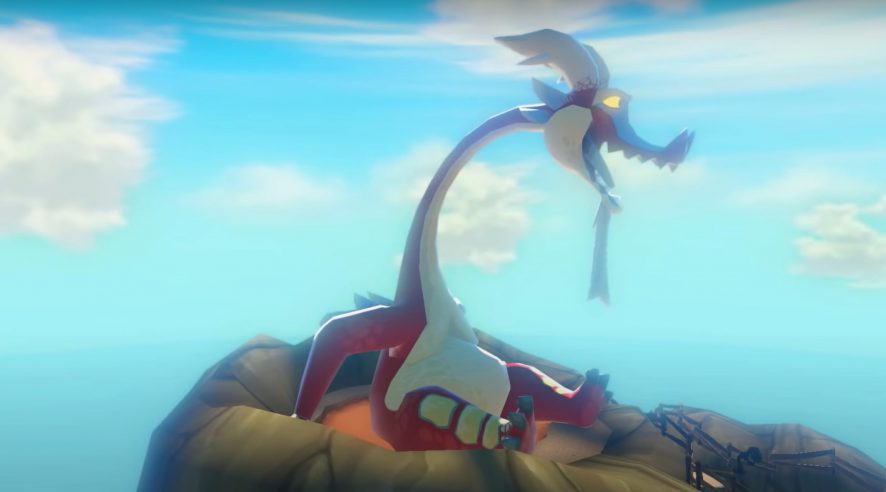
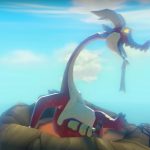
Valoo, featured in The Wind Waker, initially appears to be dangerous. From the point of Link’s arrival on Dragon Roost Island, Valoo is enraged and therefore poses a threat to those around him. However, after scaling the island’s mountain and defeating Gohma, who was tormenting Valoo, Link enables him to resume his peaceful ways as the Sky Spirit of the game. There actually appears to be a common theme among Zelda games wherein an otherwise peaceful spirit becomes a threat due to torment from an external force: Valoo and the Gohma, Naydra corrupted by Malice in Breath of the Wild, and Levias possessed by Bilocyte in Skyward Sword.
Valoo in The Wind Waker
There are a number of other Zelda dragons that are not hostile. In Breath of the Wild, despite being listed under “Monsters” in the Hyrule Compendium, Farosh, Naydra, and Dinraal wish no harm upon Hyrule or its inhabitants. While it is true that their powerful natures mean that getting too close can result in injury, they never directly attack Link, nor do they serve Calamity Ganon in any capacity.
Similarly, the trio of dragons that appear in Skyward Sword is allied with Link. They differ from the Breath of the Wild dragons in that they have a more humanoid appearance and can speak directly to Link in his own language (unlike Valoo, who only spoke the ancient Hylian language). Skyward Sword also features Levias, a spirit who is not himself a dragon but is closely tied into their role in the story. Again, Levias and Link communicate freely.
The dragons that appear in Breath of the Wild and Skyward Sword are arguably the most complex, as their thread of existence is tied to more than one game. However, their lineage can be unraveled into a relatively straightforward set of connections.
Argorok in Twilight Princess HD
Across the timelines
Though each Zelda game brings something new to the timeline, many elements persevere throughout, whether they be concepts, themes, locations, or characters. The idea of the dragons being spirits or guardians appears in several games, with the most notable connection being between Skyward Sword and Breath of the Wild. Both of these games feature a set of three dragons. In Skyward Sword, the dragons share their name with the province for which they are responsible: Faron, Eldin, and Lanayru, respectively. These shared names are said to be a result of provinces being named after the dragon that serves as their respective guardian. In Breath of the Wild, their counterparts are Farosh, Dinraal, and Naydra.
With a little more work to trace these spirits back through Hyrule’s history and the games themselves, such connections extend beyond both sets of dragons. Twilight Princess features four Spirits of Light, three of which align with the aforementioned dragons. The fourth is Ordona, who does not appear to have a relation with creatures or spirits outside of Twilight Princess. Much like the dragons, the Spirits watch over Hyrule and dedicate themselves to a specific region, with which they share a name.
If we look all the way back to the creation of the Triforce and even the kingdom of Hyrule, we are met with the three Golden Goddesses: Farore, Din, and Nayru. Each Golden Goddess is tied to one piece of the Triforce, and in turn, each of these Triforce pieces can be attributed to one of the three dragons.
While the dragons act as guardians for their assigned province, the goddesses are responsible for their creation. As a result, it would be more accurate to say that the dragons are extensions of the goddesses rather than reincarnations or reimaginings of them. While they are themselves spiritual beings, they still serve the even higher being that is the goddess Hylia. The Spirits of Light appear to have the closest relationship with the Golden Goddesses, as they experience direct communication with them when Hyrule becomes threatened and requires their action.
In essence, each of the three dragons in Skyward Sword and Breath of the Wild is connected to three core things: the province for which they are responsible for protecting, one of the Golden Goddesses, and one piece of the Triforce. In order to prevent the connections themselves from becoming too complex, each of them is laid out clearly in the sections below.
The Dragons of Faron
In Skyward Sword, the Faron province is under the protection of the dragon of the same name. Faron is a water dragon who is initially injured when Link first meets her, though she later regains her power with his help. Within Faron Woods lies Skyview Temple, where Link must venture in search of Skyview Spring. Keen-eyed players have noted the Skyview Spring bears a strong resemblance to the Spring of Courage in Breath of the Wild. This is a valid comparison, as the Spring of Courage is also found within the Breath of the Wild’s Faron region. Furthermore, this region — and therefore the spring that lies within it — is served by the dragon Farosh, which ties the connection between the two dragons as counterparts of each other.
Farosh in Breath of the Wild
In terms of their related Golden Goddess, the similarity in name acts as a clue in itself: Farore. While she is the Goddess of Courage, which lines up neatly with the dragons, she also possesses other characteristics that are less straightforward to connect. Farore’s associated element is wind, whereas Faron’s is water and Farosh’s is electricity. She is also represented by the color green — while this is also true for Farosh, Faron’s color is undoubtedly blue.
Despite these mismatches, the existing evidence is enough to show that Farore, Faron, and Farosh are strongly connected beings who serve (or are responsible for) the Triforce of Courage.
Though not as a dragon, Faron also makes an appearance in Twilight Princess as one of the four Spirits of Light. Similar to their Skyward Sword equivalent, Faron requires Link’s intervention to return them to power. Once he does, they assist him on his mission. Since dragons as a species still exist in the Era of Twilight, it is not entirely clear whether the Spirits are complete reimaginings or simply at a different place in the timeline, perhaps inheriting their names and responsibilities from those who came before them.
The Dragons of Eldin
As with Faron, the relationship between the Skyward Sword and Breath of the Wild dragons for this province is relatively straightforward. In Skyward Sword, Eldin is home to the dragon of the same name — specifically, he resides within Eldin Volcano. The volcano is also where the Earth Temple can be found, which is home to the Earth Spring.
The Earth Spring is believed to be one and the same as the Spring of Power in Breath of the Wild. Though the latter is not within the volcano itself, it is close enough to still be within Dinraal’s area of protection. As such, Eldin and Dinraal are each other’s counterparts between the two games. Dinraal’s servitude of the Spring of Power also aligns him with the Triforce of Power, as is the same with Eldin.
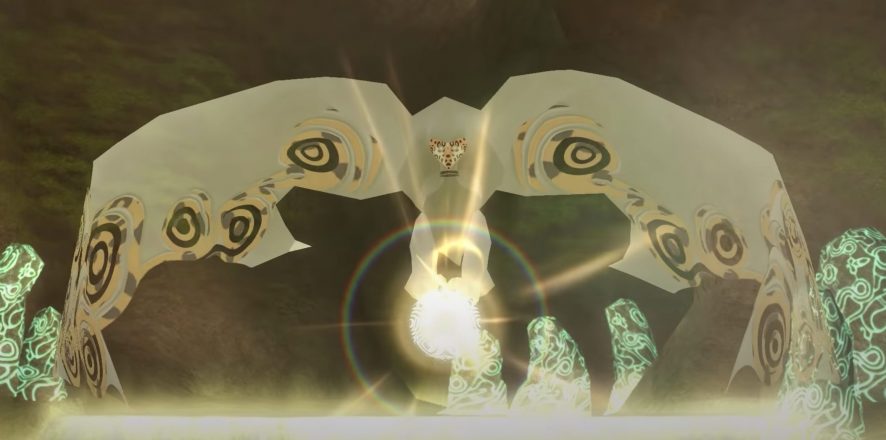
Eldin in Twilight Princess HD
In addition to their connection to Power, both Eldin and Dinraal mirror their associated Golden Goddess, Din, in terms of color (red) and element (fire). In Twilight Princess, the Spirit of Light Eldin shares the same glowing white and gold appearance as the other spirits, however, their shared name and role is enough to connect them to the other spirits serving under the Goddesses Din and, by extension, Hylia.
The Dragons of Lanayru
Unlike the Springs of Courage and Power, the Spring of Wisdom has no equivalent in Skyward Sword. While this does interrupt a cleaner line of connection, there is still enough evidence to relate the remaining dragons to one another. In Skyward Sword, the dragon Lanayru is the guardian of the province of the same name; in Breath of the Wild, the protector of the Lanayru region is Naydra. Therefore, it can safely be concluded that the two are an intertwined pair.
The absence of the Spring of Wisdom’s counterpart could be for a number of reasons, not least of all is the difference in terrain between the games. In Breath of the Wild, Lanayru encompasses wetlands, a stretch of Hyrule’s eastern coast, rugged cliffs, Zora’s Domain, and the snow-covered Mount Lanyru (at the peak of which reside both Naydra and the Spring of Wisdom). In contrast, Skyward Sword’s Lanayru is a seemingly endless stretch of desert. Though it had previously flourished in natural greenery, the region has fallen into an unforgiving landscape following the demise of its dragon protector.
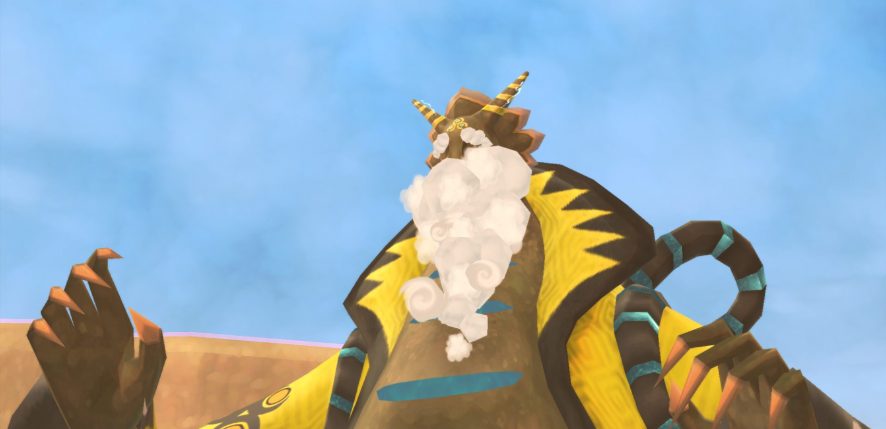
Fortunately, Link is able to resurrect the dragon Lanayru using a Timeshift Stone, meaning the province can begin to return to its natural state. These significant changes in terrain, not to mention all structures falling into complete disrepair, could be blamed for the absence of the final Spring. It could have simply dried up, collapsed into ruin, and faded away.
Lanayru in Skyward Sword
Some could argue that we don’t see the Spring as Link never visits Mount Lanayru. However, the locations of other buildings that appear in both gamesdo tend to move around. For example, the Temple of Time is found in Lanayru Desert in Skyward Sword, yet it moves to the Great Plateau in Breath of the Wild. All we can assume is that the Spring of Wisdom is hidden away somewhere in the barren Lanayru landscape.
Lanayru and Naydra both serve the final Golden Goddess, Nayru. Dispelling any remaining doubt about this connection, Skyward Sword‘s Lanayru even bears the symbol of Nayru on his forehead and both sleeves. The three are woven together with the Triforce of Wisdom. Finally, though it may go without saying, their associated Spirit of Light in Twilight Princess is Lanayru.
The Future of the Dragons
At present, the future of the Zelda franchise focuses heavily on the Breath of the Wild sequel. Therefore, it is likely that we’ll continue to encounter the dragons in their Breath of the Wild forms: Farosh, Dinraal, and Naydra. Naturally, the sequel brings opportunities for expansion on these ideas. The core dragons or spirits of previous games have been accompanied by a fourth being, such as Levias and Ordona, who guards an additional region unique to their map.
If Link and Zelda traverse a new area of Hyrule, there is potential for a fourth dragon or spirit to be introduced. Perhaps the game will delve into the rich history of the Zonai people, as many theorists suspect it might. A discovery along these lines would not necessarily be far-fetched.
Dragons are an enormous part of Hyrulean history and will likely be of similar importance in games to come. Whether existing spirits will undergo further development or entirely new ones will be introduced remains to be seen; it is simply one more element we have to anticipate with the Breath of the Wild sequel. There’s only one thing to be sure of: The skies of Hyrule would feel very empty without its protectors.
Caitlin Stratford
ZU feature writer and aspiring fantasy author. Hobbies include reciting obscure Zelda trivia to people who are politely feigning interest.


 by Caitlin Stratford on June 30, 2021