Exploration and puzzles are great, but what would Zelda games be if they didn’t also help us let out our aggression from time to time?
Few things are as thrilling as facing down a powerful foe.
Swords and sword fighting are synonymous with the adventure genre across all mediums, but I think it’s fair to say that video games offer the most satisfying interactive experience with the age-old form of combat (LARPing and renaissance fairs notwithstanding). For me, among the bevy of games that let me hack and slash to my heart’s content, Zelda games remain my favorite. Some people might think this is only because of the whole “die-hard Zelda fan” thing I have going on — and they’d be right. Well, they’d be half right. The combat being integrated into Zelda makes it easy to love, but it’s the gameplay that draws me in and keeps my attention. That’s what I love so much about Zelda games. They hit every emotional and psychological nerve in the perfect way. Think of it as the opposite of a vindictive ex-partner.
Whenever I assume the role of the hero of Hyrule, I become invested in every aspect of the character. So, if Link is meant to be a legendary swordsman, then there’s an incredible sense of satisfaction in the ability to hack at giant monsters until they explode into fireballs or clouds of weirdly colored smoke. Nintendo clearly recognizes this investment from the players, so each game has been built from the ground up to ensure the combat feels as though it belongs.
Everyone has different reasons for why they love killing stuff (keep that statement within the context of combat in video games, please). What are mine, you may — or probably didn’t — ask? Well, there are many, so I’ll cut to the chase and take a stab at explaining what I love about blades and battles in Zelda.
Combat evolves
Every component of a game — the story, the physics, the graphics, and everything in between — improves with each new game that follows. That’s obvious, but knowing the ways to improve those components are the more crucial and harder points to determine. The individual pieces come together to create a coherent experience. They all have to play nice with each other. The Legend of Zelda’s combat is no exception. It has to “make sense” for the rest of the game. That’s why I appreciate how subtle the improvements tend to be.
Look at the combat evolution from Ocarina of Time and Majora’s Mask to The Wind Waker. Upon careful examination, Nintendo didn’t add many new features or an array of new attacks for Link to unleash. He had the Hurricane Spin and the Parry Attack, but most of his sword techniques were revisions of what he used in the previous games. The things that changed were Link’s character design and the game’s physics, and those are where the evolution in combat came from.
The action in The Wind Waker is remarkable.
Link from The Wind Waker is a small and remarkably agile character. He scurries around and transitions into acrobatic stunts when challenging his opponents. Link from the previous 3D games, even in his boyhood version, was more rigid and linear in his tactics. It was a very defensive, wait-for-an-opening style. Sure, it was an aesthetic choice meant to reflect a medieval fighting style, but there were also a lot of technical reasons for why Link fought that way. Two of the most influential factors were gameplay limitations and unfamiliarity with creating 3D games. Luckily, those limitations had been overcome by the time the GameCube saw its first Zelda title. Controls were smooth, and Link could move more freely. It was also, again, a design choice, and both aspects, paired together, equaled Link being able to fight like a stumpy little Jedi. The action had been increased and improved, but it was done by letting Link take advantage of his mobility, of the game’s core action, rather than adding anything essential to his kit.
Anyone who has played The Wind Waker, especially those who have played it as much as I have, can appreciate how effective and fun the sword fighting is. The secret to this success was that the improvements and abilities that we had at our disposal were appropriate for the game as a whole. Switching to another game, Skyward Sword, we again can see how much thought the developers always put into the combat.
Skyward Sword’s combat is slower than most other modern Zelda games. It harkens back to the old defensive style of the two N64 games, but the level of engagement goes far beyond either of those. Skyward Sword focused on providing an immersive experience with the motion controls, so, naturally, the combat needed to reflect this. The focus was placed on controlling every motion of Link’s blade. Finding an enemy’s weak points and hitting precise targets were the goals, and these could only be accomplished by slowing things down. The action matched the situation. Anything else would have made the gameplay too erratic or sloppy, and the result would have been like watching Link bring a knife to a gunfight.
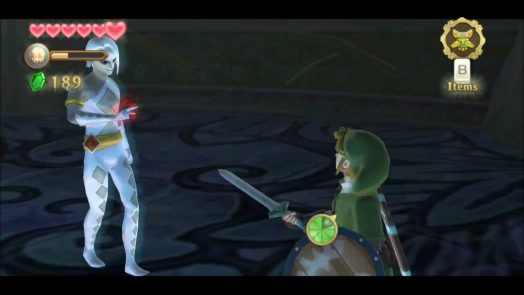
Defeating Ghirahim required patience and precision.
Link’s skills with a blade have never reached extremes, save for spin-off games such as Age of Calamity, but that proves my point. In Age of Calamity, the game centers on combat, so it makes sense to be intense. Take a slightly subdued version of what Link can do in that game and place it in Twilight Princess. Sure, it would look cool, but it would not seem right after a while. The goal is for Link’s abilities to match the tone of each game.
A puzzling turn of events
Having the combat fit the game’s overall mechanics is important, and I can’t say it has ever felt out of place to me. The fights have never been odd or unnatural. This is important, but not just for the sake of the battle systems. It’s important for another crucial aspect of Zelda: the puzzles.
I enjoy a lot of games, and I enjoy fighting, killing, and blowing things up in those games, but there’s almost always a level of separation between the combat and the rest of the experience in those games. That’s not the case with Zelda. The combat is not exaggerated or sequential. It’s typically subdued compared to many other games and is integrated into the entire adventure. I’ve noticed this the most with the puzzle-solving challenges of the Zelda series. Many times in Zelda games, the hackings and the slashings are tools to solve a conundrum.
I’ll strike a switch with my sword to activate a timer, or, as in Breath of the Wild, I’ll chop down a tree so it will roll down a hill as to flatten a cluster of Bokoblins. One of my favorite instances of solving a dilemma with the sword came in Twilight Princess. It was the first time I freed Talo and the girl monkey from their wooden prison in Faron Woods. It’s a short and easy situation to rectify, but I found it hilarious how my best and only option to free the frightened youths was to make them duck as I obliterated the cage with a spin attack.
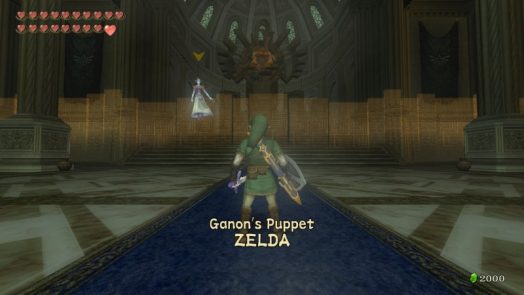
The only way to defeat Zelda was to figure that you needed to fling her attack back at her.
And to further blend puzzle solving and combat, the sword is used to solve puzzles during certain battles. Whenever I see an enemy take their time creating a ball of magical energy, I know I’m in for a fun game of Dead Man’s Volley. The only way to defeat these particular enemies is to use the sword as a baseball bat, and I love it.
I’m not sure how the games would play if Link only used his sword to fight, but I imagine they would be too linear for my liking. We never cut to the action in a Zelda game, we simply go from what we are doing to what we are fighting. And once we are done, we quietly go back to our peaceful endeavors, such as mowing down a field of grass in search of Hearts and Rupees. My sword isn’t just a weapon, it’s also a tool.
Showmanship from swordsmanship
The last thing I love about the combat is how it helps create senses of both excitement and spectacle in the games. Adventures are incomplete without them, and I can’t imagine how quickly I’d become disinterested with the games if I couldn’t feel at least some tension or thrill as I play hero for a land in peril.
As anyone should probably expect, I get the most thrill when facing down some manner of horrendous and massive boss monster. Chopping Gohma to bits while inside the Great Deku Tree, spin-attacking Kalle Demos to oblivion in The Wind Waker, cleaving the tentacles off of Tentalus in Skyward Sword, and letting my flurry rushes obliterate the many hairstyles of Ganon are some of my fondest memories for my portrayal of a heroic swordsman. Now, most of these battles were not difficult — most boss battles in Zelda games are fairly easy — but they aren’t usually meant to offer a challenge. They are about the payoff and the satisfaction of solving the problem, figuring out the correct battle tactic, and delivering pushing blow after punishing blow to Link’s enemies once he has the upper hand.
The thrill of gaining the advantage in the fight was a conscious design choice on Nintendo’s part. It’s even noted by the change in music. When I first played Twilight Princess, after two or three bosses into Twilight Princess, the familiar tune that plays whenever Link can freely assault the boss had the same effect on me as the sound of a bag of Beggin’ Strips being shaken would have on a Labrador. I know I’m about to feel a mixed sense of accomplishment and satisfaction.
The stress levels felt during fights with Iron Knuckles were wonderfully horrible.
Again, most boss battles are not incredibly difficult. That said, there are still times when the player is challenged to use their fighting skills to the best of their abilities. For me, the mid-bosses are what usually give me a hard time. The Iron Knuckles hit like a truck — if that truck picked up a different truck and then smacked me with it. And before I can even hit my armored menace, I have to break through multiple pieces of armor. Once I finally do break through all of the armor, the monstrous knight starts to move fast. I don’t often feel stressed while playing games, but once the thing that has been slowly smacking me around a room starts to instead run toward me, I begin to question why I choose to do this for fun.
Not every battle is this intense, and I am thankful for that. Not out of a sense of cowardice (well, that is sometimes the case) but because it offers variety to the gameplay. Lows and highs in difficulty are part of what makes Zelda games good. They do not simply adhere to a single theme. How could anyone become fully immersed in the land of Hyrule if every battle was as taxing as the ones found in Dark Souls or as trivial as encounters in Kirby’s Dreamland?
A cut above
The Legend of Zelda series may not be most intense source of combat among the myriad of fantasy games out there, but I cannot help but adore how expertly the fighting and weapons are integrated into the entirety of each game. Nintendo doesn’t need to radically adjust or advance the swordplay in every new game — they only need to adjust how Link used it. They also make full use of Link’s entire array of tools, his weapons and fighting prowess being among them. And they know how to balance the satisfaction and terror that come from facing down an imposing foe. Sword fighting is simply one of the many beautiful parts that make up the legendary whole that is any given Zelda game.
Zac Pricener
Zac Pricener has been an avid Zelda fan for twenty years. The series has been a source of creative inspiration for him and fueled his desire to become a writer. That desire to write in turn led him to now serve as the Features Manager, Assistant Columns Manager, and Assistant News Manger for Zelda Universe.


 by Zac Pricener on January 4, 2021