There is an item that is common in RPGs and Adventure titles: the secret weapon. A hidden artifact that normally requires a great deal of searching and sacrifice, often involving an enemy more powerful than the final boss. But once obtained, that special weapon puts all other items to shame. It’s a badge of honor to say that you have it, and having it in your possession certainly makes charging into the final conflict an easier burden to bear.
But not every hidden item is created equal. While most are impressive weapons with great power and abilities, some are little more than gimmicks. And hidden in the land of Termina is a singular mask that is one of the most overpowered “secret” items ever created.
The Fierce Deity Mask
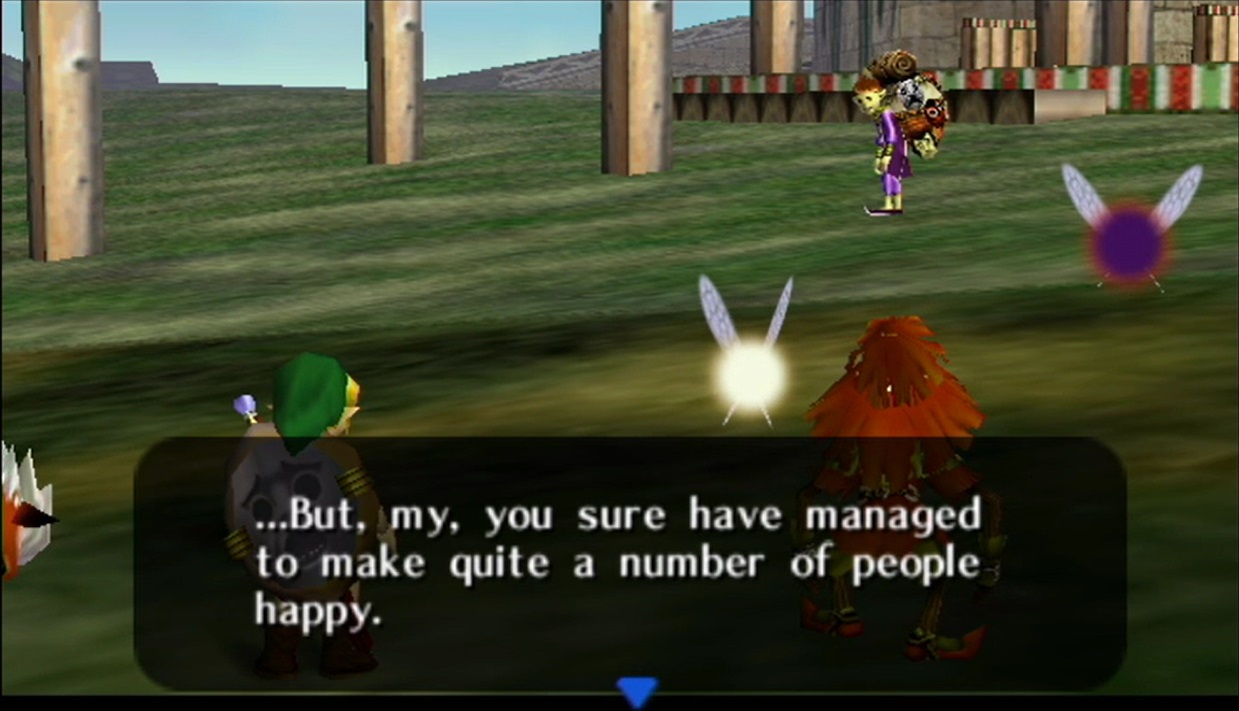
Inside of the falling Moon, next to a tree in an open meadow are four children ― each one wearing a mask that represents one of the bosses defeated during your quest, and each one asking you for masks. If you are able to give them their requested number of masks, and then play hide-and-seek with each child, they ask you some very deep questions. However, you are always magically transported back to the meadow before you can actually answer any of their questions.
Satisfying the four children’s requests is not easy. It requires you to go through essentially every sidequest in the game, collecting every single mask in Termina. Then, if you are successful in giving every child the masks they ask for, you will be left with only the three transformation masks (Deku, Goron, and Zora).
Like with every secret item, this process for obtaining it isn’t necessary for beating the game, but if you are able to collect every mask in Termina and give them to all four moon children, the fifth child ― the one wearing Majora’s Mask ― will take note of your mask-less state, and give you a new one: the Fierce Deity Mask. With this new mask, the child decides to play a different game called “Good guys and Bad guys.” The child tells you that you are playing the role of the bad guy, and as the bad guy, all you have to do is run.
It doesn’t take long to realize that the transforming power of the Fierce Deity Mask grants you a form not designed for running, but for combat, with a magical blade that is easily the most overpowered item ever seen in the Zelda series. Those who have managed to beat the Majora’s Mask without the Fierce Deity Mask are surprised at how easily the item can overwhelm the demonic entity. Throw in a bottle of Chateau Romani, and the final boss goes down faster than a Stalchild.
Once the euphoria of such domination wears off, however, one can’t help but wonder why the Fierce Deity Mask is so powerful. Special item or not, the final boss is meant to be the culmination of the entire game; a final challenge to test the player’s skill. Yet, with one item, the ultimate test of the game becomes child’s play.
The Mask’s Nature
The answer to this contradiction in gameplay would seem to lie in the nature of the Fierce Deity Mask itself. The problem is that very little is actually known about the mask. The theories and rumors regarding the mask’s origins and properties are wide and varied, but we are given barely any clues in the game. The item description tells us that it has dark powers that potentially rival the Majora’s Mask (and our immediate experience tells us that it is, in fact, much stronger), but if they are indeed dark powers, the game certainly does a bad job of showing it.
According to Tatl, upon obtaining Majora’s Mask, the Skull kid almost immediately started behaving aggressively. His pranks turned darker and fouler, and the mask was easily able to influence the Skull Kid’s thoughts and actions to cause the Moon’s descent, the Giants’ imprisonment, and every other major catastrophe in Termina. Surely the Fierce Deity Mask, whose dark powers seem to be on a completely different level than the Majora’s Mask, would be able to do that and more, but it doesn’t. The mask quietly sits in your inventory until you decide to put it on. Once you do, you are simply transformed and are allowed to act freely without any side effects aside from the depletion of magic power. It is no different in that regard than if you were wearing the Deku Mask or Goron Mask.
If the fierce deity mask is so evil, why does it have no effect on us?
So, is the Fierce Deity Mask as dark as we have been led to believe? Possibly. But if it is, then there must be something special about us that has safeguarded our use of the mask (aside from being a legendary hero, although that’s never really protected us from much). In order to understand why it’s more than just an overpowered item and a method to easily beat the game, we need to learn a little bit more about not only this mask but also about Termina’s masks in general.
Among the masks you can obtain is a familiar one from Ocarina of Time: the Mask of Truth. Just like before, the Mask of Truth allows you to communicate with the Gossip Stones that are located all over Termina and learn the secrets they are willing to share. One of the stones, located on the other side of the river from Sakon’s hideout, speaks of the Fierce Deity Mask as a mask with the merits of all the other masks hidden throughout Termina.
A quick comparison of the masks shows that we can’t take this statement literally. Nothing about a mask of a crying man or a frog could possibly translate into a dark demi-god with a mystical sword. The closest masks are your other transformation masks, but the Moon Children refuse to accept them, so they don’t fit into the equation.
The Use of Masks
Oddly enough, if you look at each mask individually, their uses are actually pretty gimmicky. Leaving out the transformation masks, about only a quarter of them actually have any supernatural abilities. Even more interesting is the fact that just three of them (the Stone Mask, the Bomb Mask, and the Bunny Hood) have general, commonplace use. The other seventeen are beneficial only for certain people or situations. Seven of them are useful in one specific circumstance, never to be used again.
But how are they used? In most cases, pretty harmlessly.
Only four of the masks (the transformation masks and the Bomb Mask) have any offensive potential. Aside from that, all you’re doing is running really fast, finding mushrooms, and growing really tall. Only the Garo’s mask creates any battle situations, and three of them (The Captain’s hat, the Gibdo Mask, and the Stone Mask) actually eliminate hostilities.
Almost none of the masks let you attack. Instead, they let you speak.
The most common thing one does with the masks is use them to speak to other people. Six of the masks permit you to speak with things that you were unable to before, while an additional seven (ten, if you include the transformation masks) open up new interactions with already established characters. This expands your knowledge of these people, including their needs and concerns. And it’s those concerns, along with how they are coping, that gives a new light to what you are doing in Termina.
The People Behind the Masks
It’s no surprise that the entire country is becoming increasingly aware of the falling Moon and that everyone is constantly trying to handle the reality of a seemingly inevitable end. Their reactions fit nearly every possible mood you could expect from such a crisis, from anger and denial to grim acceptance and despair. But interlaced with the fear of death is a plethora of concerns and hidden emotions that are as varied as the masks themselves.
While the mainline quest of the game is a comparatively tiny affair (a petty four dungeons compared to the other games’ much larger totals), the sidequests are not only plentiful but also in-depth and sometimes even more engaging. Each deals with a character who is battling loss and regret, aligning their problems perfectly with that of the Skull Kid, who is lashing out due to the loss of his friends. While the side characters do not react in the same violent manner, they do exhibit the same feelings of frustration and hopelessness as they do when referring to the Moon.
And what do you do with their situations? You solve them. You help them. You bring light into their lives. Much like how you bring the Skull Kid back from the brink, you help them find peace in an otherwise troubled world. This isn’t anything new. The vast majority of The Legend of Zelda sidequests see you helping people with their problems. But the way their small concerns reflect the greater doom caused by Majora’s Mask, and the way that your rewards for such efforts (the masks) come together to enable you to receive the Fierce Deity Mask, seem to suggest a significant connection.
As is obvious through the entire game, masks in Termina hold great significance. They commemorate special occasions and are a focus for the Carnival of Time. Additionally, half of the masks you obtain either imply or directly bestow a level of respect and authority. Combined with that are the many instances when the people you are assisting are wearing masks of their own, either literally or figuratively, to hide their emotions and problems. In contrast, while Link wears those same masks and uses the power and authority contained within them, what he does with those gifts unmasks and resolves the pain and regret of those same people. He replaces all of their darkness with light, making friends and connections that would otherwise be impossible.
The Answers and the Response
Returning once again to the Moon, and to the children who essentially safeguard the Fierce Deity Mask, it always confused me why the children asked those questions when you never seem to be given the chance to answer. But what you give those children ― all those masks that you have collected ― in one way or another answer those questions for you. As a reward for all your efforts to bring light to everyone, you are given a mask that permits you to easily do just that. Through your efforts to be true to yourself despite all the masks you have worn, the dark powers of the Fierce Deity have no effect on you.
By being true to yourself, and believing in the strength that comes from that, you gained the respect and friendship of those around you. When that friendship was asked for again, you did not hold back, and in return, you literally obtained the power to drive back a great evil, and reverse a most terrible fate.
Connor Schultz
Adventurer, Traveler, and lifelong resident of Hyrule. With a love of immersion and lore, there is always another world to see and another story to be told.
You can join the adventures at https://www.twitch.tv/conterez


 by Connor Schultz on April 18, 2020
 Satisfying the four children’s requests is not easy. It requires you to go through essentially every sidequest in the game, collecting every single mask in Termina. Then, if you are successful in giving every child the masks they ask for, you will be left with only the three transformation masks (Deku, Goron, and Zora).

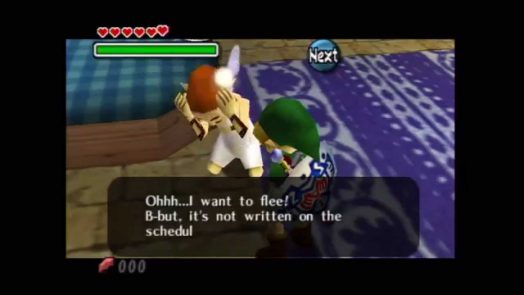 While the mainline quest of the game is a comparatively tiny affair (a petty four dungeons compared to the other games’ much larger totals), the sidequests are not only plentiful but also in-depth and sometimes even more engaging. Each deals with a character who is battling loss and regret, aligning their problems perfectly with that of the Skull Kid, who is lashing out due to the loss of his friends. While the side characters do not react in the same violent manner, they do exhibit the same feelings of frustration and hopelessness as they do when referring to the Moon.