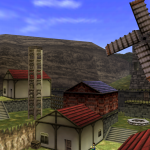
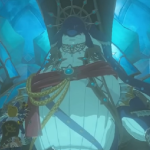
Is it strange for me to say that, in a fantasy kingdom full of flirty humanoid fish, jitterbugging rock people, and mustachioed trees who sound like they should be delivering a soliloquy in Macbeth, the characters that have always seemed the most out-of-place in Ocarina of Time are the music-loving scarecrows who hang out next to Lake Hylia?
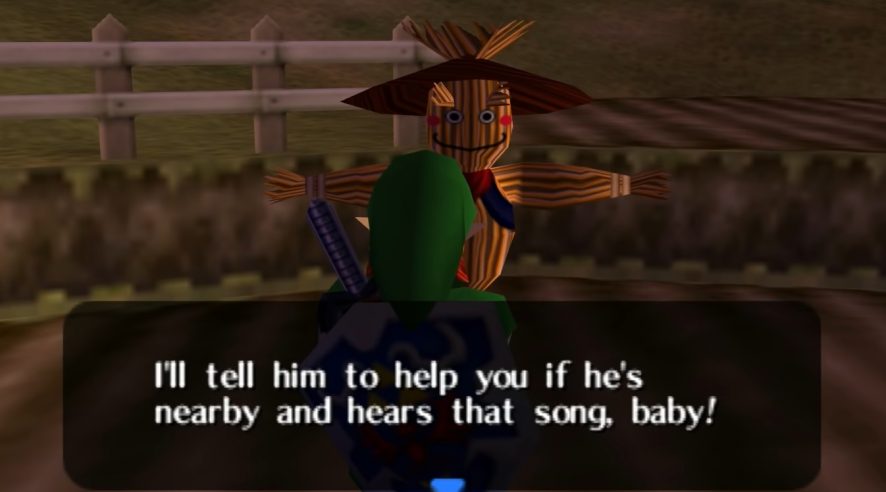
As a kid, I found Bonooru and Pierre to be oddly superfluous additions to a game whose other NPCs all served an essential purpose, even if they were just quirky townsfolk who added a splash of color to the fabric of Kakariko Village. The two dancing cornfield mannequins stand on an isolated patch of cultivated ground by the lake and appear on surface-level to only offer an opportunity to compose an original ocarina ditty, so why was all that time and space wasted on programming them in? My young mind simply couldn’t comprehend why these weirdos were so needlessly shoved into the story when another existing character could have easily facilitated a write-your-own-song sidequest. And to top it off, movies like The Wizard of Oz had led me to primarily associate scarecrows with Midwestern America. So what in the world were they doing in a game heavily influenced by Japanese culture?
But based on what I recently discovered via my usual route of researching Shinto mythology, it seems that I not only misunderstood how scarecrows influence cultures all across the world, but I may have also grossly underestimated the potential of the dopey straw-stuffed statues that grace Hyrule with their presence. Could it be that during all those years of button-mashing discordant tunes that made our ocarinas weep with shame, we were actually serenading gods?
Sentient scarecrows are certainly nothing new under the fictional sun, being portrayed as sweet and sincere blockheads, terrifyingly deranged supervillains, and just about everything else in-between. But one of the earliest known references to such a creature comes from the Kojiki, a “Record of Ancient Matters” from the 8th century that is considered by many scholars to be the oldest surviving literary work in Japan. Though the second and third volumes of this story primarily focus on the establishment of the Imperial Family and its long line of successors up until the mid-600s, the first volume contains the creation saga that comprises the backbone of Shinto belief, exploring the legends behind Izanagi, Izanami, Amaterasu, and other “Kami” who established the islands of Japan (Ōkami fans, this is the book for you).
One such mythological tale in the Kojiki concerns a man named Ōkuninushi, who is descended from the hot-tempered god Susanoo. One day, he spots a diminutive deity riding towards him from across the sea, and not a single person seems to know the god’s origins or identity. Thus, Ōkuninushi is advised to seek the answer from a most unlikely source: a living scarecrow god known as Kuebiko.
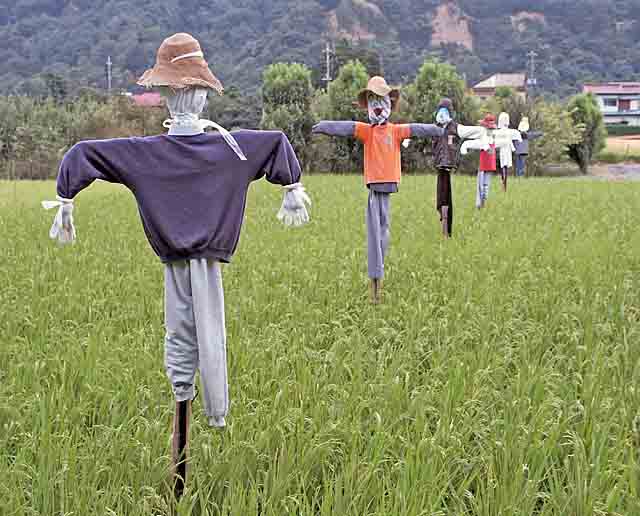
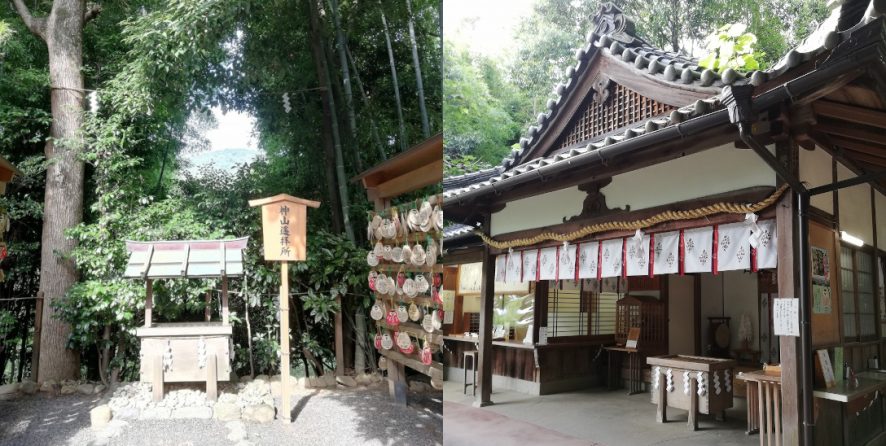
Yes, as peculiar as it may sound, even the tattered, weather-beaten, charmingly rustic tools farmers use to chase off avian pests are believed to possess a divine spirit in Japan. Kuebiko is the god of folk wisdom and agriculture who, despite his built-in handicap that prevents him from moving around freely, has an encyclopedic knowledge of the entire world around him. Even though the role he plays in identifying the god Sukunabikona is relatively small in the grand scheme of Shinto mythology, the Japanese still honor his contribution with a humble little shrine in the city of Sakurai, sharing space with one of the oldest, most sacred shrines in Japanese history.
So now you might be wondering: what prompted me to correlate Bonooru and Pierre with Kuebiko beyond the simple fact that they’re all talking scarecrows? For starters, two of the literal translations for Kuebiko’s name are “long stretch help old” and “long-reaching old helping hand.” Oddly enough, this perfectly describes what kind of services Pierre offers to Link once he starts traversing Hyrule as an adult. Certain areas inside the Sages’ temples and scattered across the kingdom at large are inaccessible until Link plays the “Scarecrow’s Song,” summoning Pierre to act as a Longshot target from afar; this is particularly true in the Master Quest edition of the game, as the Water Temple can’t even be completed without Pierre’s help (at least from my experience). So the jovial straw man is metaphorically stretching out his hand over a long distance to help our hero overcome seemingly insurmountable obstacles. Pretty interesting coincidence, is it not?
In addition, Bonooru has a memory sharp enough to recall a melody he heard only once seven years prior, which sounds like a quality Kuebiko would possess as an intelligent entity with vast knowledge. And when Link is a child, Pierre laments about the fact that he cannot travel around to search for lovely sounds, aligning with the Shinto god’s description as a “scarecrow who cannot walk but has comprehensive awareness.” But what convinces me of the duo’s divine status more than anything else is the role Pierre plays in Majora’s Mask. He can still be used as a Hookshot target here, but this time, he also dispenses some of the most valuable information in the entire game: how to utilize the Inverted Song of Time and the “Song of Double Time.” But why him? Of all the wise individuals in the land of Termina who could have shed light on this amazing ability to manipulate time, why does the grinning mannequin tucked away in the corner of the Astral Observatory get the privilege of doing so? Well, I like to think that it’s Nintendo’s way of paying subtle homage to Kuebiko’s small but vital role in Ōkuninushi’s journey. Though Pierre and his brother may seem like pointless additions compared to the more iconic characters in the Zelda series, they fulfilled their own essential purpose and should be recognized for their intelligence, warmth, and charisma.
So the next time I find myself floating around Nara Prefecture, I’ll make a point of visiting the Kuebiko Shrine and offering a tribute to the god who stoically stands guard over the beautiful pastures in the Land of the Rising Sun. And when I do so, I will include an extra few coins as an apology to the friendly dancing duo that I dismissed as a youth. Bonooru and Pierre have earned my respect, and they can rest assured that I will never belittle them again.