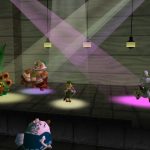
When the final boss in any game morphs into a second form, you know things are about to get serious. That’s exactly what happens when you defeat Majora’s Mask and it transforms into the gangling cyclops Majora’s Incarnation, though not in the way you might expect. Between sprinting bouts that produce a psychedelic blur of afterimages, the boss stops to display some serious dance moves. The jarring unexpectedness of this transition adds to the surrealism of battling a giant, tie-dyed mask/monster on the moon. But a dance-off can be an effective fighting technique: Just ask the Sharks or Jets of West Side Story or Peter Quill, aka Star-Lord.
Majora’s Incarnation’s effectiveness may be questionable, but its style isn’t. Seeing as it’s International Dance Day, let’s get down with the Zelda boss’s best moves.
Majora’s Incarnation struts three dances around the floor. If you were alive during the ’80s, ’90s, or even ’00s and not hiding under a rock, you probably recognize the first as the moonwalk. How appropriate for the occasion. The moonwalk is closely linked with pop legend Michael Jackson, who adopted it as his signature move. However, the move has been performed as far back as the 1930s and went by many other names, the most common being the backslide. Jackson saw the move performed by Jeffrey Daniel on the show Soul Train and hired the dancer to teach it to him. During a 1983 televised performance of “Billie Jean,” Jackson bust out his moonwalk, and the rest is history. Perhaps Majora’s Incarnation saw the performance and decided to make the move its own.


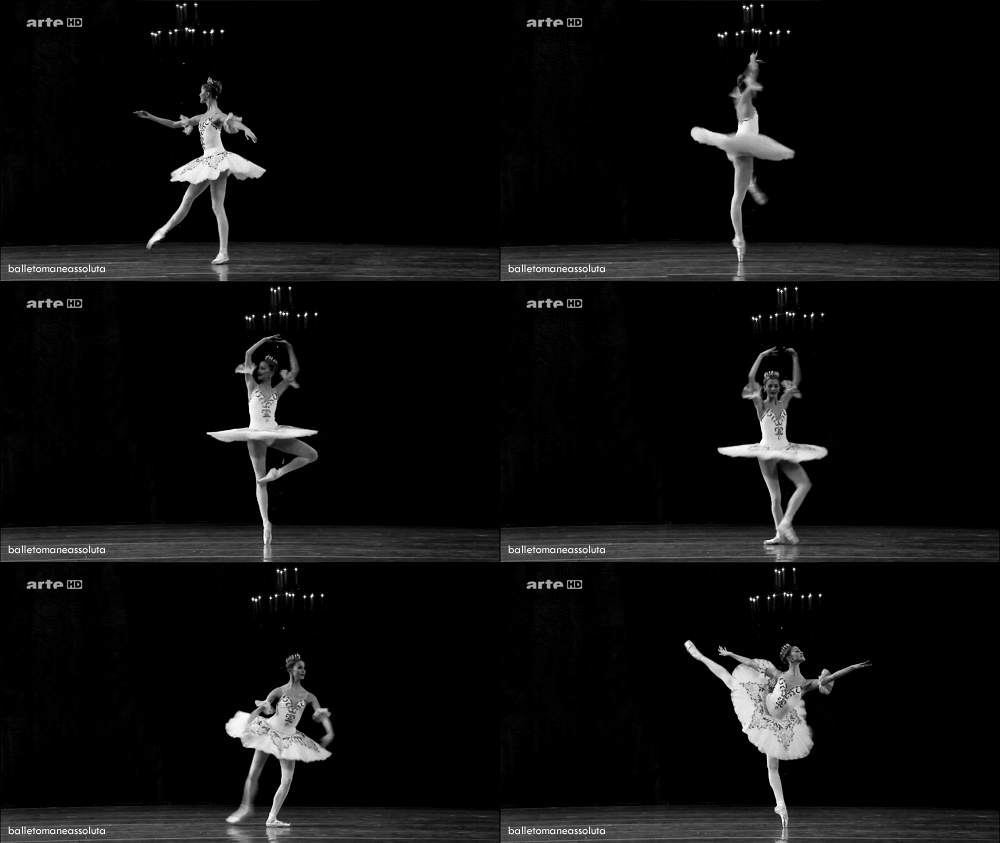
Next, Majora’s Incarnation takes a cue from classical ballet. With arms raised over its head, one knee bent with the foot of that leg resting on the other knee, and the other leg propped up on the ball of its foot, the boss twirls round and round in a technique known as the pirouette. “Pirouette” is french for “to whirl about,” and it is a standard move in ballet, often performed in a series of spectacular spins. There are many variations of the pirouette, though Majora’s Incarnation appears to be the classic version en dedans, meaning it is turning inside and toward the supporting leg. Its dizzying display would make even the members of the Paris Opera Ballet jealous.

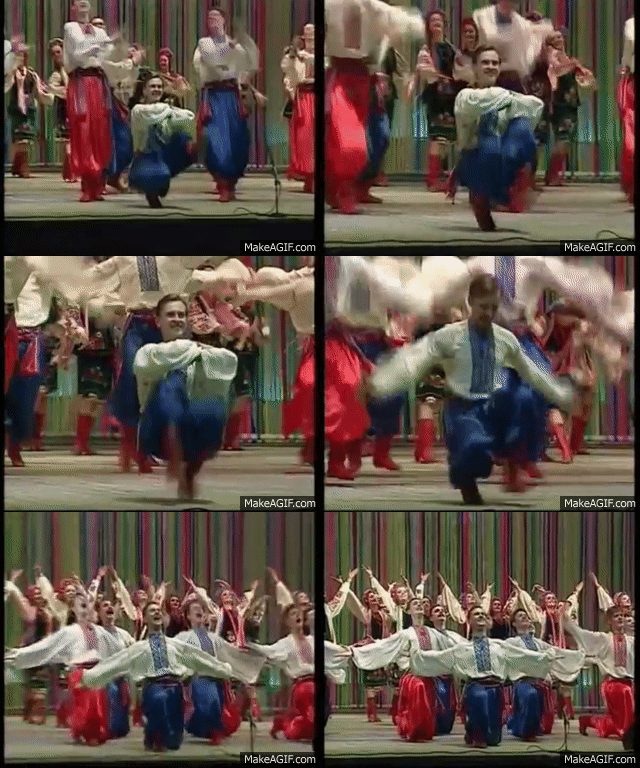
Majora’s Incarnation final dance move is taken from a centuries-old Ukrainian folk dance called the hopak. This dance was developed in the 1500s by a specific band of Cossacks — a group of democratic, self-governing military communities renowned for horsemanship — who inhabited the hinterlands that stretched from the northern Black Sea to the Caspian Sea, encompassing parts of modern-day Ukraine, Russia, and Kazakhstan. To be exact, the Zaporozhian Cossacks, who lived in the “Wild Fields” of central Ukraine, created the hopak as a form of celebration after victory in battle. It spread into the villages and across Ukraine, eventually being adopted by professional dance troupes.
The hopak is an improvised dance that emphasizes athletic skills such as high leaps, low squats, and agile stretching on the ground and in the air. Squat sequences are common, including alternating one-legged squats while the other leg extends straight out. Majora’s Incarnation performs this feat with ease, demonstrating its battlefield prowess to a bewildered Link. Luckily for Link, the boss’s leg strength doesn’t really translate into fighting ability.

The second form of Majora’s Mask‘s final boss flashes some fancy footwork, but like all good dance parties, it must come to an end. In this case, that end comes when Link beats (get it?) Majora’s Incarnation into submission. That’s when the true challenge comes in the boss’s third and final form. The dance is over.

Be sure to check out the rest of our articles from Majora’s Month, our month-long celebration of Majora’s Mask’s 20th anniversary!