Return to the Forest
One of the best things that OoT has been praised for over the past ten years is its story: a compelling, battle-weary struggle to rescue Hyrule and its people from Ganondorf. In several titles prior and later, the Zelda series has touched on saving the world, but it has more often than not focused solely on Princess Zelda as a catalyst for this. Not so here. As Link departs the Temple of Time, a dark reality set in on the player as they discover the happy, light-filled land from the Child Arc has changed a lot in seven years. Darkness reigns, monsters roam the world, and all that which we spent the Child Arc trying to prevent has come true. All within a blink of an eye to Link, but seven weary years to the people. And boy have they changed…
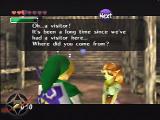
Despite very clearly being a girl, Malon communicates in a manner thick-headed Link can understand.
For starters, all of the people of Hyrule have become much more developed. As a child, most were snobby to Link and disliked him because of his strange clothes or his youth. Now they view him as an equal. Now that I could do all the cool things that adults can do (again, not what you’re thinking, perverts) I set out for Lon Lon Ranch to rescue Epona and the beautiful Malon from Ingo through a horserace. However, being rusty on the old controller, I’m afraid I lost, so to drown my sorrows I went to Kakariko instead and grabbed the Hookshot from Dampé before setting off back to Kokiri Forest.
I’ve said before that Miyamoto relates more to the land of Hyrule than its people, and that is why he has sent us home first, to view the damage from Ganondorf’s reign in the very first parts of the game we explored. Like everything else in the game, the difficulty has steeped up significantly, as I discovered when I entered my first temple, the Forest Temple, and proceeded to fight my way through the dark and gritty dungeon. The puzzle in it, one with four Poes, is one that I have noticed in several other Zelda games such as Phantom Hourglass and Twilight Princess, which really goes to show how much this game has influenced its successors. Interestingly enough, this dungeon was the one I gave up on as a child first playing this on the N64. I tried getting through it, failed, and popped in Banjo-Kazooie. But this time I blazed through with few problems, most of which were caused by the erroneous hour that I am awake at attempting to finish this review. Oi, I need a drink real quick… we’ll continue the next section in a few minutes.
Oh, and there’s probably some sort of symbolism in Saria being the Sage, Link having to let her stay to accept her new responsibilities, and thus accepting his own, but it’s lost to me because I am struggling to keep my eyes open. Where’s the caffeine?
Oh, almost forgot this one point: there’s a part just after the Forest Temple where Link meets the Deku Tree Sprout. Now, in between Link’s origin story I noticed something really odd. Specifically, the fact that the light that left the Deku Tree’s Grove had returned with the Sprout. Now, while that might seem like an obvious event to take place, think again about its meaning. The Great Deku Tree’s death at the beginning of the game signified the end of the life Link knew as a Kokiri and the end of his childhood, which was represented by the graying of the Deku Tree in its death throes. Conversely, the light returning with the Sprout marks the beginning of Link’s life as a Hylian adult and as the Hero of Time. It also represents the return of good in the presence of the evil Ganondorf had been sowing since before the beginning of the game.
Think about it.
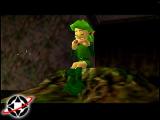
In-No-Way-Legal Saria playing her ocarina and taunting us with her incredibly designed pixels.